Quick Answer:
Nosferatu refers to a vampire-like undead creature, especially one associated with the classic 1922 horror film Nosferatu. The word is strongly linked with vampires, fear, darkness, and gothic horror.
Some words sound mysterious before you even know what they mean. Nosferatu is one of them. You may have seen it in a horror movie, heard it in a gaming community, noticed it in a meme, or come across it while reading about vampires. But what does this strange word actually mean?
If you enjoy horror movies, gothic stories, gaming, books, Halloween culture, or dark fantasy, understanding the nosferatu meaning can make many references easier to understand. The word is strongly connected with the image of a pale, frightening vampire who hides from daylight and hunts at night.
For casual readers, the word may simply mean “vampire.” However, it has a much deeper cultural history. It is connected with folklore, literature, cinema, and one of the most famous vampire films ever made. Today, people also use it online as a nickname or a dramatic way to describe something creepy.
Definition & Meaning
Nosferatu is commonly understood as a name or term connected with a vampire or undead creature that feeds on blood.
In modern English, the word has a strong association with the 1922 German silent horror film Nosferatu: A Symphony of Horror. The movie presented Count Orlok, a terrifying vampire character who became one of the most recognizable figures in horror cinema.
Because of this film, the word Nosferatu became closely tied to a particular kind of vampire. Instead of imagining a charming or romantic vampire, people often picture something much more disturbing.
The classic Nosferatu image includes features such as:
- Pale skin
- Long fingers
- Sharp teeth
- A bald head
- Pointed ears
- A thin body
- A frightening face
- A connection to darkness and death
Is Nosferatu Just Another Word for Vampire?
In modern usage, it can be.
If someone says:
“That creature looks like Nosferatu.”
They probably mean that the creature looks like a frightening, old-fashioned vampire.
However, the word can also refer specifically to Count Orlok, the vampire from the famous film.
Example
Jake: “Why does that character look so creepy?”
Mia: “He looks like Nosferatu.”
Here, Mia is comparing the character to the classic vampire image.
The word can therefore work in two ways. It can refer to a specific fictional vampire, or it can describe the broader image of a terrifying vampire.
Background & History
The history of the word Nosferatu is complicated and interesting.
The term became famous in Western popular culture through the 1922 German film Nosferatu: A Symphony of Horror, directed by F. W. Murnau. The film was an unauthorized adaptation of Bram Stoker’s 1897 novel Dracula.
Because the filmmakers did not have permission to adapt Dracula, they changed several names and details. Count Dracula became Count Orlok, and the title became Nosferatu.
The film became a landmark in horror cinema.
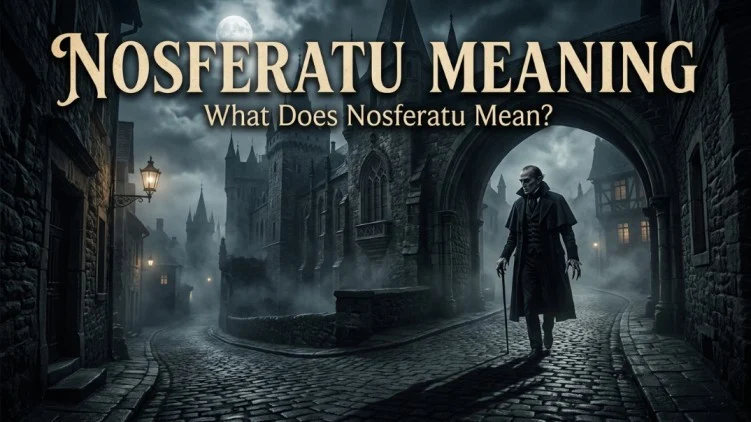
Count Orlok looked very different from many later vampire characters. He was not presented as a handsome or seductive figure. Instead, he appeared almost corpse-like, with a strange face, long fingers, pointed ears, and an unsettling physical presence.
This visual style had a huge influence on how people imagined vampires.
What About the Original Word?
The word’s supposed connection to Romanian folklore has been debated by historians and language experts. It has often been linked to a Romanian term associated with vampires or supernatural creatures, but the exact linguistic history is not as simple as many popular explanations suggest.
Over time, the word became famous mainly because of cinema rather than everyday Romanian usage.
Today, when English speakers hear Nosferatu, they usually think of:
vampires + horror + Count Orlok + gothic atmosphere
The term has therefore developed a strong cultural identity far beyond its early history.
Usage in Various Contexts
You can encounter Nosferatu in many different settings.
1. Horror Movies
The most obvious use is in discussions about vampire films.
“Nosferatu is one of the most influential vampire movies ever made.”
Here, the word refers to the film.
2. Literature
Readers may use the term when discussing vampire fiction.
“The novel has a Nosferatu-like villain.”
This means the villain resembles the frightening, traditional vampire image.
3. Gaming
Gaming communities often use Nosferatu as a character name, creature name, clan name, or nickname.
A player might say:
“That boss looks like Nosferatu.”
The player is comparing the boss to a classic vampire.
4. Social Media
People may use the word in captions or jokes.
“Me before coffee at 7 a.m. looking like Nosferatu.”
This is a humorous comparison. The person is not claiming to be a vampire. They are joking about looking tired or scary.
5. Halloween
Nosferatu is also popular in Halloween culture.
Someone wearing pale makeup, dark clothing, fake vampire teeth, and long fingers might describe the costume as:
“My Nosferatu costume.”
6. Casual Conversation
The word can describe anything that looks extremely creepy.
Sam: “Did you see that shadow?”
Alex: “Yes. It looked straight out of Nosferatu.”
The speaker is using the word as a cultural reference.
Common Misconceptions & Clarifications
There are several common misunderstandings about Nosferatu.
Misconception 1: Nosferatu Is the Original Word for Dracula
Not exactly.
The 1922 film Nosferatu was based on Dracula, but the character in the film was called Count Orlok.
The filmmakers changed names and other details because they did not have permission to make a direct adaptation.
Misconception 2: Nosferatu Means Every Vampire
Not necessarily.
In casual English, people may use the word to mean a vampire. However, Nosferatu also refers specifically to the famous film and its vampire character.
Misconception 3: Nosferatu Is a Romantic Vampire
The classic Nosferatu image is almost the opposite.
Modern vampire stories often show vampires as attractive, mysterious, or romantic. The original cinematic Nosferatu is much more disturbing.
He looks more like a supernatural corpse than a charming immortal.
Misconception 4: The Word Is Always Scary
Not always.
Online, people may use Nosferatu humorously.
For example:
“I look like Nosferatu before my first cup of coffee.”
The speaker is making a joke about their appearance.
Misconception 5: Nosferatu Is a Common Everyday Word
It is not common in normal conversation.
Most people encounter it through horror films, literature, gaming, memes, Halloween content, or internet culture.
Similar Terms & Alternatives
Several words are related to Nosferatu, but each has a slightly different meaning.
Vampire
A vampire is a supernatural creature traditionally associated with drinking blood.
This is the broadest and most common term.
Dracula
Dracula refers to Count Dracula, the famous vampire created by Bram Stoker.
People sometimes use Dracula as a general vampire reference, but technically Dracula is one specific fictional character.
Count Orlok
Count Orlok is the vampire character in the 1922 film Nosferatu.
He is the character most directly connected to the word.
Undead
Undead describes beings that are dead but continue to exist in supernatural form.
Vampires are often described as undead.
Ghoul
A ghoul is another type of supernatural creature, but it is not the same as a vampire.
Ghouls are often associated with graves, corpses, and eating human flesh.
Creature
Creature is a much broader term for a strange or supernatural being.
| Term | Meaning | Connection to Nosferatu |
|---|---|---|
| Nosferatu | Famous vampire figure or vampire-like creature | Direct |
| Vampire | Blood-drinking supernatural being | Very strong |
| Dracula | Famous fictional vampire | Related |
| Count Orlok | Vampire from the 1922 film | Direct |
| Undead | Being that exists after death | Related |
| Ghoul | Supernatural corpse-related creature | Similar horror theme |
How to Respond to This Term
If someone uses Nosferatu in conversation, your response depends on the context.
Casual Response
If a friend says:
“That guy looks like Nosferatu.”
You could respond:
“Haha, I see it!”
Funny Response
If someone jokes:
“I look like Nosferatu before breakfast.”
You could say:
“You just need sunlight and coffee.”
Horror Fan Response
“Classic vampire energy!”
This works well when talking with someone who enjoys horror.
Curious Response
If you do not know what they mean, ask:
“Do you mean the vampire from the old movie?”
This is a simple way to confirm the reference.
Professional Response
If the word appears in a workplace conversation, keep your response neutral.
For example:
“Are you referring to the classic vampire character?”
This avoids assuming what the speaker means.
Regional or Cultural Differences
The word Nosferatu is now recognized in many countries because of international horror culture.
Its meaning is generally similar in English, German, and other languages when people are discussing the famous film or vampire character.
However, the cultural associations can differ.
- In English-speaking countries, Nosferatu is strongly connected with classic horror cinema.
- In Germany, the word has an especially strong connection with the original 1922 film because the movie was produced there.
- In Romania, discussions of vampire folklore may involve a much broader collection of traditional supernatural beliefs. It is important not to assume that the modern cinematic use of Nosferatu represents all Romanian folklore.
Modern Global Use
Today, the word appears in:
- Movies
- TV shows
- Video games
- Books
- Music
- Halloween costumes
- Memes
- Social media
- Horror communities
- Fan discussions
Because of this, someone from almost anywhere may recognize the term even if they do not speak German or Romanian.
Comparison with Similar Terms
Understanding the difference between Nosferatu, vampire, Dracula, and other horror terms makes the word easier to use.
| Expression | What it refers to | Main difference |
|---|---|---|
| Nosferatu | Classic vampire figure or film | Strong gothic horror association |
| Vampire | General supernatural blood-drinker | Broad category |
| Dracula | Specific fictional character | Created by Bram Stoker |
| Count Orlok | Specific film character | Appears in the 1922 Nosferatu |
| Bloodsucker | Informal vampire term | More general and sometimes metaphorical |
| Undead | Supernatural being that is dead | Broader category |
| Ghoul | Corpse-related supernatural creature | Different creature type |
For example:
“He is a vampire.”
This is a general statement.
“He looks like Nosferatu.”
This suggests a very specific visual style.
“He is Dracula.”
This identifies a particular fictional character.
That small difference can completely change the meaning.
Usage in Online Communities & Dating Apps
Nosferatu appears online more often than many people expect.
Horror fans may use it when discussing classic movies, vampire lore, gothic fashion, or Halloween.
On social media, the word can also become a joke.
For example:
“No sleep, no coffee, just Nosferatu vibes.”
The person is using the horror reference for humor.
Gaming Communities
Gamers may use Nosferatu as:
- A username
- A character name
- A clan name
- A vampire reference
- A nickname for a creepy character
A player might say:
“That enemy has serious Nosferatu vibes.”
This usually means the enemy looks pale, creepy, undead, or vampire-like.
Dating Apps
The term can appear in dating profiles, especially among people interested in horror, gothic culture, Halloween, or dark fantasy.
Someone might write:
“Looking for someone who enjoys horror movies and has a little Nosferatu energy.”
That is usually playful and may indicate an interest in gothic or horror culture.
If someone uses the term in a dating conversation, do not automatically assume it is an insult. Look at the surrounding message.
Hidden or Offensive Meanings
Nosferatu does not have a standard hidden offensive meaning.
Its normal associations are with vampires, horror, death, darkness, and gothic fiction.
However, someone might use it as an insult or joke.
For example:
“You look like Nosferatu today.”
Depending on the relationship, this could be funny or rude.
If close friends are joking, it may simply mean:
“You look unusually pale or creepy.”
If a stranger says it, the comment could feel insulting.
Why Tone Matters
Imagine two situations.
Friend: “You look like Nosferatu after that all-nighter.”
You: “Thanks, I guess. 😂”
This is clearly playful.
But if someone says:
“You look like Nosferatu.”
with no friendly context, they may be criticizing your appearance.
The word itself is not offensive. The intention behind it matters.
Suitability for Professional Communication
Nosferatu is not normally needed in formal professional communication unless the topic itself involves horror, cinema, literature, entertainment, or cultural studies.
For example, it would be completely appropriate in a film review:
“The visual design of Nosferatu influenced later vampire cinema.”
It could also appear in an academic discussion of horror films.
However, using the word to describe a colleague’s appearance would be inappropriate in most workplaces.
Instead of saying:
“You look like Nosferatu today.”
a professional speaker should avoid commenting on someone’s appearance in that way.
When It Is Appropriate
The word works well in:
- Film criticism
- Literature studies
- Horror journalism
- Entertainment writing
- Gaming discussions
- Cultural analysis
- Halloween marketing
When to Avoid It
Avoid using it as a personal insult or workplace joke unless you know the audience very well.
FAQs
What does Nosferatu mean?
Nosferatu is a term strongly associated with vampires and undead creatures, especially the vampire from the famous 1922 horror film Nosferatu.
Is Nosferatu another word for vampire?
In casual modern English, people may use it to describe a vampire. More specifically, it is strongly associated with the classic film and its vampire character, Count Orlok.
Is Nosferatu Dracula?
No. The 1922 film was inspired by Bram Stoker’s Dracula, but its vampire character is Count Orlok, not Count Dracula.
Why is Nosferatu famous?
The 1922 film Nosferatu became one of the most influential works in horror cinema. Its frightening vampire design helped shape the visual image of vampires for generations.
Is Nosferatu a real creature?
No. The famous Nosferatu character is fictional. The word is connected with folklore discussions, but the cinematic Nosferatu is a fictional horror character.
Is calling someone Nosferatu an insult?
It can be, depending on the context. Among friends, it may be a joke about someone looking pale, tired, or creepy. From a stranger, it could be intended as an insult.
How do you pronounce Nosferatu?
A common English pronunciation is roughly “nos-fuh-RAH-too.” Pronunciation can vary slightly between languages and speakers.
Conclusion
Nosferatu is one of the most recognizable words in classic vampire culture. While people often use it as another way to describe a vampire, the word has a much stronger connection to the 1922 German horror film and its terrifying vampire, Count Orlok.
Today, you can find Nosferatu references in movies, books, video games, Halloween costumes, social media posts, memes, and gothic communities. It can describe a classic horror character, a vampire-like appearance, or even something creepy in a humorous way.
The word is not normally offensive, but context and tone matter. Calling a fictional creature Nosferatu is natural, while calling a real person Nosferatu may be funny among friends but rude in other situations.
If you remember one thing, remember this: Nosferatu is strongly linked with the frightening, gothic image of the classic vampire.
Read More Related Articles:
What Does OFC Mean| Complete Meaning, Origin, Usage …
What Does Encanto Mean| Complete Meaning, Origin, Usage …
What Does Bop Mean| Complete Meaning, Origin, Usage …