Quick Answer:
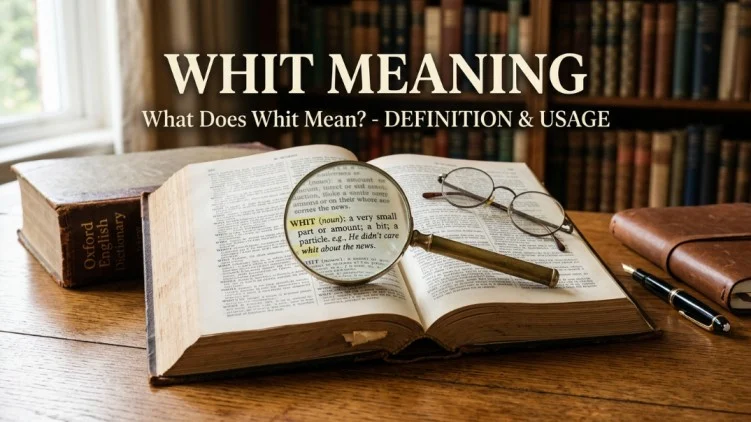
“Whit” means a very small amount or tiny bit of something. It is most often used in phrases like “not a whit,” meaning “not at all” or “not even a little.”
Some English words are short and simple but carry a meaning that is easy to miss. “Whit” is one of them. You may see it in books, formal writing, old expressions, or the phrase “not a whit.” If you have come across this word and wondered what it means, you are not alone.
The word whit means a tiny amount, small part, or slightest degree of something. It is not very common in everyday conversation today, but you may still find it in literature, articles, speeches, and traditional expressions.
If you are a student, English learner, writer, reader, or someone who enjoys understanding unusual English words, knowing the whit meaning can make older or more formal sentences much easier to understand. It can also help you recognize phrases that may sound strange at first.
Let’s explore its meaning, history, examples, similar words, online use, and the best ways to understand it in context.
Definition & Meaning
The word whit is a noun that means a very small amount, tiny quantity, or slightest degree of something.
Think of it as meaning “a tiny bit.”
For example:
“I don’t care a whit about his opinion.”
This means:
“I don’t care at all about his opinion.”
The word often appears in negative expressions. One of the most common is:
“Not a whit.”
This means “not at all,” “not even a little,” or “not in the slightest.”
Examples of “Whit”
“The criticism did not change her mind one whit.”
Meaning: The criticism did not change her mind at all.
“He was not a whit afraid.”
Meaning: He was not at all afraid.
“The new plan is not a whit better.”
Meaning: The new plan is not even slightly better.
Although whit means a small amount, it is rarely used to describe ordinary physical quantities. You would normally say “a little,” “a bit,” or “a tiny amount” in everyday speech.
Instead, whit often appears in fixed or literary expressions.
Simple Meaning
| Word | Simple meaning |
|---|---|
| Whit | A tiny amount |
| A whit | A very small bit |
| Not a whit | Not at all |
| Not one whit | Not even slightly |
The most important thing to remember is that whit describes something extremely small.
Background & History
The word whit has a long history in English. It comes from Old English and has been used for centuries to describe a small amount or tiny part of something.
Its older forms were connected with the idea of something small or insignificant. Over time, the word developed into the English noun whit, which continued to carry the meaning of a tiny quantity.
The word became especially common in expressions such as “not a whit.” Writers used the phrase to emphasize that something had not changed even slightly.
For example, an older writer might say:
“He was not a whit concerned.”
A modern writer might say:
“He was not at all concerned.”
Both sentences communicate nearly the same idea, but the first sounds much more literary or old-fashioned.
As English changed, everyday speakers began using simpler alternatives such as bit, little, slightest, and amount. Because of this, whit became less common in casual conversation.
However, it did not disappear.
Today, you may still encounter it in:
- Literature
- Historical writing
- Formal prose
- Essays
- Newspapers
- Speeches
- Idiomatic expressions
- Classic books
The word is also useful when reading older English because it can appear in sentences that sound unusual to modern readers.
Its meaning, however, has remained quite stable. When you see whit, think “tiny amount.”
Usage in Various Contexts
The word whit is not commonly used in casual texting or everyday speech. However, it remains understandable in many written contexts.
1. Everyday Meaning
You could technically say:
“I don’t care a whit.”
But most people today would probably say:
“I don’t care at all.”
The first version sounds more formal, literary, or old-fashioned.
2. Literature
Authors may use whit to create a serious or traditional tone.
“She was not a whit impressed by his argument.”
This means she was not impressed at all.
3. Formal Writing
A writer might use the phrase to emphasize that there is no difference.
“The revised version is not a whit clearer than the original.”
This means the revised version is not even slightly clearer.
4. Conversation
It can appear in conversation, but it may sound unusual.
Tom: “Did that criticism bother you?”
James: “Not a whit.”
Tom: “So you really don’t care?”
James: “Not at all.”
5. Social Media
Someone might use whit online for humor or dramatic effect.
“That comment did not change my opinion one whit.”
The unusual wording can make the sentence sound playful or intentionally formal.
6. Academic Writing
The word may occasionally appear in essays or historical discussions, especially when the writer wants to emphasize a very small degree.
“The evidence does not differ one whit from the earlier findings.”
The meaning is that the evidence does not differ at all.
Common Misconceptions & Clarifications
Because whit is uncommon today, it can be confusing.
Misconception 1: “Whit” Means White
No. Whit and white are different words.
Whit means a tiny amount.
White is a color.
For example:
“There isn’t a whit of evidence.”
This means there is not even a tiny amount of evidence.
It has nothing to do with the color white.
Misconception 2: “Whit” Means a Large Amount
It means the opposite.
A whit is a very small amount.
You can think of it as:
whit = tiny bit
Misconception 3: “Not a Whit” Means “A Little”
It actually means not even a little.
For example:
“She was not a whit worried.”
This means:
“She was not worried at all.”
Misconception 4: It Is Common Modern Slang
It is not.
Whit is a traditional English word and is much more common in written or literary language than in modern texting.
Misconception 5: It Is Offensive
No. Whit itself is not an offensive word.
It is simply an old or less common term for a tiny amount.
Similar Terms & Alternatives
There are many modern words that can replace whit depending on the sentence.
Bit
Bit is the most natural everyday alternative.
“I don’t care a bit.”
This means:
“I don’t care at all.”
Little
Little can describe a small amount.
“There is little evidence.”
Tiny Amount
This is a direct modern explanation of whit.
“There was only a tiny amount left.”
Slightest
This works especially well in negative expressions.
“It did not make the slightest difference.”
Trace
A trace means a very small amount or sign of something.
“There was no trace of fear in her voice.”
Iota
Iota is one of the closest alternatives to whit.
It means a very small amount.
“It doesn’t make one iota of difference.”
| Word | Meaning | Modern use |
|---|---|---|
| Whit | Tiny amount | Uncommon |
| Bit | Small amount | Very common |
| Iota | Very small amount | Moderate |
| Trace | Small amount or sign | Common |
| Slightest | Smallest degree | Very common |
| Tiny amount | Very small quantity | Very common |
How to Respond to This Term
If someone uses whit in conversation, you usually do not need a special response. Simply understand it based on the surrounding sentence.
If you are unsure, you can politely ask:
“What do you mean by whit?”
Or:
“Do you mean a tiny amount?”
If someone says:
“It doesn’t matter one whit.”
You can respond normally:
“So it doesn’t matter at all?”
The speaker can then confirm what they mean.
Casual Response
“Got it. You mean not even a little.”
Funny Response
“Not one tiny whit? That’s pretty serious!”
Professional Response
“Understood. So you are saying there is no meaningful difference.”
If You Are Learning English
It is perfectly fine to ask for clarification. Uncommon words such as whit are not expected to be familiar to every English speaker.
Regional or Cultural Differences
The basic meaning of whit does not change much across English-speaking regions.
People in the United States, United Kingdom, Canada, Australia, and other English-speaking areas can generally understand the word when it appears in writing.
The main difference is frequency of use.
Modern speakers rarely use whit in casual conversations. It is more likely to appear in formal, literary, historical, or deliberately old-fashioned language.
British and American readers may both encounter the word in books and established expressions.
For example:
“Not one whit.”
This can be understood across English varieties as:
“Not at all.”
There are also similar expressions in other languages that describe a tiny amount. However, those expressions may not have exactly the same history or usage as whit.
For English learners, the best approach is to recognize whit rather than trying to force it into everyday conversation.
You can understand it easily without needing to use it frequently.
Comparison with Similar Terms
Several English expressions can communicate nearly the same idea as whit.
| Expression | Meaning | Tone |
|---|---|---|
| Not a whit | Not at all | Literary |
| Not a bit | Not at all | Casual |
| Not an iota | Not even slightly | Formal |
| Not the slightest bit | Not at all | Natural |
| Not one bit | Not at all | Casual |
| Not in the least | Not at all | Neutral/Formal |
| Not in the slightest | Not at all | Neutral |
Consider these examples:
- “It didn’t bother me one whit.”
- “It didn’t bother me one bit.”
- “It didn’t bother me one iota.”
All three communicate almost the same idea.
The difference is mainly in style and frequency.
One bit sounds natural and conversational.
One iota sounds more formal.
One whit sounds literary or old-fashioned.
Usage in Online Communities & Dating Apps
You are unlikely to see whit used as common slang on platforms such as Tinder, Instagram, X, Reddit, Discord, or gaming chats.
Most users would choose simpler words.
Instead of:
“I don’t care a whit.”
A person is more likely to write:
“I don’t care.”
or:
“I don’t care at all.”
However, someone may deliberately use whit online to sound witty, dramatic, educated, or old-fashioned.
For example:
“Your dramatic announcement has not affected me one whit.”
That sentence sounds intentionally formal and could be used as a joke.
On Dating Apps
If someone writes:
“Your opinion does not concern me one whit.”
They probably mean:
“Your opinion does not concern me at all.”
The unusual wording may make the message sound playful or theatrical.
In Gaming
A player might jokingly say:
“That defeat has not affected my confidence one whit.”
The person probably does not speak this way seriously. They are using an old-fashioned expression for humor.
The key is to read the whole message instead of treating whit as slang.
Hidden or Offensive Meanings
There is no common hidden offensive meaning associated with the word whit.
Its standard meaning is simply a very small amount.
It can appear in phrases such as:
“not a whit”
“not one whit”
“one whit less”
These expressions are not inherently rude or offensive.
However, the sentence containing the word can still be negative.
For example:
“I do not care one whit about your argument.”
The word itself is neutral, but the sentence can sound dismissive.
Tone also matters.
Compare:
“I don’t care one whit.”
This sounds firm or dismissive.
“It didn’t bother me one whit.”
This sounds more neutral.
“That changed nothing, not one whit.”
This can sound dramatic or forceful.
So, if you see whit in an argument, do not assume the word itself is offensive. Look at the complete sentence.
Suitability for Professional Communication
Whit is grammatically acceptable in professional writing, but it is not always the best choice.
Because it sounds literary or old-fashioned, a simpler phrase may make professional communication clearer.
For example:
Less natural:
“The new policy is not a whit better.”
More natural:
“The new policy is not any better.”
Or:
“The new policy has not improved the situation at all.”
In formal writing, clarity is usually more important than using unusual vocabulary.
However, whit can work well when writing in a literary, historical, or rhetorical style.
Professional Alternatives
Instead of “not a whit,” consider:
- Not at all
- Not in the slightest
- Not even slightly
- Not one bit
- No difference
- No meaningful change
For business emails, reports, and workplace communication, these alternatives will usually sound more natural.
FAQs
What does whit mean?
Whit means a very small amount, tiny part, or slightest degree of something.
What does “not a whit” mean?
“Not a whit” means “not at all” or “not even slightly.”
Is whit still used today?
Yes, but it is uncommon in everyday conversation. You are more likely to see it in literature, formal writing, or traditional expressions.
Is whit the same as white?
No. Whit means a tiny amount, while white is a color.
What is another word for whit?
Common alternatives include bit, iota, trace, tiny amount, slightest degree, and little, depending on the sentence.
Is “whit” a slang word?
No. It is a traditional English word rather than modern slang.
Is “whit” offensive?
No. Whit is a neutral word. However, a sentence containing it can sound dismissive depending on the context.
Conclusion
The word whit means a very small amount or tiny bit. Although it is not common in everyday modern English, it still appears in literature, formal writing, and familiar expressions such as “not a whit” and “not one whit.”
When someone says “not a whit,” they mean “not at all” or “not even slightly.” The word is not related to white, and it does not have a hidden offensive meaning.
If you are learning English, you do not need to use whit in every conversation. Simply recognizing it will help you understand books, articles, and formal or old-fashioned writing. In casual conversation, words like bit, little, or slightest will usually sound more natural.
Discover More Post:
- Blunt Meaning | What Does “Blunt” Really Mean? Simple …
- Susurrus Meaning | The Beautiful Word for a Soft, Whispering …
- Missus Meaning | What Does “Missus” Mean in 2026