Quick Answer:
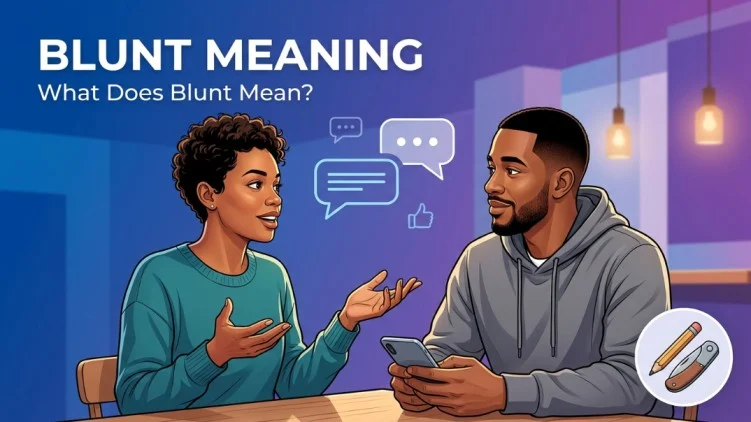
“Blunt” usually means direct, honest, and not softened, especially when describing the way someone speaks. It can also mean dull, not sharp, or refer to a type of rolled cannabis cigarette.
Sometimes one small word can have several meanings, and blunt is a perfect example. You may hear someone say, “She is very blunt,” read “Just be blunt with me” in a text, or see the word in a social media post. But what does it actually mean?
If you are learning English, chatting with friends, using social media, playing games, or reading online conversations, understanding the blunt meaning can help you avoid confusion. The word often describes a person who says exactly what they think without trying to make their words sound softer.
For example, instead of saying, “Maybe this idea needs a little work,” a blunt person might say, “This idea is not good.” The message may be honest, but the delivery can feel strong.
In this guide, you will learn the main meanings of blunt, how people use it in daily conversations, texting, social media, dating, gaming, and professional settings, plus how to respond when someone is being blunt.
Definition & Meaning
The most common meaning of blunt is direct and very honest in speech. A blunt person usually says what they think without adding many polite or gentle words.
For example:
Sarah: “What do you think about my presentation?”
Mike: “Honestly, it was boring.”
Mike is being blunt because he gives his opinion directly. He does not try to make the criticism sound softer.
Being blunt is not always the same as being rude. A person can be honest and direct while still being respectful. However, blunt words can sometimes hurt someone’s feelings if they are too harsh.
Blunt as an adjective for speech
When we describe someone’s communication as blunt, we often mean:
- Direct
- Straightforward
- Very honest
- Frank
- Unfiltered
- Not softened
Example:
“My manager was blunt about my performance.”
This means the manager spoke very directly and did not hide their concerns.
Blunt can also mean not sharp
The word has another common meaning. Something blunt can have a dull or rounded edge instead of a sharp one.
For example:
“This knife is blunt.”
This means the knife is not sharp.
You can also describe an object as blunt when its end is rounded.
“The pencil has a blunt tip.”
Blunt in slang
In some contexts, especially in American slang, blunt can refer to a cigar or cigar wrapper filled with cannabis. This meaning is informal and depends heavily on context.
So, the meaning of blunt can change based on how it appears in a sentence.
Background & History
The word blunt has a long history in English. Its older uses were connected to physical objects that were dull, rounded, or lacking a sharp edge.
For example, a blunt knife does not cut easily because its edge is not sharp. A blunt object can also have a rounded end rather than a pointed one.
Over time, the word developed a figurative meaning related to communication. If something is not sharp physically, the idea can be extended to words that are not carefully polished or softened.
That is how blunt became associated with people who speak in a very direct way.
Imagine someone asking:
“Do you like my new haircut?”
A gentle response might be:
“It is different. I think you looked great with your old style too.”
A blunt response could be:
“No, I don’t like it.”
The second response is direct and leaves little room for interpretation.
Today, this meaning is very common in everyday English. You can find it in conversations, books, television, interviews, social media posts, workplace discussions, and online chats.
The slang meaning of blunt developed separately from the adjective meaning “direct.” In American slang, it can refer to a cannabis-filled cigar or cigarillo. Because this meaning is associated with recreational drug use, it is more informal and should not be confused with the standard meaning.
The word has therefore developed several meanings while keeping the idea of something being direct, dull, or unsoftened.
Usage in Various Contexts
The meaning of blunt changes depending on the situation.
Casual Conversations
In everyday conversation, blunt usually describes someone’s communication style.
Tom: “Was my joke funny?”
Jake: “No, it really wasn’t.”
Tom: “Wow, you’re blunt.”
Here, Jake gave a direct answer without trying to protect Tom’s feelings.
Texting
Blunt language is common in texts because people often write short messages.
“I’ll be blunt. I don’t want to go.”
This tells the reader that the person is about to speak honestly and directly.
Another example:
**“Can I ask you something?”
“Sure.”
“Be blunt. Do you actually like him?”**
Here, blunt means completely honest without avoiding the truth.
Social Media
People may describe themselves as blunt in online profiles.
“I’m blunt, not rude. I just say what I think.”
This usually means the person values direct communication.
Gaming
Gamers may use blunt language when discussing performance.
Player 1: “How was my gameplay?”
Player 2: “Blunt answer? You need more practice.”
The speaker is giving honest feedback.
Workplace
Blunt communication can also happen at work.
Manager: “I’ll be blunt. We missed the deadline because the planning was poor.”
This is direct and serious.
However, professional communication usually benefits from being clear without being unnecessarily harsh.
Common Misconceptions & Clarifications
One common misunderstanding is that blunt always means rude.
That is not correct.
A blunt person is direct, but directness and rudeness are not exactly the same thing.
Compare these two statements:
Blunt but respectful:
“Your report needs more evidence before we can approve it.”
Blunt and rude:
“Your report is terrible.”
Both are direct, but the second one is much harsher.
Another misconception is that being blunt means telling everyone everything you think. It does not. A person can be direct while still choosing appropriate words.
Is blunt a negative word?
Not always.
Some people see bluntness as a positive quality because they prefer honesty and clear communication.
For example:
“I appreciate how blunt she is. I always know where I stand with her.”
Others may dislike blunt communication because it can sound insensitive.
Does blunt mean honest?
It can suggest honesty, but the two words are not identical.
Someone can be honest without being blunt.
For example:
“I don’t think this is the best option for us.”
This can be honest but gentle.
Does blunt mean straightforward?
Often, yes. Straightforward is usually more positive, while blunt can suggest that the person’s directness feels unusually strong.
Similar Terms & Alternatives
Several English words are close to blunt, but each has a slightly different feeling.
Direct
Direct means clear and straightforward.
“She was direct about what she wanted.”
This is usually neutral or positive.
Frank
Frank means open and honest.
“To be frank, I disagree.”
It often sounds mature and honest.
Straightforward
Straightforward means simple, clear, and easy to understand.
“He gave me a straightforward answer.”
This is generally positive.
Honest
Honest means truthful.
“I want an honest opinion.”
Someone can be honest without being blunt.
Tactless
Tactless means saying things without enough care for other people’s feelings.
This word is more negative than blunt.
Abrasive
Abrasive describes communication that feels harsh or unpleasant.
It is usually stronger and more negative than blunt.
| Word | Main idea | Typical feeling |
|---|---|---|
| Blunt | Very direct | Neutral or negative |
| Direct | Clear and straight | Usually neutral |
| Frank | Open and honest | Often positive |
| Straightforward | Clear and simple | Positive |
| Honest | Truthful | Positive |
| Tactless | Lacking sensitivity | Negative |
| Abrasive | Harsh and unpleasant | Negative |
How to Respond to This Term
Your response depends on what the person means by blunt.
If Someone Says They Are Blunt
You can respond casually:
“I don’t mind. I prefer honest answers.”
Or:
“That’s fine. Just be respectful.”
If Someone Gives You a Blunt Opinion
You might say:
“Thanks for being honest.”
If the comment was too harsh:
“I appreciate the honesty, but you could have said that more gently.”
Funny Response
If a friend is always direct:
“You really don’t believe in sugarcoating anything, do you?”
This keeps the conversation playful.
Professional Response
At work, you could say:
“I appreciate the direct feedback. Could you also suggest how I can improve?”
This turns a blunt comment into something useful.
Privacy-Conscious Response
If someone asks a personal question and says, “Be blunt,” you do not have to answer.
You can say:
“I’d rather not discuss that.”
Being direct does not mean you have to share private information.
Regional or Cultural Differences
The basic meaning of blunt is widely understood in English-speaking countries. However, people’s attitudes toward blunt communication can differ across cultures.
In some cultures and families, direct communication is highly valued. People may believe that saying exactly what they think shows honesty and respect.
In other cultures, people may prefer indirect or softer communication. They may use polite phrases to avoid embarrassing someone or creating conflict.
For example, consider criticism about food.
A blunt speaker might say:
“This food needs more salt.”
A softer speaker might say:
“Maybe a little more salt would make it even better.”
Both people may mean the same thing, but the communication style is different.
Regional English can also affect how words like blunt, frank, and straightforward are perceived.
The important point is that bluntness is often about communication style, not simply vocabulary.
Online communication can make this difference even stronger because text does not include facial expressions or voice tone.
A short message such as:
“That was bad.”
may sound much harsher in a text than it would during a friendly conversation.
Comparison with Similar Terms
Understanding the differences between related words makes the meaning easier to remember.
| Term | Meaning | Example |
|---|---|---|
| Blunt | Very direct, sometimes harsh | “I’ll be blunt. I disagree.” |
| Direct | Clear and straightforward | “She directly answered the question.” |
| Frank | Honest and open | “To be frank, I was disappointed.” |
| Honest | Truthful | “Give me your honest opinion.” |
| Tactful | Careful with feelings | “She gave tactful feedback.” |
| Rude | Disrespectful | “His comment was rude.” |
| Harsh | Very severe or critical | “That was a harsh response.” |
The biggest difference is tone.
For example, saying someone is direct often sounds positive. Calling someone blunt can suggest that their honesty may be difficult to hear.
Calling someone rude goes further because it suggests a lack of respect.
Usage in Online Communities & Dating Apps
The word blunt appears often in online conversations because people regularly discuss communication styles.
On dating apps, someone might write:
“I’m a blunt person. I don’t like playing games.”
They usually mean they prefer honest and direct communication.
Someone else might say:
“Please be blunt. Are you interested or not?”
Here, the person wants a clear answer instead of vague messages.
On social media, people may say:
“I’ll be blunt. This movie was disappointing.”
This introduces a strong opinion.
In gaming communities, blunt feedback can be common:
“Blunt opinion: our team needs better communication.”
Tips for Online Conversations
If someone says they are blunt, do not automatically assume they are rude.
Look at the full message.
Ask yourself:
- Are they giving useful feedback?
- Are they insulting someone?
- Are they joking?
- Are they being honest about their feelings?
- Is the conversation sensitive?
Text does not show facial expressions or voice tone, so blunt comments can easily be misunderstood.
If a message feels too harsh, ask for clarification instead of immediately starting an argument.
Hidden or Offensive Meanings
The standard meaning of blunt is not offensive. It usually describes direct communication or something that is not sharp.
However, the word has an informal slang meaning in some contexts.
In American slang, a blunt can refer to a cigar or cigarillo that has been filled with cannabis. This meaning is common in some music, pop culture, and online conversations.
For example:
“They were talking about smoking a blunt.”
Here, the word does not mean “direct.”
This is why context matters.
If someone says:
“He was blunt with me.”
They are talking about communication.
If someone says:
“They rolled a blunt.”
They are using the slang meaning.
The slang use may not be suitable for professional or family-friendly communication. It can also be inappropriate depending on the setting and local laws.
The key is not to assume that every use of blunt refers to cannabis. The surrounding words usually make the intended meaning clear.
Suitability for Professional Communication
Blunt can be used in professional communication, especially when describing a person’s communication style.
For example:
“My supervisor was very blunt about the project.”
This is grammatically correct.
However, being blunt is not always the best communication strategy at work.
Professional settings often require honesty combined with respect and tact.
Instead of saying:
“Your work is bad.”
A professional speaker could say:
“There are several areas that need improvement before this is ready.”
The second version is still honest, but it is more constructive.
Better Professional Alternatives
Consider these words:
- Direct
- Clear
- Straightforward
- Frank
- Transparent
- Constructive
For example:
Less polished: “She was blunt with the client.”
More professional: “She gave the client clear and direct feedback.”
This does not mean blunt communication is always wrong. In some situations, being clear and direct can save time and prevent misunderstandings.
The goal is to be honest without being unnecessarily harsh.
FAQs
What does blunt mean in simple words?
Blunt usually means very direct and honest, especially when someone says something without trying to make it sound softer.
Is being blunt rude?
Not necessarily. A blunt person can be respectful, but blunt comments may sound rude if they are too harsh or insensitive.
What is the opposite of blunt?
Depending on the context, the opposite can be tactful, gentle, diplomatic, or indirect when discussing communication.
Does blunt mean honest?
Blunt often involves honesty, but they are not exactly the same. Someone can be honest while still choosing gentle words.
What does blunt mean in slang?
In American slang, a blunt can refer to a cigar or cigarillo filled with cannabis. The surrounding context usually makes this meaning clear.
Is blunt a positive word?
It can be positive or negative. Some people appreciate blunt honesty, while others feel that blunt communication is too harsh.
What is a blunt person like?
A blunt person usually speaks directly, gives clear opinions, and does not spend much time softening their words.
Conclusion
The word blunt has several meanings, but the most common one describes someone who is very direct and honest. A blunt person usually says what they think without adding many soft or polite phrases.
The word can also describe something that is not sharp, such as a blunt knife or pencil. In informal American slang, blunt can have another meaning related to cannabis, so context is important.
In daily conversations, texting, dating apps, social media, gaming, and workplaces, blunt usually refers to communication style. It does not automatically mean rude. The difference depends on tone, intention, and respect.
If you want to communicate clearly, honesty is useful, but kindness matters too. Being direct does not require being hurtful.
Read More Related Articles:
What Does UwU Mean| Complete Meaning, Origin, Usage …
What Does OFC Mean| Complete Meaning, Origin, Usage …
What Does TLDR Mean| Complete Meaning, Origin, Usage …