Quick answer:
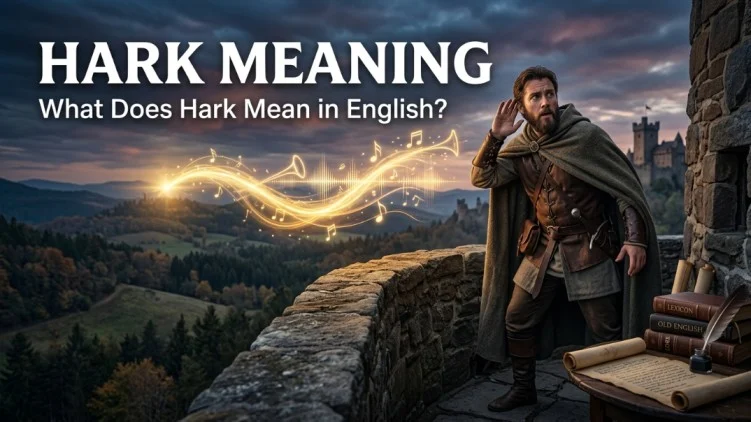
Hark means “listen” or “pay attention,” especially when someone wants you to notice a sound or important message. It is an old-fashioned word often found in literature, songs, poetry, and dramatic speech.
Imagine hearing a mysterious sound in the distance. Someone turns toward it and says, “Hark!” It sounds dramatic, almost like something from an old story or movie. But what does this unusual word actually mean?
The simple hark meaning is “listen” or “pay attention.” You may see it in books, poems, Christmas songs, historical stories, fantasy games, or dramatic online posts. It is not common in everyday modern conversation, but it still appears often enough to make understanding it useful.
If you are a student, English learner, writer, gamer, reader, or someone who enjoys old expressions, this guide will help you understand the word clearly. You will learn where hark came from, how people use it today, what it means in different contexts, and how to respond when you see it.
Definition & Meaning
The word hark is an old English verb that means “listen,” “listen closely,” or “pay attention.”
It is usually used as a command. When someone says “Hark!”, they are telling another person to stop and listen to something.
For example:
“Hark! What was that sound?”
This means:
“Listen! What was that sound?”
The word often creates a dramatic or literary feeling. It can suggest that something important, surprising, beautiful, or mysterious is about to happen.
Hark as a Command
The most common traditional use is:
“Hark!”
This is similar to:
- Listen!
- Hear this!
- Pay attention!
- Listen carefully!
You may also see longer forms.
“Hark to the music.”
This means:
“Listen to the music.”
Another example is:
“Hark, the birds are singing.”
This means:
“Listen, the birds are singing.”
Why Does “Hark” Sound So Old?
The word is strongly associated with older forms of English. Modern speakers usually say “listen” instead.
Compare these:
Old-fashioned: “Hark! Someone approaches.”
Modern: “Listen! Someone is coming.”
Both sentences communicate the same basic idea, but the first sounds much more dramatic.
Today, hark is often used for style rather than necessity. A writer may choose it to create an old, poetic, humorous, fantasy, or theatrical mood.
Background & History
Hark has a long history in the English language. It comes from an old form of English related to the idea of listening or hearing.
Over centuries, the word became a familiar way to tell someone to listen. It appeared in literature, poetry, religious writing, songs, and dramatic works.
One reason the word remains recognizable is its connection with famous English writing. Older authors often used hark when introducing an important sound or calling attention to something happening nearby.
The expression became especially effective in poetry because it is short, strong, and easy to place at the beginning of a line.
For example:
“Hark! The wind is rising.”
The word immediately tells the reader to focus on the sound.
Hark in Religious and Traditional Writing
The word also became common in traditional religious and musical language.
A famous example appears in the Christmas carol “Hark! The Herald Angels Sing.”
Here, hark means listen.
The phrase is essentially telling listeners to pay attention to the angels singing.
This song helped keep the word familiar to generations of English speakers. Even people who rarely encounter hark in ordinary conversation may recognize it from Christmas music.
Hark in Modern English
Today, hark is considered old-fashioned or literary in most everyday situations.
People usually say:
“Listen!”
instead of:
“Hark!”
However, the word has not disappeared. Writers still use it when they want an old-fashioned, poetic, dramatic, or humorous tone.
You may also encounter it in fantasy novels, historical fiction, role-playing games, memes, and jokes.
Usage in Various Contexts
The meaning of hark stays fairly consistent, but its tone changes depending on where you see it.
1. Literature
Authors may use hark to create a traditional or dramatic atmosphere.
“Hark! A cry comes from the forest.”
The word makes the scene feel mysterious and serious.
2. Poetry
Poets may use it because the word is short and expressive.
“Hark to the gentle rain.”
The meaning is:
“Listen to the gentle rain.”
3. Songs
The word is famous in traditional songs.
“Hark! The Herald Angels Sing”
Here, the listener is being asked to pay attention to the angels’ song.
4. Fantasy Games
Fantasy games often use older English words to make characters sound medieval.
Knight: “Hark! The enemy approaches!”
Player: “Where?”
The knight is simply saying:
“Listen! The enemy is coming!”
5. Social Media
Someone may use hark jokingly online.
“Hark! My food has arrived. 🍕”
This is not normal modern English. The humor comes from using a very old-fashioned word for an ordinary situation.
6. Casual Conversation
You could technically say:
“Hark! Someone is knocking.”
But most people would find it theatrical or humorous.
A normal modern version would be:
“Listen! Someone is knocking.”
7. Storytelling
Writers and storytellers can use hark to build suspense.
“Hark! What is that strange noise outside?”
This immediately creates curiosity and makes the moment feel dramatic.
Common Misconceptions & Clarifications
Because hark is an old word, people sometimes misunderstand it.
Does Hark Mean Hear?
It can be closely related to hear, but the practical meaning is closer to listen or pay attention.
Hear usually describes receiving a sound.
Listen means intentionally paying attention to a sound.
Hark works more like listen.
Is Hark a Modern Slang Word?
Not really.
Although people sometimes use it jokingly online, hark is traditionally an old-fashioned English word rather than modern slang.
Is Hark Only Used for Sounds?
Usually, the word calls attention to something that can be heard. However, writers may use it broadly as a dramatic command to pay attention.
Is Hark a Rude Word?
No.
There is nothing inherently rude or offensive about hark. It simply sounds old-fashioned.
Can I Use Hark in an Email?
You can, but it may sound unusual.
For example:
“Hark! The report is finally complete.”
This would sound playful rather than professional.
A normal business version would be:
“The report is finally complete.”
Similar Terms & Alternatives
Several modern words can replace hark.
Listen
This is the closest modern alternative.
Hark! The rain is starting.
becomes:
Listen! The rain is starting.
Pay Attention
This is stronger and more direct.
“Pay attention to what I am saying.”
Hear
This can sometimes work, especially in literary language.
“Hear my words.”
However, hear and hark are not exact equivalents in every sentence.
Look
This is sometimes used when the goal is to draw attention to something visible rather than audible.
“Look! There is a rainbow.”
Notice
This is more neutral and often more suitable for formal writing.
| Word | Basic meaning | Tone |
|---|---|---|
| Hark | Listen | Old-fashioned, dramatic |
| Listen | Pay attention to sound | Modern, neutral |
| Hear | Receive a sound | Neutral |
| Pay attention | Focus carefully | Direct |
| Notice | Become aware of something | Neutral |
| Attend | Give attention | Formal |
How to Respond to This Term
Your response depends on how hark is being used.
If someone says:
“Hark! What is that noise?”
You could respond:
“I hear it too!”
Or:
“It sounds like someone outside.”
If someone uses hark as a joke, you can play along.
Friend: “Hark! The pizza has arrived!”
You: “At last! Our feast begins!”
Casual Response
“I’m listening!”
Funny Response
“My ears are ready!”
Dramatic Response
“Speak, traveler. I am listening.”
Professional Response
In a professional situation, simply respond to the actual information.
“Yes, I hear you. What happened?”
There is no special response required for the word itself.
Regional or Cultural Differences
The word hark is English, but its familiarity can vary between speakers.
Native English speakers may recognize it from literature, songs, religious traditions, or older forms of writing. However, many younger speakers rarely use it in everyday speech.
The word is especially recognizable because of traditional English expressions and famous cultural works.
For English learners, hark can be confusing because modern textbooks may focus on common words such as listen, hear, and pay attention.
You may still encounter hark while reading older books or watching historical and fantasy content.
British and American English
Both British and American English speakers can understand hark, but neither normally uses it in ordinary conversation.
Its meaning remains essentially the same.
Cultural Associations
The word can suggest:
- Medieval settings
- Poetry
- Christmas traditions
- Historical fiction
- Fantasy stories
- Theatrical speech
- Humor
That cultural feeling is often as important as its dictionary definition.
Comparison with Similar Terms
Understanding the difference between hark, listen, and hear makes the word much easier to use.
| Expression | Meaning | Example | Tone |
|---|---|---|---|
| Hark | Listen closely | “Hark! What was that?” | Literary |
| Listen | Pay attention to sound | “Listen to this.” | Everyday |
| Hear | Perceive a sound | “I can hear music.” | Neutral |
| Pay attention | Focus carefully | “Pay attention.” | Direct |
| Take heed | Listen and act carefully | “Take heed of my warning.” | Formal or old-fashioned |
Hark vs. Listen
These are the closest matches.
Hark! The bells are ringing.
Listen! The bells are ringing.
The meaning is nearly the same, but hark sounds much older.
Hark vs. Hear
These are slightly different.
“I hear music.”
means you perceive music.
“Hark to the music.”
means you are being told to listen carefully to it.
Hark vs. Pay Attention
Pay attention can apply to sounds, instructions, visual information, and ideas.
Hark is mainly associated with listening.
Usage in Online Communities & Dating Apps
You may see hark online because people enjoy using old-fashioned English for humor.
On social media, a person might post:
“Hark! The weekend has arrived.”
The writer is not speaking seriously. They are making a simple statement sound dramatic.
On gaming platforms, players may use it to imitate fantasy characters.
“Hark! The boss has returned!”
This gives the message a medieval or fantasy feel.
Dating Apps
A dating profile might jokingly say:
“Hark! A fellow coffee lover has entered my kingdom.”
This is playful and intentionally dramatic.
Someone might also use the word as part of a fantasy-themed profile.
How to Respond Online
You can match the tone.
“I hear you, noble one. 😂”
or:
“The kingdom rejoices!”
If the person is using the word seriously, a normal response is enough.
The key is recognizing that hark often signals humor or theatrical language online.
Hidden or Offensive Meanings
There is no common offensive meaning attached to hark in standard English.
The word itself is neutral.
However, the way someone uses it can create different effects.
For example:
“Hark, the genius has arrived.”
Depending on the situation, this could be sincere or sarcastic.
The sarcasm comes from the speaker’s tone, not from the word hark.
It can also be used to imitate medieval or exaggerated speech. In that situation, it is usually humorous.
Could Hark Be Insulting?
Not by itself.
If someone says:
“Hark! Listen to this fool.”
the insulting part is “fool,” not “hark.”
This distinction is useful when interpreting messages.
Suitability for Professional Communication
The word hark is grammatically valid, but it is usually not the best choice for professional communication.
In a business email, report, presentation, or workplace message, modern alternatives are clearer.
Instead of:
“Hark! The meeting has begun.”
write:
“The meeting has begun.”
Instead of:
“Hark to the instructions.”
write:
“Please listen carefully to the instructions.”
Better Professional Alternatives
Use:
- Please listen
- Please note
- Please pay attention
- Please be aware
- Take note of
- Please review
These expressions are clearer and more natural in professional settings.
That does not mean hark is wrong. It simply carries a literary and dramatic tone that may not fit ordinary workplace communication.
FAQs
What does hark mean?
Hark means “listen” or “pay attention,” especially when someone wants another person to notice a sound or message.
Is hark an old word?
Yes. Hark is an old-fashioned English word that is now mainly found in literature, poetry, songs, historical writing, and dramatic speech.
Is hark the same as listen?
They have nearly the same meaning when hark is used as a command. The main difference is tone because hark sounds much more old-fashioned.
What does “Hark!” mean?
“Hark!” means “Listen!” or “Pay attention!” It is often used to draw attention to a sound or important event.
Why is hark used in Christmas songs?
The word appears in traditional Christmas music because it creates a poetic and traditional tone. A famous example is “Hark! The Herald Angels Sing.”
Is hark still used today?
Yes, but rarely in normal conversation. It is more common in literature, fantasy stories, historical settings, songs, jokes, and theatrical language.
Is hark a positive or negative word?
Hark is neutral. It simply means listen or pay attention. The surrounding sentence and tone determine whether the overall message is positive, negative, serious, or humorous.
Conclusion
The word hark may sound unusual today, but its meaning is simple. It generally means “listen,” “listen closely,” or “pay attention.” You will most often find it in older literature, poetry, traditional songs, fantasy stories, historical settings, and playful online writing.
Unlike modern words such as listen and hear, hark has a strong old-fashioned and dramatic feeling. That is why writers often choose it when they want a sentence to sound poetic, mysterious, medieval, or humorous.
If you see “Hark!”, simply read it as “Listen!” Understanding this one small word can make older books, songs, games, and dramatic expressions much easier to understand.
Read More Related Articles:
What Does UwU Mean| Complete Meaning, Origin, Usage …
What Does OFC Mean| Complete Meaning, Origin, Usage …
What Does TLDR Mean| Complete Meaning, Origin, Usage …