Quick answer:
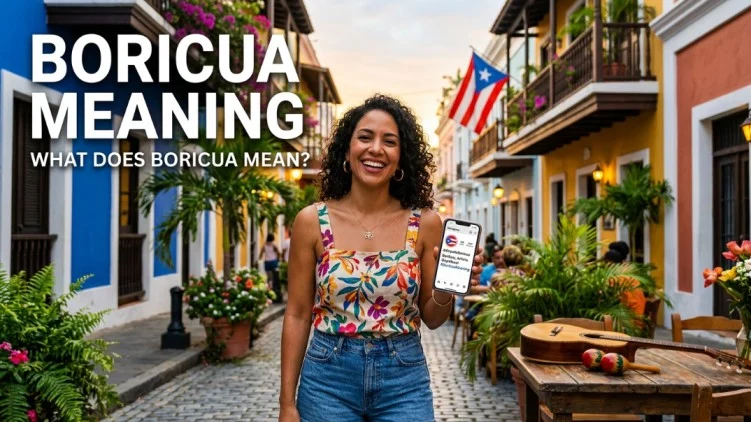
Boricua is a term used by Puerto Ricans to describe themselves or someone connected to Puerto Rico. It comes from Borikén, the Taíno name for Puerto Rico.
A single word can carry a whole culture inside it. Boricua is one of those words. You may see it in social media bios, hear it in music, spot it on clothing, or come across it while chatting with someone from Puerto Rico. But what does it actually mean?
If you are learning Spanish, talking with Puerto Rican friends, exploring Caribbean culture, or simply trying to understand a word you saw online, knowing the Boricua meaning can help you understand more than just a translation. The word has a strong connection to Puerto Rican identity, history, pride, and community.
You might hear someone say, “Soy Boricua,” which means “I am Puerto Rican.” You may also see someone proudly write “Boricua” in an Instagram bio or caption.
So, if you have wondered whether Boricua is slang, a nickname, or a cultural term, let’s break it down in a simple way.
Definition & Meaning
Boricua is a cultural term used by Puerto Ricans to describe themselves and their connection to Puerto Rico.
In simple English, Boricua means “Puerto Rican.” However, the word carries more emotional and cultural meaning than the basic phrase “from Puerto Rico.”
For many people, calling themselves Boricua is a way of expressing pride in their heritage and identity.
For example:
“Soy Boricua.”
This means:
“I am Puerto Rican.”
Someone might also say:
“Mi familia es Boricua.”
This can mean:
“My family is Puerto Rican.”
The word can be used by people living in Puerto Rico and by Puerto Ricans living elsewhere, including in the United States and other parts of the world.
Is Boricua Spanish?
Yes, Boricua is used in Spanish, especially in connection with Puerto Rican identity. It is not simply a standard Spanish adjective that you would use for every person from Puerto Rico in every situation.
The standard Spanish adjective and noun puertorriqueño means Puerto Rican. Boricua, however, has a stronger cultural and identity-based feeling.
Compare these:
“Ella es puertorriqueña.”
“She is Puerto Rican.”
“Ella es Boricua.”
“She is Boricua.”
Both communicate Puerto Rican identity, but the second can feel more connected to cultural pride and heritage.
Is Boricua a nickname?
It can function like a cultural nickname or identity label, but it is more than a casual nickname.
For many Puerto Ricans, Boricua is an important expression of identity.
It can appear in music, art, sports, family conversations, social media, festivals, and everyday speech.
Background & History
The history of Boricua is connected to the Indigenous Taíno people of the Caribbean.
Before Spanish colonization, the island now known as Puerto Rico was associated with the name Borikén, with spelling variations also appearing in historical sources. The term became an important part of Puerto Rican cultural identity over time.
The modern word Boricua reflects that connection to the island’s Indigenous past.
This history gives the word a meaning that goes beyond simply saying Puerto Rican. It can represent a connection to the island, its people, ancestry, culture, and history.
Puerto Rican identity itself has developed through many cultural influences, including Indigenous Taíno heritage, Spanish colonial history, African heritage, and later migration and cultural exchange.
Because of this rich history, Boricua can carry a strong sense of belonging.
How the Word Became Popular
Over time, Boricua became widely used as an expression of Puerto Rican pride. It appears in music, poetry, sports, political and cultural discussions, clothing, festivals, and everyday conversations.
Puerto Rican artists and musicians have also helped spread the word around the world.
You may see phrases such as:
“Orgullo Boricua”
Meaning:
“Puerto Rican pride.”
You may also see:
“Boricua de corazón.”
Meaning:
“Boricua at heart.”
Today, the word is especially recognizable among Puerto Rican communities both on the island and in the diaspora.
Usage in Various Contexts
The word Boricua can appear in many different situations.
1. Everyday Conversation
A person might use it when introducing their background.
Person 1: “Where are you from?”
Person 2: “I’m Boricua. My family is from Puerto Rico.”
Here, Boricua identifies the person’s Puerto Rican heritage.
2. Family Conversations
A Puerto Rican family may use the word when talking about their roots.
“Todos somos Boricuas.”
Meaning:
“We are all Puerto Rican.”
3. Social Media
You may see captions such as:
“Proud to be Boricua 🇵🇷❤️”
This expresses cultural pride.
Another example:
“Boricua vibes all day!”
This could refer to Puerto Rican food, music, traditions, celebrations, or general cultural identity.
4. Music
Boricua is common in discussions about Puerto Rican music and culture. Artists, fans, and communities may use it to celebrate Puerto Rican identity.
A singer might say:
“This song is for every Boricua around the world.”
The message is directed toward Puerto Rican people and communities.
5. Sports
Fans may use Boricua when supporting Puerto Rican athletes or teams.
“Let’s go, Boricuas!”
This expresses support and pride.
6. Dating Conversations
Someone might mention the word when discussing their background.
“I’m Boricua, but I live in New York.”
That tells the other person about their Puerto Rican heritage.
7. Online Communities
You may encounter Boricua in usernames, hashtags, comments, gaming profiles, and community groups.
For example:
“Boricua gamer here 🎮🇵🇷.”
The person is identifying themselves as Puerto Rican while also sharing an interest in gaming.
Common Misconceptions & Clarifications
Because Boricua is a cultural term, people sometimes misunderstand how it works.
Misconception 1: Boricua Means a Specific Race
It does not.
Boricua refers to Puerto Rican identity and heritage, not one specific race.
Puerto Ricans can have different racial and ethnic backgrounds. The word describes a connection to Puerto Rico rather than assigning someone to a particular racial category.
Misconception 2: Only People Living in Puerto Rico Can Say It
Not necessarily.
Puerto Ricans living outside the island may proudly identify as Boricua.
For example, someone born in New York to Puerto Rican parents might say:
“I’m Boricua.”
They are expressing their Puerto Rican heritage and identity.
Misconception 3: Boricua Is an Insult
Generally, no.
Boricua is usually a positive or neutral cultural identity term. Many Puerto Ricans use it proudly.
As with almost any identity-related word, tone matters. Someone could use any term mockingly, but that does not make the word itself offensive.
Misconception 4: Boricua and Puerto Rican Are Completely Different Identities
They are closely connected.
Puerto Rican is the standard English term.
Boricua is a culturally meaningful term associated with Puerto Rican identity.
The difference is mostly in tone, history, and cultural context.
Misconception 5: It Is Just Internet Slang
No.
Although you may see Boricua frequently online, it existed as a cultural identity term long before social media.
Similar Terms & Alternatives
There are several words that may appear alongside Boricua, but they are not always exact replacements.
Puerto Rican
This is the standard English term.
Example:
“She is Puerto Rican.”
Puertorriqueño or Puertorriqueña
These are standard Spanish terms for a Puerto Rican man or woman.
Examples:
Puertorriqueño = Puerto Rican man or masculine form
Puertorriqueña = Puerto Rican woman or feminine form
Borinqueño or Borinqueña
These terms are also connected to the historical name Borinquen, another form associated with Puerto Rico’s Indigenous name.
Boricua
This is the cultural identity term discussed in this article.
It is often used with a sense of pride and belonging.
| Term | Meaning | Main feeling |
|---|---|---|
| Boricua | Puerto Rican | Cultural identity and pride |
| Puerto Rican | From Puerto Rico | Standard English term |
| Puertorriqueño | Puerto Rican | Standard Spanish |
| Puertorriqueña | Puerto Rican woman | Standard Spanish |
| Borinqueño | Connected to Borinquen | Historical and cultural |
| Borinqueña | Feminine form | Historical and cultural |
How to Respond to This Term
If someone tells you “I’m Boricua,” your response can be simple and friendly.
Casual Response
“Oh, nice! You’re Puerto Rican?”
This is natural if you are unfamiliar with the term.
Friendly Response
“That’s awesome! I love Puerto Rican culture.”
This can open the door to a positive conversation.
Curious Response
“I’ve heard the word before. Does Boricua mean Puerto Rican?”
This is a good choice if you genuinely want to understand the word.
Fun Response
“Boricua pride! 🇵🇷”
This works best when you already have a friendly relationship with the person and understand the context.
If Someone Uses It in Their Bio
You usually do not need to ask about it unless you want to learn more.
For example, if someone’s profile says:
“Boricua 🇵🇷 | Music lover | Traveler”
You can understand Boricua as a statement of Puerto Rican identity.
What Not to Do
Avoid turning someone’s identity into a joke if you do not know them well.
Also, do not assume their exact family background based only on the word.
A respectful question is better:
“Are you Puerto Rican?”
rather than making assumptions.
Regional or Cultural Differences
Boricua is strongly connected to Puerto Rican culture, so its use is different from ordinary Spanish vocabulary.
You are most likely to encounter it among Puerto Ricans and people connected to Puerto Rican culture.
The word is especially common in Puerto Rico and among Puerto Rican communities abroad.
You may see it in places with large Puerto Rican communities, including parts of the United States.
The meaning stays fairly consistent, but the emotional tone can vary.
For one person, Boricua may simply be a casual way to say Puerto Rican. For another, it may express deep cultural pride and a connection to family history.
Boricua Identity Outside Puerto Rico
A person does not have to live in Puerto Rico to identify as Boricua.
Puerto Rican communities around the world maintain connections through:
- Family traditions
- Food
- Music
- Language
- Festivals
- Dance
- Religion
- Art
- Community events
- Social media
This is why the word can appear in conversations far away from the island itself.
Comparison with Similar Terms
The easiest way to understand Boricua is to compare it with related identity words.
| Word or phrase | Meaning | Cultural tone | Common setting |
|---|---|---|---|
| Boricua | Puerto Rican | Strong cultural identity | Casual and cultural |
| Puerto Rican | Person from Puerto Rico | Neutral | General English |
| Puertorriqueño | Puerto Rican | Standard Spanish | Spanish conversation |
| Puertorriqueña | Puerto Rican woman | Standard Spanish | Spanish conversation |
| Borinqueño | Connected to Borinquen | Historical and cultural | Cultural discussions |
| Orgullo Boricua | Puerto Rican pride | Strong pride | Social media and culture |
| Boricua de corazón | Boricua at heart | Emotional | Cultural and personal |
One important difference is Boricua’s emotional connection.
If someone says:
“Soy puertorriqueño.”
They are giving a standard statement about being Puerto Rican.
If someone says:
“Soy Boricua.”
They may be expressing both identity and cultural pride.
Neither expression is wrong. The choice often depends on personal preference and context.
Usage in Online Communities & Dating Apps
Social media has made Boricua easy to encounter around the world.
You might see it on Instagram, TikTok, X, Facebook, Reddit, Discord, dating apps, or gaming platforms.
A person might write:
“Boricua girl 🇵🇷✨”
or:
“Proud Boricua.”
These phrases usually highlight Puerto Rican identity.
Dating Apps
Someone might include:
“Boricua, coffee lover, and beach person.”
This gives potential matches a quick idea about their cultural background.
If you see the word on a dating profile, there is no hidden romantic meaning by default.
Gaming Communities
A player might write:
“Boricua gamer 🎮🇵🇷.”
This simply combines their cultural identity with their gaming interest.
Social Media Comments
You might see:
“Another Boricua here!”
This means the commenter is also Puerto Rican or connected to Puerto Rican identity.
How to Respond Online
A simple response is best.
“Nice! Are you from Puerto Rico?”
or:
“Cool! I have always wanted to visit Puerto Rico.”
If you are talking about culture, you can ask:
“What is your favorite Puerto Rican food?”
This can create a more meaningful conversation without making assumptions.
Hidden or Offensive Meanings
There is no standard hidden offensive meaning attached to Boricua.
The word is generally associated with Puerto Rican identity and pride.
However, identity terms can become uncomfortable when people use them disrespectfully.
For example, mocking someone’s pronunciation, culture, accent, food, or appearance while using the word could make the conversation offensive. The problem would be the behavior and context, not the basic meaning of Boricua.
Can Non Puerto Ricans Say Boricua?
This is where cultural sensitivity matters.
A person who is not Puerto Rican can learn the word, use it when discussing Puerto Rican culture, or repeat a phrase respectfully. But claiming an identity that is not yours can be misleading.
For example, saying:
“My friend is Boricua.”
is completely different from falsely claiming:
“I’m Boricua.”
Respect the identity behind the word.
Is Boricua a Slur?
No. Boricua is not generally considered a slur.
It is commonly used positively by Puerto Ricans themselves.
Still, any cultural term can be used disrespectfully depending on the speaker’s intention and tone.
Suitability for Professional Communication
Boricua can be appropriate in professional communication when the context is cultural, personal, or community-focused.
For example, a Puerto Rican cultural organization might write:
“Celebrating Boricua culture through music and art.”
That is completely natural.
A tourism organization might also use the term in cultural content.
However, in formal business writing, clarity is important.
If you are writing to an international audience unfamiliar with the term, Puerto Rican may be clearer.
For example:
Less familiar:
“Boricua communities participated in the event.”
Clearer for a broad audience:
“Puerto Rican communities participated in the event.”
You can also introduce the term first:
“Puerto Rican, or Boricua, communities participated in the event.”
After explaining it once, you can use Boricua if it fits the tone.
When to Use Boricua Professionally
It can work well in:
- Cultural organizations
- Arts and music projects
- Community events
- Puerto Rican heritage campaigns
- Cultural journalism
- Personal biographies
- Creative writing
- Community outreach
For highly formal documents, Puerto Rican may be the safer choice when your audience may not know the term.
FAQs
What does Boricua mean?
Boricua means Puerto Rican and is commonly used as a cultural identity term connected to Puerto Rico and Puerto Rican heritage.
Is Boricua a Spanish word?
Boricua is widely used in Spanish in connection with Puerto Rican identity and has roots connected to the Indigenous name for Puerto Rico.
Is Boricua an insult?
No, Boricua is generally a positive cultural identity term and is proudly used by many Puerto Ricans.
Can someone living outside Puerto Rico be Boricua?
Yes, Puerto Ricans living outside the island may identify as Boricua because the term can describe heritage and cultural identity.
What is the difference between Boricua and Puerto Rican?
Puerto Rican is the standard term, while Boricua often carries a stronger sense of cultural identity, heritage, and pride.
What does “Soy Boricua” mean?
“Soy Boricua” means “I am Puerto Rican” and can express both personal identity and cultural pride.
Where does the word Boricua come from?
Boricua is connected to Borikén or Borinquen, names associated with Puerto Rico’s Indigenous Taíno heritage.
Conclusion
Boricua is much more than another way to say Puerto Rican. It is a word closely connected to Puerto Rican culture, heritage, history, and identity. Its roots are associated with the Indigenous name for the island, which gives the term a deeper cultural meaning.
You may see Boricua in everyday conversations, social media profiles, music, sports, dating apps, gaming communities, and cultural events. Someone who says “Soy Boricua” is usually expressing that they are Puerto Rican and may also be showing pride in their heritage.
If you are not familiar with the word, the easiest translation is “Puerto Rican.” But remember that the feeling behind the word can be stronger than a simple geographic description.
When used respectfully, Boricua is a proud and meaningful expression of Puerto Rican identity.
Discover More Post:
- Blunt Meaning | What Does “Blunt” Really Mean? Simple …
- Susurrus Meaning | The Beautiful Word for a Soft, Whispering …
- Missus Meaning | What Does “Missus” Mean in 2026