Quick Answer:
BTW means “by the way.” People use it in texts, chats, social media, and casual conversations to add a new thought or extra detail.
A short message can sometimes change the whole flow of a conversation. You might be chatting with a friend, scrolling through social media, playing an online game, or reading a comment when you suddenly see “BTW.” It is only three letters, but knowing what they mean can make the conversation much easier to follow.
BTW meaning is simple: it stands for “by the way.” People use it when they want to add something that is related to the conversation but was not the main topic. It can introduce a reminder, question, opinion, joke, or small piece of information.
If you are learning internet slang, texting language, or modern English, BTW is worth knowing. You will see it often in casual messages, group chats, social media comments, gaming conversations, and even workplace chats. The good news is that it is easy to understand once you know what it means.
Definition & Meaning
BTW is an abbreviation for “by the way.”
The phrase “by the way” is used when someone wants to add another thought or piece of information to an ongoing conversation. Instead of typing the full phrase, people often shorten it to BTW, especially when texting or chatting online.
For example:
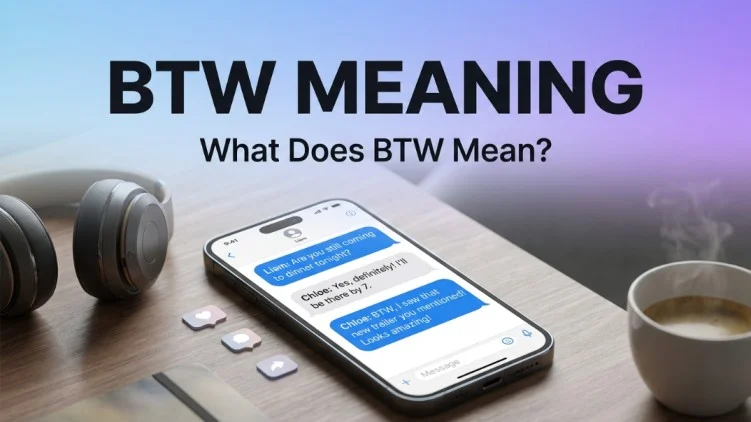
Emma: “Are you coming to the party tonight?”
Jake: “Yeah, I should be there. BTW, what time does it start?”
Here, BTW introduces a new but related question.
It can also introduce a reminder:
“BTW, don’t forget to bring your charger.”
It can introduce extra information:
“BTW, I already finished the assignment.”
Or it can introduce something completely casual:
“BTW, your new profile picture looks great.”
What Does BTW Stand For?
BTW stands for:
B = By
T = The
W = Way
Together:
BTW = By the way
The abbreviation is usually written in capital letters, but lowercase “btw” is also extremely common.
You may see:
“BTW, are you free tomorrow?”
or:
“btw are you still coming?”
Both mean the same thing.
BTW is usually informal. It is most common in texting, instant messaging, social media, comments, forums, and casual online conversations.
The tone depends on the sentence around it. It can sound friendly, neutral, funny, or even slightly abrupt.
For example:
“BTW, I got you a gift!”
sounds excited and friendly.
But:
“BTW, you forgot to pay me.”
can sound like a reminder or mild complaint.
So, while the abbreviation itself is neutral, the surrounding message determines the real tone.
Background & History
The phrase “by the way” has been part of English for a long time. It is used to move from one point to another while adding information that is not the main focus of the conversation.
The abbreviation BTW became popular as written communication became faster and more informal.
As texting, instant messaging, online forums, and social media grew, people began shortening common phrases to save time and effort. Expressions such as LOL, BRB, IDK, and BTW became widely recognized.
Unlike some internet slang, BTW does not have a complicated or controversial origin. It is simply a shortened form of an existing English phrase.
Its popularity grew with digital communication because typing three letters is faster than typing the full phrase.
For example, instead of:
“By the way, did you see my message?”
someone could quickly type:
“BTW, did you see my message?”
Today, BTW is widely understood by English speakers, especially people who regularly use texting and social media.
It is no longer limited to teenagers or younger internet users. Adults also use BTW in casual emails, workplace messaging apps, group chats, and personal conversations.
However, the full phrase “by the way” is still more natural in formal writing.
You are more likely to see:
“By the way, I wanted to ask about the meeting.”
in a formal message than:
“BTW, I wanted to ask about the meeting.”
This makes BTW a good example of how digital communication can create shorter forms of familiar language without changing the original meaning.
Usage in Various Contexts
BTW can appear in many types of casual communication.
BTW in Texting
Texting is probably one of the most common places to see BTW.
Sarah: “I’m almost home.”
Mike: “Okay. BTW, can you pick up some milk?”
The abbreviation allows Mike to add a quick request without making it sound like a major topic.
BTW on Social Media
People often use BTW in comments and posts.
“BTW, this is my favorite restaurant in town.”
Here, the writer is adding an extra opinion.
You may also see:
“BTW, who else watched the finale?”
This introduces a new question.
BTW in Gaming
Gamers often use short abbreviations because conversations can move quickly.
Player 1: “Meet me near the base.”
Player 2: “Got it. BTW, do you have extra ammo?”
The word simply means “by the way.”
BTW in Group Chats
Group chats are another common place for the abbreviation.
“BTW everyone, the meeting moved to 5 PM.”
It can work as a quick attention grabber before an additional message.
BTW in Casual Conversations
People sometimes use the spoken phrase “by the way” rather than saying the letters B-T-W.
In written communication, however, BTW is much more common.
BTW in Comments
A comment might say:
“BTW, your explanation helped me a lot.”
This adds a friendly extra thought to the main comment.
Common Misconceptions & Clarifications
Because BTW is short, people sometimes misunderstand how it works.
Does BTW Mean “Between”?
No.
BTW means “by the way.”
It does not normally mean “between.”
If you see BTW in a text message, the intended meaning is almost always “by the way.”
Is BTW Rude?
Not usually.
BTW is a neutral abbreviation. However, the sentence that follows it can affect how the message feels.
Compare:
“BTW, I love your new shoes!”
This sounds friendly.
With:
“BTW, you still owe me money.”
This sounds more serious.
The abbreviation is not rude. The message creates the tone.
Is BTW Only Used by Young People?
No.
BTW is common among many age groups who use digital communication. It has become a widely recognized abbreviation.
Does BTW Mean the Same Thing as “Anyway”?
Not exactly.
“Anyway” can be used to return to the main topic or move a conversation forward.
BTW usually introduces additional information.
For example:
“BTW, did you call Mom?”
means the speaker is adding another question.
Can BTW Be Used in Formal Writing?
It can be understood, but it is usually better to write “by the way” in formal communication.
Similar Terms & Alternatives
Several expressions can perform a similar conversational function.
By the Way
This is the complete form of BTW.
“By the way, I wanted to ask you something.”
It is suitable for casual and many neutral situations.
- Anyway
“Anyway” often helps change direction or return to the main point.
“Anyway, let’s talk about the meeting.”
- Also
“Also” adds another piece of information.
“Also, remember to send the file.”
Incidentally
“Incidentally” can introduce an additional fact. It sounds more formal than BTW.
“Incidentally, I met your brother yesterday.”
Speaking of Which
This phrase connects a new thought to something just mentioned.
“You mentioned the restaurant. Speaking of which, have you tried the new one downtown?”
| Expression | Meaning | Tone |
|---|---|---|
| BTW | By the way | Casual |
| By the way | Adds another thought | Casual to neutral |
| Anyway | Changes or redirects the topic | Casual |
| Also | Adds information | Neutral |
| Incidentally | Adds a related fact | Formal |
| Speaking of which | Connects to the previous topic | Casual to neutral |
How to Respond to This Term
You do not need a special response just because someone uses BTW. Simply respond to the information or question that comes after it.
For example:
Alex: “BTW, are you free Saturday?”
You: “Yeah, I think so. Why?”
Casual Response
“Oh yeah, I’m free.”
Friendly Response
“BTW, thanks for reminding me!”
Funny Response
“BTW? Now I’m curious. 😂”
Direct Response
“Yes, I can do that.”
Professional Response
If someone uses BTW in a workplace chat, you can simply answer the actual question.
Coworker: “BTW, can you send the report before lunch?”
You: “Sure, I’ll send it before noon.”
If You Do Not Understand
If the abbreviation is unfamiliar, there is nothing wrong with asking:
“What does BTW mean?”
That is better than guessing.
Regional or Cultural Differences
BTW is mainly an English abbreviation, but it is widely recognized online in many countries.
Because the internet connects people from different languages, English abbreviations often spread beyond English-speaking countries.
You may see BTW in conversations between people who speak English as a second language. It can appear in international gaming groups, social media communities, online classrooms, and messaging apps.
However, not every language uses BTW in the same way.
For example, Spanish speakers may use the Spanish phrase “por cierto”, which can mean “by the way.”
French speakers may use expressions such as “au fait” depending on the context.
The English abbreviation may still appear when people communicate online in English.
There can also be differences in how often abbreviations are used. Some people love short forms such as BTW, while others prefer complete words.
Age, personality, platform, and communication style can all affect usage.
If you are speaking with someone from another culture, remember that abbreviations may not always be obvious to them. When clarity matters, writing “by the way” is safer.
Comparison with Similar Terms
- BTW is easy to confuse with other short expressions that appear in online conversations.
| Term | Full Form | Main Meaning | Common Use |
|---|---|---|---|
| BTW | By the way | Adds another thought | Texting and chats |
| FYI | For your information | Gives information | Work and casual messages |
| TBH | To be honest | Gives an honest opinion | Social media and texting |
| IDK | I don’t know | Shows uncertainty | Texting |
| IMO | In my opinion | Gives an opinion | Online discussions |
| IRL | In real life | Refers to offline life | Online communities |
| TMI | Too much information | Says information is excessive | Casual chats |
BTW vs FYI
BTW introduces an additional thought.
FYI gives information that the other person may need or find useful.
Example:
“BTW, are you coming?”
“FYI, the meeting starts at 10.”
BTW vs TBH
TBH means “to be honest.”
It signals an opinion or honest statement.
“TBH, I don’t like the movie.”
BTW does not carry that meaning.
BTW vs IDK
IDK means “I don’t know.”
It expresses uncertainty.
“IDK what time they arrive.”
BTW has nothing to do with uncertainty.
Usage in Online Communities & Dating Apps
BTW is common in online communities because it is quick and easy to type.
On dating apps such as Tinder, someone might write:
“BTW, your dog is adorable.”
This is simply an extra comment.
Another example could be:
“You seem really fun. BTW, are you into hiking?”
The abbreviation introduces a new question while keeping the conversation relaxed.
On social platforms, people might use it in comments:
“BTW, where did you buy that jacket?”
In gaming communities:
“BTW, are you joining the tournament tonight?”
The meaning stays the same across these situations.
Dating Tip
Do not assume BTW has a hidden romantic meaning.
If someone says:
“BTW, you look great today.”
the person may simply be giving a compliment.
If the message is:
“BTW, want to grab coffee sometime?”
the invitation matters more than the abbreviation itself.
Always read the full message and consider the relationship between the people involved.
Online Community Tip
Match the communication style of the group.
If everyone uses casual abbreviations, BTW will probably fit naturally. If the community is formal or academic, writing “by the way” may be clearer.
Hidden or Offensive Meanings
BTW does not have a standard offensive or hidden meaning.
Its normal meaning is “by the way.”
Still, abbreviations can sometimes appear in sarcastic or unfriendly messages.
For example:
“BTW, nobody asked.”
The word BTW is harmless, but the complete sentence is dismissive.
Another example:
“BTW, you spelled that wrong.”
Depending on the relationship and tone, this could sound helpful or critical.
This is why it is important not to judge the tone of a message based only on BTW.
Look at:
- The words that follow it
- Punctuation
- Emojis
- The relationship between the people
- The topic being discussed
- The overall conversation
BTW can even be used humorously.
“BTW, I accidentally ate the whole cake. 😂”
There is nothing offensive about the abbreviation.
Suitability for Professional Communication
BTW is generally considered informal.
It is common in personal texts, casual chats, social media, and friendly conversations. In professional communication, its suitability depends on the workplace.
A quick message to a close coworker might say:
“BTW, are you joining the meeting?”
This may be perfectly acceptable in a relaxed workplace chat.
However, for formal emails, reports, official documents, presentations, or communication with clients, writing the complete phrase is usually better.
Instead of:
“BTW, I attached the document.”
write:
“By the way, I attached the document.”
Or, if the information is important:
“I have also attached the document for your review.”
Professional Alternatives
Use:
“By the way” for a neutral conversational tone.
“Also” when adding information.
“Additionally” for formal writing.
“Please note” when highlighting important information.
“For your information” when providing useful details.
The goal in professional writing is clarity. Short abbreviations can sometimes make a message feel too casual.
FAQs
What does BTW mean in texting?
BTW means “by the way.” It is used to introduce an additional thought, question, reminder, or piece of information.
What does BTW stand for?
BTW stands for “by the way.” It is a common abbreviation used in texting and online communication.
Is BTW formal or informal?
BTW is generally informal. It is common in texting, social media, gaming, and casual chats, but the full phrase is better for formal writing.
Is BTW rude?
No. BTW itself is not rude. However, the words that come after it can make a message sound friendly, serious, sarcastic, or dismissive.
What is the difference between BTW and FYI?
BTW means “by the way” and usually introduces an extra thought. FYI means “for your information” and is used to provide information.
Can I use BTW in a professional email?
You can, especially in a relaxed workplace, but “by the way” or a more direct phrase is usually more professional.
How do I reply to BTW?
You simply respond to whatever comes after BTW. For example, if someone says, “BTW, are you free tonight?”, you can answer, “Yes, I am.”
Conclusion
The BTW meaning is simple but extremely useful. BTW stands for “by the way” and is commonly used when someone wants to add another thought, question, reminder, or detail to a conversation.
You will often see it in texts, social media posts, gaming chats, group messages, comments, and casual online conversations. It is usually friendly or neutral, although the rest of the message can change its tone.
BTW is best suited to informal communication. In formal emails, reports, and professional documents, writing “by the way,” “also,” “additionally,” or another suitable phrase is usually clearer.
Once you recognize BTW, you can understand a large number of everyday online conversations more easily. It is one of those short internet abbreviations that is simple to learn and useful to know.
Discover More Post:
What Does UwU Mean| Complete Meaning, Origin, Usage …
What Does Collate Mean| Complete Meaning, Origin, Usage …
What Does WTW Mean| Complete Meaning, Origin, Usage …