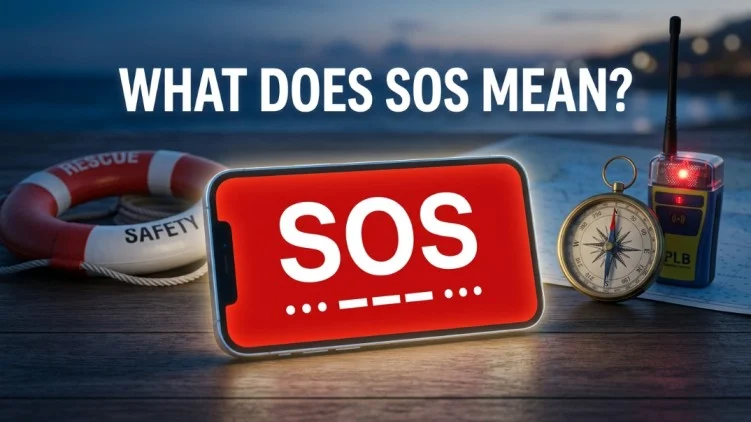
If you’ve ever received a text message, seen a social media post, or watched a movie where someone uses the term SOS, you might have wondered what it actually means. Unlike many internet slang terms that have emerged recently, SOS has a long and fascinating history that spans over a century. Its meaning has evolved from a specific maritime distress signal to a versatile expression used in everyday digital communication.
Understanding the full meaning of SOS is important because it appears in so many different contexts. Some people use it seriously to indicate genuine emergencies, while others use it casually and humorously in text messages and social media posts. Knowing the difference between these uses can help you interpret messages correctly and respond appropriately in various situations.
This guide explains what does SOS mean, where it came from, how it has evolved over time, why people use it in different ways, and when you should and shouldn’t use it yourself. You will also find examples, comparisons with similar expressions, professional alternatives, common mistakes, FAQs, and practical tips for using SOS effectively in your daily communication.
What Does SOS Mean? Meaning & Definition
SOS is one of the most recognized signals in the world. It is most commonly known as a distress signal used to request immediate help in emergency situations. The letters themselves do not actually stand for any specific words, despite popular beliefs that they mean “Save Our Souls” or “Save Our Ship.” In reality, SOS was chosen simply because its Morse code sequence, three dots, three dashes, three dots, is easy to remember and transmit.
In modern usage, SOS has taken on broader meanings beyond its original emergency context. People now use it in text messages, social media posts, and everyday conversations to express a wide range of emotions from genuine distress to playful exaggeration. The acronym has become a versatile tool for communication in the digital age.
The phrase is commonly used in:
Emergency situations and distress calls
Text messages and SMS communication
Social media posts and comments
Email subject lines
Casual conversations among friends
Professional communication in certain fields
Gaming communities and online chats
Customer service and support requests
Because SOS has such a long history and multiple meanings, understanding the context is essential for interpreting its intended message correctly.
Definition
| Term | Meaning |
|---|---|
| SOS | An international distress signal originally used in Morse code. It does not stand for any specific words. In modern usage, it can also mean “Save Our Souls” or be used casually to ask for help or express frustration. |
Pronunciation: Ess-Oh-Ess
Origin
The origin of SOS dates back to the early 20th century and the development of maritime communication. The signal was officially adopted as the international distress signal at the second International Radiotelegraphic Convention in 1906, and it went into effect on July 1, 1908.
Several key facts about its origin:
The signal was chosen for its simplicity in Morse code. The sequence of three dots, three dashes, and three dots, written as “… — …” is easy to send and recognize even in poor conditions.
Contrary to popular belief, SOS does not stand for “Save Our Souls” or “Save Our Ship.” These interpretations were created later and became widely known through popular culture, but they were not the original meaning.
The signal replaced older distress calls like CQD, which was used by the Marconi Company. SOS became the standard because it was easier to remember and transmit under stressful conditions.
The use of SOS became famous worldwide after the sinking of the Titanic in 1912, when the ship’s radio operators used both CQD and SOS distress signals. This event cemented SOS in public consciousness as the ultimate call for help.
Over time, SOS evolved from a purely maritime signal to a general symbol of distress used in various fields including aviation, emergency services, and ultimately everyday communication.
Popularity
SOS has maintained its popularity for over a century because of its simplicity and universal recognition. Several factors have contributed to its enduring presence in global culture:
Historical Significance
The signal’s role in maritime history and major events like the Titanic disaster gave it lasting cultural importance.
Universal Recognition
SOS is recognized across languages and cultures as a signal for help, making it a truly global symbol.
Adaptability
The term has proven adaptable, moving from Morse code to spoken language to digital communication.
Pop Culture References
Movies, television shows, music, and literature have consistently used SOS, keeping it familiar to new generations.
Morse Code Legacy
Even as Morse code use declined, the SOS signal remained a cultural touchstone that people continue to recognize.
Digital Communication
The rise of texting and social media gave SOS new life as a casual expression of needing help or support.
The signal’s ability to cross generations and communication mediums has ensured its continued relevance in the modern era.
Where You May See SOS
| Platform | Common Usage |
|---|---|
| Text Messages | Asking for help, expressing overwhelm, making requests |
| Social Media | Posts asking for advice, expressing frustration, seeking support |
| Urgent requests, customer support, emergency notifications | |
| Gaming | Asking for backup, expressing frustration, coordinating teams |
| Emergency Services | Official distress signals, emergency alerts |
| Movies and TV | Dramatic scenes, rescue situations, character crises |
| Music | Song titles, lyrics expressing emotional distress |
How It Is Used
SOS is used in multiple ways depending on the context and the relationship between communicators. The intended tone ranges from extremely serious to completely casual.
Serious Emergency Tone 🆘
Used in genuine life-threatening situations.
Example:
“MAYDAY MAYDAY SOS, the ship is sinking, need immediate rescue.”
Urgent But Not Life-Threatening Tone
Used for urgent requests that are not emergencies.
Example:
“SOS, I locked myself out of my apartment and need a spare key.”
Casual Help Request Tone 🙋
Used when asking for assistance in everyday situations.
Example:
“SOS, anyone know how to fix a broken phone screen?”
Humorous and Playful Tone 😂
Used to exaggerate minor problems or express frustration humorously.
Example:
“SOS, my coffee maker broke and I haven’t had caffeine yet.”
Ironic Tone
Used to mock dramatic situations or self-deprecating humor.
Example:
“SOS, my battery is at 5% and there’s no charger in sight.”
Examples
Serious Examples
These examples show SOS used for genuine emergencies or urgent situations.
“The climber activated his emergency beacon and sent an SOS signal from the mountain.”
“The pilot declared an emergency and transmitted the SOS distress call.”
“When the hikers got lost in the wilderness, they used their satellite device to send an SOS.”
Casual Examples
These examples demonstrate how people use SOS in everyday communication.
“SOS, I need a ride to work because my car won’t start.”
“SOS, does anyone have a printer I can use? I need to print something urgently.”
“SOS, I forgot my wallet and I am already at the checkout counter.”
Humorous Examples
Internet culture often exaggerates the use of SOS for comedic effect.
- “SOS, I opened my fridge and there is nothing but condiments.”
- “SOS, my alarm clock failed me and now I am running late for everything.”
- “SOS, I have to adult today and I am not prepared for this.”
Professional Examples
SOS should be used sparingly in professional settings. For routine professional communication, consider these alternatives instead:
“I urgently need assistance with this matter.”
“Could I request immediate support on this project?”
“I require your help with a time-sensitive issue.”
“This is a priority matter that needs attention.”
“Your immediate response would be appreciated.”
Comparison with Similar Terms
Many terms express the need for help or convey urgency. Here is how SOS compares.
| Term | Meaning | Urgency Level | Typical Context |
|---|---|---|---|
| SOS | Distress signal or call for help | Very high to casual | Emergencies, casual requests |
| HELP | Request for assistance | Moderate to high | General help requests |
| MAYDAY | International distress call | Extremely high | Life-threatening emergencies |
| PAN PAN | Urgent but not emergency | High | Urgent situations |
| HELP ME | Direct plea for assistance | High | Personal emergencies |
| NEED BACKUP | Request for support | Moderate | Gaming, work situations |
| URGENT | Time-sensitive request | High | Professional communication |
| ASAP | As soon as possible | Moderate | Professional and casual |
| I NEED HELP | Clear request | Moderate to high | General situations |
SOS stands out among these terms because it carries historical weight and universal recognition that few other expressions can match.
Alternate Meanings
While SOS is primarily known as a distress signal, it has acquired several alternate meanings over the years through popular culture and common usage.
Save Our Souls
This is the most common alternate interpretation, popularized through movies, books, and oral tradition. Although historically inaccurate, this meaning has become widely accepted.
Save Our Ship
Another popular interpretation that specifically references maritime emergencies. This meaning also emerged from cultural usage rather than official designation.
Same Old Stuff
A humorous reinterpretation used in casual conversation to express boredom or monotony.
Sense of Security
Used in some psychological and self-help contexts to describe emotional needs.
SOS in Music
The term has been used as song titles and lyrics, often representing emotional distress or a plea for help in relationships.
SOS in Branding
Some companies and organizations use SOS in their names or product lines, usually emphasizing reliability or assistance.
When encountering SOS, always consider the context to determine which meaning is intended.
Professional or Polite Alternatives
If you need to request help or express urgency in professional or formal settings, there are more appropriate alternatives.
| Situation | Better Alternative |
|---|---|
| Formal workplace | “I require immediate assistance.” |
| Professional email | “Your urgent attention to this matter is appreciated.” |
| Customer service | “I need support with the following issue.” |
| Academic setting | “I request guidance on this assignment.” |
| Medical context | “This requires immediate medical attention.” |
| Legal context | “I need urgent legal consultation.” |
| Technical support | “I am experiencing a critical system issue.” |
These alternatives communicate urgency without being overly dramatic or informal.
Common Mistakes
Many people misunderstand or misuse SOS. Here are the most common mistakes.
Using It Casually in Serious Contexts
Using SOS humorously in situations where genuine distress might be expected can create confusion and cause unnecessary alarm.
Not Clarifying the Context
When using SOS casually, adding context helps prevent misunderstandings about the seriousness of your message.
Assuming Everyone Knows the Signal
While SOS is widely recognized, not everyone may understand its various modern interpretations.
Using It Too Frequently
Overusing SOS for minor issues diminishes its impact and can make people take your serious requests less seriously.
Confusing It with Other Signals
Some people confuse SOS with other distress signals like MAYDAY, which has a much higher urgency level and is reserved for life-threatening emergencies.
Ignoring Cultural Differences
In some cultures, SOS is taken very seriously and using it casually may be considered inappropriate or offensive.
Using It in Formal Writing
SOS is generally inappropriate for formal writing and professional documentation.
Quick Tips
Keep these practical guidelines in mind when using or interpreting SOS.
Understand the original meaning of SOS as a distress signal.
Recognize that casual usage has become common in digital communication.
Always consider the context before interpreting or using SOS.
Use SOS seriously in genuine emergencies.
Add context when using SOS casually to prevent misunderstandings.
Avoid overusing SOS for minor inconveniences.
Choose professional alternatives for formal situations.
Be aware that some people may take SOS literally regardless of context.
When in doubt, use clearer language to express your needs.
FAQ
What does SOS stand for?
Despite popular belief, SOS does not officially stand for anything. It was chosen as a distress signal because its Morse code sequence, three dots, three dashes, three dots, is simple and recognizable. Over time, people have interpreted it as “Save Our Souls” or “Save Our Ship.”
What does SOS mean in texting?
In texting and casual digital communication, SOS is often used to ask for help, express urgency, or exaggerate a minor problem. It can mean anything from “I need assistance” to “I am completely overwhelmed” depending on the context.
Is SOS an emergency signal?
Yes, SOS is officially recognized as an international distress signal. It should be used only in genuine emergency situations where immediate help is needed.
Can I use SOS casually?
Yes, many people use SOS casually in text messages, social media posts, and informal conversations. However, it is important to provide context so others understand the seriousness of your message.
When should I not use SOS?
Avoid using SOS in professional documents, formal emails, academic writing, or any situation where your message might be misinterpreted as a genuine emergency.
What is the difference between SOS and MAYDAY?
SOS is a distress signal that can be transmitted through various means including Morse code and visual signals. MAYDAY is a spoken distress call used in voice communication. MAYDAY is considered more urgent and is reserved for life-threatening emergencies.
Why is SOS so well known?
SOS became well known through its use in maritime history, particularly the Titanic disaster, as well as its widespread representation in movies, television, music, and literature.
What are polite alternatives to SOS?
Polite alternatives include “I need assistance,” “Your help would be appreciated,” “I require support,” “This is a priority,” and “Your immediate attention to this matter would be valued.”
Conclusion
SOS has evolved significantly from its origins as a maritime distress signal to become a versatile expression used across multiple communication contexts. The signal was officially adopted in 1906 for its simple Morse code sequence of three dots, three dashes, and three dots. Contrary to popular belief, SOS does not stand for “Save Our Souls” or “Save Our Ship,” though these interpretations have become widely accepted through cultural usage.
In modern times, SOS serves dual purposes. It remains a serious distress signal in genuine emergencies while also functioning as a casual expression of needing help or support in everyday communication. Text messages, social media posts, and casual conversations frequently use SOS to request assistance, express frustration, or exaggerate minor problems humorously. Understanding the context is essential for interpreting whether SOS is being used seriously or casually.
Discover More Post:
- What Does Sigma Mean| Complete Meaning, Origin, Usage …
- What Does PMO Mean| Complete Meaning, Origin, Usage …
- What Does Huzz Mean| Complete Meaning, Origin, Usage …