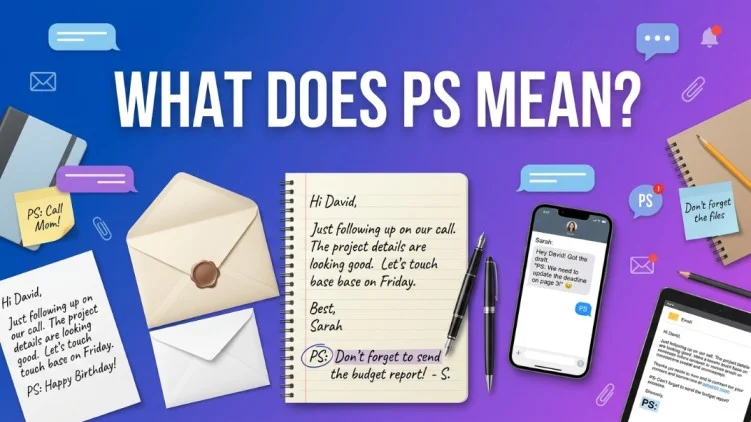
You have probably noticed PS at the bottom of an email, a handwritten letter, or even a marketing message and wondered why it appears after everything else has already been said. While it may look like a small addition, it often becomes one of the most memorable parts of a message.
The meaning of what does PS mean is surprisingly simple, yet its purpose has evolved over time. Originally, writers used it when they remembered something after signing a letter. Today, PS has become a communication tool used to emphasize important details, add a personal touch, make readers smile, or encourage action.
You’re reading an email from your boss, receiving a birthday card, or browsing promotional emails, understanding how PS works can help you communicate more naturally and professionally.
What Does PS Mean? Meaning & Definition
The abbreviation PS means Postscript, a Latin derived term that literally translates to “written after.” It appears after the main body of a message and usually follows the writer’s signature in letters or the closing line in emails.
Today, PS is used far beyond traditional handwritten letters. You’ll frequently see it in:
- Emails
- Business correspondence
- Text messages
- Marketing emails
- Newsletters
- Social media captions
- Personal notes
- Greeting cards
Although PS originally served as a way to add forgotten information, modern writers often use it intentionally to draw attention to an important point.
Quick Meaning Table
| Term | Meaning | Common Use |
|---|---|---|
| PS | Postscript | Extra note after the main message |
| P.S. | Alternative punctuation style | More traditional writing |
| PS: | Modern informal format | Emails and online messages |
Origin
The abbreviation PS comes from the Latin phrase:
Post Scriptum
- Post = After
- Scriptum = Written
Together, they mean “written after.”
Before computers and word processors existed, people wrote letters entirely by hand. If the writer remembered something after signing the letter, rewriting the whole page was inconvenient. Instead, they simply added a PS below the signature.
For example:
Best wishes,
Sarah
PS: I forgot to tell you that the meeting starts at 10 AM.
Over time, this writing habit became a standard part of personal and professional communication.
Popularity
Even though editing digital documents is incredibly easy today, PS remains widely used.
Its popularity continues because it naturally grabs attention. Studies in email marketing have shown that readers often notice the PS section almost immediately because it stands apart from the rest of the message.
You’ll commonly find PS in:
- Business emails
- Sales promotions
- Newsletters
- Personal letters
- Greeting cards
- Educational emails
- Customer support messages
- Social media announcements
Many marketers intentionally place discounts, deadlines, or reminders in the PS because readers frequently scan it before reading everything else.
How It Is Used
The purpose of PS depends on the situation.
To Add Forgotten Information
This is the original use.
Example:
PS: I forgot to send the attachment earlier.
To Highlight Important Information
Example:
PS: Registration closes tonight!
To Add a Personal Touch
Example:
PS: Tell your family I said hello!
To Encourage Action
Businesses often write:
PS: Don’t miss your 20% discount before midnight.
To Add Humor
Example:
PS: Yes, I really did eat the last slice of pizza. 🍕
In Digital Communication
Although editing is easy today, writers still intentionally use PS because it feels conversational and naturally attracts attention.
Examples
Friendly Examples
Here are everyday examples you might send to friends or family.
| Message | Tone |
|---|---|
| PS: Can’t wait to see you tomorrow! 😊 | Friendly |
| PS: Bring your camera! | Helpful |
| PS: Thanks again for everything. ❤️ | Appreciative |
| PS: Don’t forget the snacks! | Casual |
| PS: Your dog is adorable! | Warm |
Professional Examples
These examples work well in business settings.
| Message | Purpose |
|---|---|
| PS: Please review the attached report before Friday. | Reminder |
| PS: Feel free to contact me with questions. | Supportive |
| PS: Registration closes on August 20. | Deadline |
| PS: Thank you for your continued partnership. | Appreciation |
| PS: The updated schedule is attached. | Additional information |
Funny Examples
Sometimes PS simply adds personality.
| Example | Tone |
|---|---|
| PS: Coffee deserves employee benefits too. ☕ | Funny |
| PS: I promise I’m almost on time. | Playful |
| PS: My cat approved this email. 🐱 | Humorous |
| PS: Ignore the typo… if you can find it. | Lighthearted |
| PS: This message self-destructs in your imagination. | Silly |
Comparison with Similar Terms
People often confuse PS with other abbreviations.
| Abbreviation | Meaning | When Used |
|---|---|---|
| PS | Postscript | Extra information after the message |
| PPS | Post-Postscript | Another note after the PS |
| FYI | For Your Information | Sharing useful information |
| NB | Nota Bene | Drawing attention to an important point |
| TL;DR | Too Long; Didn’t Read | Summary before or after long content |
| BTW | By The Way | Casual transition during conversation |
PS vs PPS
| PS | PPS |
|---|---|
| First additional note | Second additional note |
| Most common | Less common |
| Used frequently | Used occasionally |
Example:
PS: I attached the document.
PPS: Congratulations on your promotion!
Alternate Meanings
Although Postscript is the most common meaning, PS can represent different things depending on the context.
| Meaning | Context |
|---|---|
| Postscript | Writing, emails, letters |
| PlayStation | Gaming |
| Public School | Education (UK) |
| Photosynthesis | Biology |
| Pferdestärke | German horsepower measurement |
| PostScript | Adobe page description language in computing |
| Political Science | Academic subject |
| Personal Statement | College admissions |
How to Identify the Correct Meaning
Context makes the meaning clear.
For example:
I bought a new PS.
Here, PS probably means PlayStation.
Meanwhile:
PS: Thanks for your support.
Here, it clearly means Postscript.
Professional or Polite Alternatives
In formal writing, PS is perfectly acceptable, but sometimes integrating the information into the main message is even better.
Instead of:
PS: Please submit your report by Friday.
You could write:
- As a reminder, please submit your report by Friday.
- Please note that the report is due Friday.
- Kindly remember to submit the report before Friday.
- Additionally, the report should be submitted by Friday.
- Before we conclude, please remember the Friday deadline.
These alternatives may feel smoother in highly formal documents.
Common Mistakes
Many people misuse PS without realizing it.
1. Using Too Many Postscripts
Poor example:
PS…
PPS…
PPPS…
This can make writing look cluttered.
2. Including Important Information Only in the PS
Critical instructions should appear in the main message as well.
3. Forgetting Consistency
Choose one style:
- PS:
- P.S.
Avoid mixing both styles in the same document.
4. Using PS Before the Main Message
PS always comes after the main message.
5. Overusing It
Every email doesn’t need a PS. Use it only when it genuinely adds value.
Quick Tips
Follow these best practices when using PS:
- Use PS to emphasize one important point.
- Keep it short and clear.
- Make it relevant to the main message.
- Avoid multiple postscripts whenever possible.
- Match the tone to your audience.
- Use PS for reminders, appreciation, humor, or calls to action.
- Don’t rely on PS for critical information that readers must not miss.
- In business emails, keep the wording professional and concise.
FAQ
What does PS stand for?
PS stands for Postscript, meaning something written after the main message has been completed.
Why do people use PS in emails?
People use PS to highlight reminders, forgotten information, important announcements, or calls to action.
Is PS still used today?
Yes. It remains common in emails, newsletters, greeting cards, marketing campaigns, and personal messages.
Should PS come before or after the signature?
Traditionally, PS appears after the signature or closing line.
What is the difference between PS and PPS?
PS is the first additional note, while PPS is an additional note written after the PS.
Is it professional to use PS?
Yes. A concise and relevant PS can make professional emails more engaging, especially when emphasizing reminders or important details.
Can I use PS in text messages?
Absolutely. Many people use PS casually in texts and online conversations to add an extra thought after finishing their message.
Example:
PS: Don’t forget your charger!
Is “P.S.” or “PS” correct?
Both are correct.
- P.S. is the traditional punctuation style.
- PS is more common in modern digital communication.
Conclusion
The answer to what does PS mean is simple: it stands for Postscript, an additional note written after the main body of a message. Although it originated centuries ago when handwritten letters couldn’t easily be edited, PS continues to thrive in modern communication because it naturally draws attention to important reminders, personal thoughts, humorous comments, and calls to action. You’re writing a professional email, sending a friendly note, or creating marketing content, using PS thoughtfully can make your message more memorable. Keep it brief, relevant, and purposeful, and you’ll communicate more effectively in both personal and professional settings.
Discover More Post:
What Does Bop Mean| Complete Meaning, Origin, Usage …
What Does Gooning Mean| Complete Meaning, Origin, Usage …
What Does TLDR Mean| Complete Meaning, Origin, Usage …