Quick Answer:
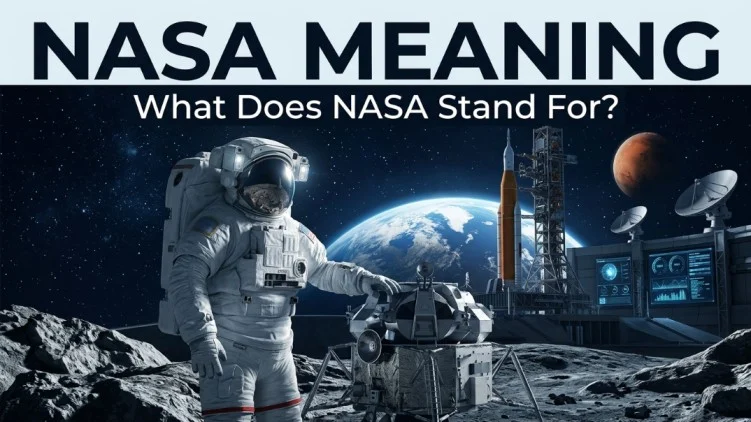
NASA stands for National Aeronautics and Space Administration, the U.S. government agency responsible for civilian space and aeronautics research.
In everyday conversations, “NASA” usually refers to space missions, astronauts, rockets, planets, and scientific discoveries.
Imagine looking up at the night sky and wondering how humans learned what is happening millions of miles beyond Earth. Much of that story leads back to four simple letters: NASA. You may have seen NASA mentioned in a news story, YouTube video, school lesson, social media post, science documentary, or even a casual conversation about space.
If you are a student, science fan, traveler, gamer, content creator, or simply someone who came across the word NASA and wondered what it means, understanding the term can make those conversations much easier to follow. NASA is far more than a name connected with astronauts and rockets. It is a major U.S. organization involved in space exploration, Earth science, aeronautics, and scientific research.
The NASA meaning is easy to remember once you know what each letter represents. In this guide, we will explain what NASA stands for, where the name came from, how the agency works, how people use the word online, and what you should know when you see it in different contexts.
Definition & Meaning
NASA stands for National Aeronautics and Space Administration.
It is a U.S. government agency that conducts civilian space and aeronautics research. NASA is widely known for human spaceflight, robotic missions, space telescopes, scientific discoveries, and research involving Earth and the atmosphere.
The acronym is pronounced:
NASA = “NA-suh”
It is normally treated as a name rather than pronounced letter by letter.
What does each letter mean?
| Letter | Word |
|---|---|
| N | National |
| A | Aeronautics |
| S | Space |
| A | Administration |
- The word aeronautics refers to the science and technology involved in flight through Earth’s atmosphere.
- The word space refers to NASA’s work beyond Earth’s atmosphere.
- The word administration reflects the organization’s role as a U.S. federal agency.
What does NASA actually do?
NASA works on many areas of science and technology, including:
- Human spaceflight
- Robotic space missions
- Planetary exploration
- Earth observation
- Astronomy
- Aeronautics research
- Space technology
- Scientific research
- Climate and atmospheric studies
For example, NASA has been involved in missions that study the Moon, Mars, the Sun, distant planets, galaxies, and Earth’s own environment.
Simple example
Student: “What does NASA mean?”
Teacher: “It stands for National Aeronautics and Space Administration.”
Student: “So NASA is the American space agency?”
Teacher: “Yes. It is the U.S. civilian agency responsible for space and aeronautics research.”
This is the most common meaning of NASA.
Background & History
NASA was established in 1958 in the United States.
Its creation came during a period when space exploration was becoming a major scientific and political focus. The Soviet Union had launched Sputnik 1 in 1957, the world’s first artificial satellite, which increased interest in American space research and technology.
NASA officially began operations on October 1, 1958.
It replaced the earlier National Advisory Committee for Aeronautics, commonly known as NACA. NACA had been created decades earlier to conduct research related to aviation and aeronautics.
NASA expanded that scientific mission into a much broader organization that included space exploration.
The Space Race
During the 1960s, NASA became a major part of the U.S. space program.
One of its most famous achievements was the Apollo program, which sent astronauts to the Moon.
The Apollo 11 mission became a historic moment in 1969 when astronauts Neil Armstrong and Buzz Aldrin became the first humans to walk on the Moon, while Michael Collins remained in lunar orbit.
The event brought NASA into homes around the world through television broadcasts.
NASA after Apollo
NASA’s work did not end with the Moon landings.
The agency later became involved in:
- The Space Shuttle program
- The International Space Station
- Mars exploration
- Space telescopes
- Earth science
- Asteroid research
- Lunar exploration
- Advanced aircraft research
NASA also developed and operated scientific spacecraft that transformed our understanding of the universe.
Today, NASA remains strongly associated with space exploration, but its work also includes studying Earth, developing aviation technologies, and supporting scientific research.
Usage in Various Contexts
The word NASA can appear in many different conversations.
1. Everyday Conversations
Someone might say:
“Did you see the NASA launch last night?”
They are referring to a NASA-related launch or mission.
Another person might say:
“NASA found something interesting on Mars.”
In casual speech, people often use NASA as a broad reference to the agency and its scientific discoveries.
2. Texting
In text messages, NASA is usually used in exactly the same way.
- Friend 1: “I just watched a NASA documentary.”
- Friend 2: “Was it about Mars?”
- Friend 3: “Yeah. It was really interesting.”
There is no special texting meaning required.
3. Social Media
NASA frequently appears in posts about:
- Rockets
- Astronauts
- The Moon
- Mars
- Solar eclipses
- Space photographs
- Black holes
- Earth images
- New discoveries
For example:
“NASA just shared an amazing image of space.”
Here, NASA refers to the organization.
4. School and Education
Students often encounter NASA in science classes.
Teacher: “NASA has sent several robotic spacecraft to Mars.”
Student: “How long does it take to reach Mars?”
This use is educational and factual.
5. Gaming
NASA can appear in games involving space exploration, spacecraft, planets, or futuristic technology.
A gamer might say:
“This spaceship looks like something from NASA.”
That does not necessarily mean NASA created the spaceship. It may simply mean the design reminds the speaker of real space technology.
6. Professional Settings
NASA is also used in scientific, engineering, educational, aviation, and government discussions.
For example:
“The research team used NASA satellite data.”
In this context, the acronym has its standard institutional meaning.
Common Misconceptions & Clarifications
Because NASA is such a famous name, people sometimes misunderstand what it represents.
Misconception 1: NASA only sends astronauts into space
NASA does support human spaceflight, but that is only one part of its work.
The agency also conducts research involving Earth, the atmosphere, aeronautics, planetary science, astronomy, and robotic missions.
Misconception 2: NASA only studies planets
NASA studies planets, but its scientific work is much broader.
Its missions can examine:
- Stars
- Galaxies
- The Sun
- Earth
- Asteroids
- Comets
- Planetary atmospheres
- Space weather
- The Moon
Misconception 3: NASA means “space agency”
This is a useful informal description, but it is not the literal expansion of the acronym.
The exact name is:
National Aeronautics and Space Administration
Misconception 4: NASA is a private company
NASA is a U.S. government agency, not a private aerospace company.
Private companies may work with NASA or provide services and technology for NASA missions, but NASA itself is a government organization.
Misconception 5: NASA only works in space
This is another common misunderstanding.
NASA also conducts research related to aeronautics and studies Earth using satellites and other scientific systems.
Similar Terms & Alternatives
NASA is sometimes mentioned alongside other space organizations, but these organizations are not the same thing.
ESA
ESA stands for European Space Agency.
It is an international organization involving European member countries.
SpaceX
SpaceX is a private aerospace company founded by Elon Musk.
It develops rockets, spacecraft, and other space technologies.
CNSA
CNSA stands for China National Space Administration.
It is China’s national space agency.
Roscosmos
Roscosmos is Russia’s state space corporation.
ISRO
ISRO stands for Indian Space Research Organisation.
It is India’s national space agency.
| Name | Full Name | Country or Region | Type |
|---|---|---|---|
| NASA | National Aeronautics and Space Administration | United States | Government agency |
| ESA | European Space Agency | Europe | International organization |
| CNSA | China National Space Administration | China | Government agency |
| ISRO | Indian Space Research Organisation | India | Government agency |
| Roscosmos | Roscosmos State Corporation | Russia | State corporation |
| SpaceX | Space Exploration Technologies Corp. | United States | Private company |
These organizations may cooperate on certain projects, but they have different structures, missions, and responsibilities.
How to Respond to This Term
If someone uses NASA in conversation, your response depends on what they are talking about.
Casual Response
Friend: “NASA is studying Mars again.”
You: “Yeah, Mars is fascinating. I wonder what they will discover next.”
Curious Response
If you do not know much about the topic, you can ask:
“What mission are you talking about?”
or:
“What did NASA discover?”
Funny Response
If your friend sends a space meme, you could say:
“NASA, please come get this guy. He has clearly left Earth. 😂”
Professional Response
In a professional or academic discussion, keep your response specific.
“NASA’s research in this area has provided valuable scientific data.”
Privacy-Conscious Response
If someone asks you for personal information because they are discussing NASA or space travel, you can simply say:
“I would rather not share personal details, but the science is interesting.”
The acronym itself does not require a special response. The subject of the conversation determines how you should reply.
Regional or Cultural Differences
NASA is an American organization, but the acronym is recognized internationally.
People in many countries know NASA because its missions have received global attention for decades.
The pronunciation can vary slightly depending on a speaker’s language and accent. English speakers commonly pronounce NASA as:
“NA-suh.”
In Spanish-speaking conversations, the acronym may still be recognized as NASA, although the surrounding sentence will follow Spanish grammar and pronunciation patterns.
For example:
“La NASA estudia Marte.”
This means:
“NASA studies Mars.”
In many languages, the organization keeps the acronym NASA even when the rest of the sentence is translated.
Cultural associations
Different cultures may associate NASA with different things.
For some people, NASA immediately brings to mind:
- The Moon landing
- Astronauts
- Space Shuttle missions
- Mars
- Space telescopes
For others, it may be associated with school science, satellite images, rockets, or popular science documentaries.
Because NASA has such a long history, the word can carry strong cultural associations beyond its literal name.
Comparison with Similar Terms
People often confuse NASA with other space-related terms.
| Term | What it means | Main difference |
|---|---|---|
| NASA | National Aeronautics and Space Administration | U.S. civilian space and aeronautics agency |
| ESA | European Space Agency | European international space organization |
| SpaceX | Space Exploration Technologies Corp. | Private aerospace company |
| ISS | International Space Station | A space station, not an agency |
| NACA | National Advisory Committee for Aeronautics | Organization that preceded NASA |
| Astronaut | Person trained for spaceflight | A person, not an organization |
| Space agency | General term | Describes an organization involved in space activities |
One important distinction is between NASA and the ISS.
The ISS is a spacecraft and research facility in orbit around Earth. NASA has been one of the major partners involved in the International Space Station, but NASA itself is not the station.
Another important distinction is between NASA and an astronaut.
An astronaut is a person who may travel into space. NASA is the organization.
Usage in Online Communities & Dating Apps
The acronym NASA is common online because space content performs well across many types of communities.
On platforms such as X, Instagram, TikTok, Reddit, YouTube, Discord, and Facebook, people may use NASA when discussing launches, discoveries, space photographs, science news, or space-related jokes.
Social Media Example
User 1: “NASA’s space images are unreal.”
User 2: “Seriously. Some of them look like science fiction.”
Gaming Example
Player 1: “This game has some serious NASA vibes.”
Player 2: “The spacecraft design is incredible.”
Here, NASA is being used as a cultural reference for advanced space technology.
Dating Apps
NASA can occasionally appear in dating profiles, especially when someone lists science, astronomy, engineering, or space as an interest.
For example:
“Coffee, astronomy, and NASA documentaries.”
Someone might respond:
“Okay, important question. Moon or Mars?”
In this setting, NASA is simply an interest or conversation starter.
There is no standard romantic or secret dating meaning for NASA.
If someone uses NASA in a dating profile, read it according to the surrounding text instead of assuming it has a hidden meaning.
Hidden or Offensive Meanings
In standard English, NASA does not have a commonly recognized offensive meaning.
The normal meaning is the U.S. National Aeronautics and Space Administration.
However, people can sometimes turn ordinary words or acronyms into jokes, memes, nicknames, or private references. If you see NASA used strangely online, the surrounding conversation may explain what the person means.
Why context matters
Consider these two examples:
“NASA released a new image.”
This is a normal factual statement.
“Bro needs NASA to find his brain. 😂”
This is a joke using NASA as a reference to space exploration.
The acronym itself has not changed meaning. The speaker is simply using it creatively.
You may also see NASA in conspiracy discussions, memes, parody posts, or fictional stories. Those contexts do not automatically change the official meaning of the acronym.
If you are unsure, look at the surrounding words before deciding what the person means.
Suitability for Professional Communication
NASA is completely appropriate in professional communication when you are referring to the organization.
It can appear in:
- Research papers
- News reports
- Academic assignments
- Business presentations
- Scientific discussions
- Government documents
- Educational materials
- Engineering reports
For example:
“NASA developed the mission in collaboration with several scientific partners.”
A professional writer should use the full name when introducing the organization for the first time in a formal document:
National Aeronautics and Space Administration (NASA)
After that, NASA can normally be used throughout the document.
Professional alternatives
If you are writing about the broader subject rather than NASA specifically, you might use:
- Space agency
- U.S. space agency
- Aerospace agency
- Space research organization
- Government space agency
However, these are not exact replacements for NASA.
If your sentence refers specifically to NASA, using NASA is clearer and more accurate.
FAQs
What does NASA stand for?
NASA stands for National Aeronautics and Space Administration, the U.S. government agency responsible for civilian space and aeronautics research.
What is the simple meaning of NASA?
In simple terms, NASA is the U.S. civilian government agency that conducts space, science, and aeronautics research.
Is NASA a company?
No. NASA is a U.S. government agency. Private aerospace companies may work with NASA, but they are separate organizations.
What does the A in NASA stand for?
The first A stands for Aeronautics. The final A stands for Administration.
How do you pronounce NASA?
NASA is commonly pronounced “NA-suh,” rather than saying each letter separately.
Is NASA only about space?
No. NASA also works on aeronautics, Earth science, astronomy, atmospheric research, and other scientific and technological projects.
Is NASA used as slang?
NASA is not normally slang. It is an acronym and proper name for the National Aeronautics and Space Administration. People may use it creatively in jokes or memes, but that does not create a standard slang meaning.
Conclusion
The NASA meaning is simple once you know the full name. NASA stands for National Aeronautics and Space Administration, the U.S. government agency responsible for civilian space and aeronautics research.
Although many people immediately think of astronauts, rockets, and the Moon, NASA’s work reaches much further. The agency studies Earth, explores other worlds, supports scientific research, develops new technologies, and helps expand our understanding of the universe.
You may encounter NASA in school lessons, news reports, social media posts, documentaries, gaming conversations, dating profiles, and professional discussions. In nearly all of these situations, the acronym keeps its standard meaning.
So when someone mentions NASA, think beyond just rockets. Think space exploration, science, research, technology, Earth, and the search for a better understanding of our universe.
Discover More Post:
- Blunt Meaning | What Does “Blunt” Really Mean? Simple …
- Susurrus Meaning | The Beautiful Word for a Soft, Whispering …
- Missus Meaning | What Does “Missus” Mean in 2026