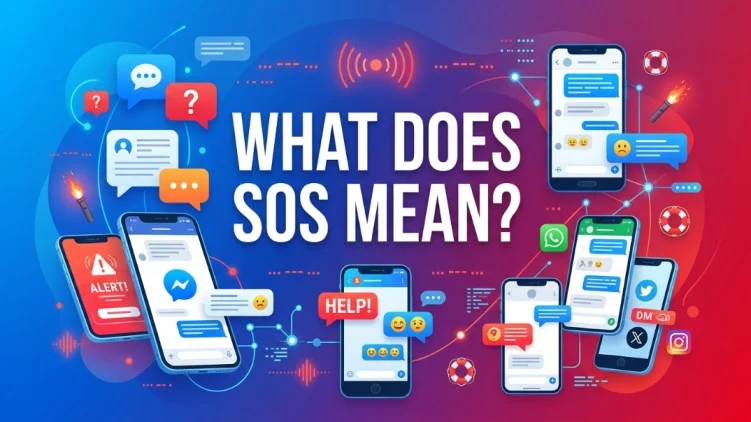
Receiving a message that simply says “SOS” can instantly grab your attention. Most of the time, it signals that someone needs urgent help or immediate assistance, but the exact meaning depends on the conversation and situation. Understanding what does SOS mean can help you respond appropriately, whether you’re texting a friend, chatting online, or using social media.
While SOS has been associated with emergencies for many years, people also use it humorously to ask for help with everyday problems. In this guide, you’ll learn the SOS meaning in text, its full form, alternative uses, platform-specific meanings, conversation examples, suitable replies, and common mistakes to avoid.
What Does SOS Mean?
The most common answer to what does SOS mean is a universal distress signal used to request urgent help or assistance.
| Detail | Explanation |
|---|---|
| Most Common Meaning | Request for urgent help |
| Full Form | No official phrase; commonly associated with the Morse code distress signal “SOS” |
| Tone | Serious or playful, depending on context |
| Common Platforms | Text messages, WhatsApp, Snapchat, Instagram, Discord |
| Formal or Informal | Mostly informal in chats but recognized universally for emergencies |
In everyday texting, people often use SOS to say they need help, support, or advice—even when the situation isn’t an actual emergency.
The Main Meaning of SOS
SOS is internationally recognized as an emergency distress signal. Contrary to a common myth, it does not officially stand for “Save Our Ship” or “Save Our Souls.” Those phrases became popular later, but the signal itself was chosen because it is easy to transmit and recognize in Morse code.
In text conversations, SOS usually means:
- I need help.
- Please respond quickly.
- I’m in trouble.
- I need your assistance.
Example:
Friend: “SOS! I forgot my presentation at home.”
Here, the sender isn’t facing a life-threatening emergency. They’re urgently asking for help before class begins.
[Internal Link: Add a related slang article here]
Alternative Meanings of SOS
Although requesting help is by far the most common meaning, SOS can have a few other legitimate interpretations depending on the setting.
| Meaning | Context | Tone | Example |
|---|---|---|---|
| Emergency distress signal | Real emergencies | Serious | “Send SOS immediately.” |
| Need help urgently | Texting friends | Casual | “SOS, my laptop won’t turn on!” |
| Dramatic request for assistance | Social media | Funny | “SOS, I spent my whole paycheck.” |
Most people will understand SOS as a call for help, whether the problem is serious or simply frustrating.
How Context Changes the Meaning
The surrounding conversation almost always reveals whether SOS is meant seriously or jokingly.
Consider these examples:
Example 1
“SOS! I locked my keys in the car.”
Meaning: The sender genuinely needs assistance.
Example 2
“SOS 😂 I accidentally watched an entire TV series instead of studying.”
Meaning: They’re joking about their situation.
Example 3
“SOS. Please call me as soon as you can.”
Meaning: The message sounds urgent and should be taken seriously.
Things that influence the meaning include:
- Previous messages
- Emojis
- Punctuation
- Relationship with the sender
- Timing of the message
- Overall conversation topic
A laughing emoji usually softens the urgency, while a short standalone “SOS” without emojis often feels much more serious.
SOS Meaning on Different Platforms
The meaning stays fairly consistent across most online platforms.
Text Messages and WhatsApp
SOS almost always means someone wants immediate help or a quick response.
Example:
“SOS! Can you pick me up?”
Tone: Urgent but often casual.
Snapchat and Instagram
On social media, SOS frequently appears in captions, stories, or direct messages to exaggerate a problem for humor.
Example:
“SOS—I can’t stop buying coffee.”
Tone: Playful or dramatic.
Discord and Gaming Chats
Players may use SOS when they need teammates immediately.
Example:
“SOS! Need backup at the base.”
Tone: Urgent within the game.
Real Conversation Examples
Friends
Person A: “SOS! My car won’t start.”
Person B: “Where are you?”
Meaning: A genuine request for help.
Family
Person A: “SOS, I forgot my wallet.”
Person B: “I’ll bring it.”
Meaning: Asking for practical assistance.
Group Chat
Person A: “SOS 😂 I burned dinner again.”
Person B: “Order pizza!”
Meaning: A humorous complaint.
Workplace
Person A: “SOS—I can’t open the project file.”
Person B: “Send it over.”
Meaning: Requesting technical help.
Gaming
Person A: “SOS! Enemy team is pushing.”
Person B: “On my way.”
Meaning: Calling teammates for immediate support.
[Internal Link: Add a related slang article here]
Tone and Emotional Meaning
SOS can express different emotions depending on the situation.
Is SOS Rude?
No. SOS is generally not considered rude. It simply asks for help, although repeatedly using it for minor issues may annoy people.
Is SOS Funny?
Yes. Friends often use SOS dramatically for small everyday frustrations.
Examples include:
- “SOS, my Wi-Fi keeps disconnecting.”
- “SOS 😂 I can’t choose what to wear.”
Is SOS Serious?
Absolutely. When someone sends SOS without jokes, emojis, or additional context, it’s wise to respond promptly because they may genuinely need assistance.
How to Reply to SOS
Your response should match the urgency of the message.
Friendly Replies
- “What’s going on?”
- “How can I help?”
- “I’m here. Tell me what happened.”
- “Do you need me to come over?”
Funny Replies
- “Emergency snacks on the way!”
- “Captain Rescue reporting for duty!”
- “What’s today’s crisis? 😂”
Replies When You’re Unsure
- “Everything okay?”
- “Do you need help right now?”
- “Should I call you?”
If the message seems genuinely urgent, replying quickly—or calling the person—is usually the best choice.
When to Use SOS
SOS works well when:
- You genuinely need assistance.
- You’re texting close friends.
- You’re chatting with family.
- You’re asking for quick help in group chats.
- You’re joking about a stressful situation.
- You’re requesting backup during online games.
People generally understand its meaning immediately, making it useful when speed matters.
When to Avoid Using SOS
Avoid using SOS in situations where the wording could cause unnecessary panic.
Examples include:
- Professional emails
- Job applications
- Business communication
- Academic papers
- Official announcements
Also avoid jokingly sending SOS to people who may interpret it as a real emergency.
Common Mistakes
| Common Mistake | Correct Understanding |
|---|---|
| Thinking SOS officially means “Save Our Souls” | It is an internationally recognized distress signal without an official phrase. |
| Assuming every SOS is life-threatening | Many people use it humorously. |
| Ignoring context | Emojis and conversation reveal the intended meaning. |
| Using SOS in formal writing | Clear language is usually better. |
Similar Slang Terms
| Term | Meaning | Main Difference |
|---|---|---|
| ASAP | As soon as possible | Focuses on speed, not distress |
| HELP | Direct request | More explicit than SOS |
| BRB | Be right back | Indicates temporary absence |
| FYI | For your information | Shares information instead of requesting help |
| LMK | Let me know | Requests information rather than assistance |
Origin and Popularity
SOS became the internationally recognized Morse code distress signal because its pattern is easy to send and identify. Although many people associate it with phrases like “Save Our Ship” or “Save Our Souls,” those are unofficial backronyms created after the signal became widely known.
Today, its original emergency meaning remains important, while online conversations have expanded its use to include urgent everyday requests and humorous exaggeration.
Quick Recap
- SOS is most commonly used to request urgent help.
- It does not officially stand for “Save Our Ship” or “Save Our Souls.”
- Context determines whether the message is serious or playful.
- It is widely used in texting, social media, and gaming.
- Respond quickly if the message appears to describe a real emergency.
Frequently Asked Questions
What does SOS mean in text?
It usually means someone urgently needs help, assistance, or a quick response from the person receiving the message.
What does SOS stand for?
SOS has no official word-based full form and is an internationally recognized Morse code distress signal.
What does SOS mean on Snapchat?
It generally means someone needs help or is humorously exaggerating a stressful situation in a casual conversation.
How should you reply to SOS?
Respond quickly by asking what happened and offering help if the message appears serious or urgent.
Can SOS have different meanings?
Yes, while it mainly signals a request for help, many people also use it humorously for everyday problems.
Final Thoughts
Understanding what does SOS mean helps you recognize when someone genuinely needs assistance and when they’re simply joking about a stressful moment. The term almost always communicates a request for help, but its emotional tone depends on the surrounding conversation, emojis, and your relationship with the sender. When you’re unsure, it’s safest to respond with concern and ask for clarification. Used thoughtfully, SOS remains one of the clearest and most widely recognized ways to signal that help or at least a helping hand is needed.
Discover More Post:
What Does ISTG Mean| Complete Meaning, Origin, Usage …
What Does Hawk Tuah Mean| Complete Meaning, Origin …