A friend once sent me a long message packed with details about a movie, and just beneath it was a simple “TL;DR” followed by a one-line summary. That tiny abbreviation instantly made the conversation easier to follow. Moments like that explain why people often search for what does TLDR mean after spotting it in texts, social media comments, emails, or online forums where quick communication matters.
The interesting thing about internet slang is that even the shortest expressions can carry more meaning than they first appear to. While what does TLDR mean usually points to a brief summary, the way people use it can change depending on the platform, audience, or tone of the conversation. Seeing it in different real-life situations makes the expression much easier to understand, and the examples ahead show exactly how it fits naturally into everyday online communication.
What Does TLDR Mean? Meaning & Definition
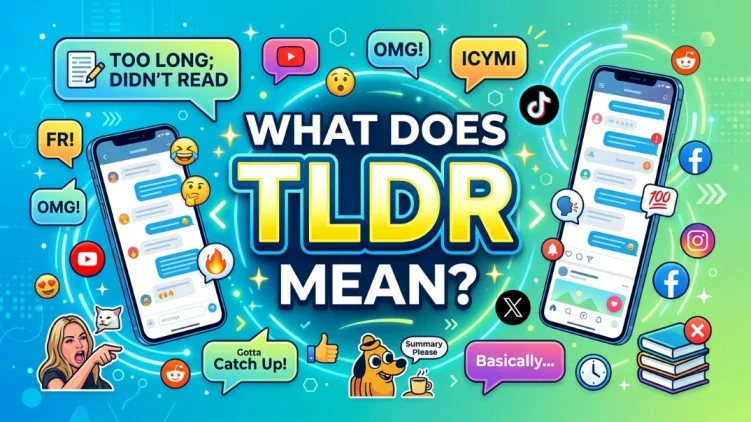
TLDR is an internet slang acronym that most commonly stands for “Too Long; Didn’t Read.” It is used to indicate that a piece of text was too lengthy and the reader did not finish it. Alternatively, it can be used to provide a brief summary of a longer post, article, or comment for those who don’t want to read the entire thing.
The phrase is commonly used in:
Reddit posts and comments
TikTok video descriptions
Instagram captions
X (Twitter) replies
Discord server conversations
Online forums and discussion boards
Email subject lines
Blog posts and articles
Because the abbreviation is so widely recognized, it has become an essential part of internet communication, serving both as a reaction and as a helpful summarization tool.
Definition
| Term | Meaning |
|---|---|
| TLDR | Internet slang meaning “Too Long; Didn’t Read.” It is used to indicate that text was too lengthy to read or to provide a brief summary of longer content. |
Pronunciation: Usually said as individual letters: T-L-D-R. Some people say it as one word: “tilder.”
Origin
The exact origin of TLDR can be traced back to the early days of internet forums and message boards. The acronym emerged organically in online communities where lengthy posts were common and readers often didn’t have the time or patience to read everything.
Several key points about its history:
The term gained traction in the early 2000s on platforms like Reddit, Something Awful, and various internet forums. Users began using “TL;DR” as a shorthand response to indicate they hadn’t read a long post. Over time, the meaning evolved to include providing summaries.
The term gained broader recognition through several key developments:
Early internet forums and message boards
Reddit’s growing popularity
Blogging culture and long-form content
Social media platforms encouraging brevity
Email communication in professional settings
Widespread adoption across all internet platforms
Like many internet acronyms, TLDR spread through reposts, memes, and everyday usage rather than originating from one specific creator. It has become so ubiquitous that it is now recognized far beyond its original internet forum context.
Popularity
TLDR became exceptionally popular because it addresses a fundamental challenge of the internet age: information overload. With so much content available, readers often don’t have time to read everything, and writers often need to summarize.
Several factors contributed to its widespread recognition:
Information overload on the internet
Reddit’s massive user base
Blogging and long-form content
Social media platforms and character limits
Need for quick summaries
Email communication culture
Professional and academic usage
Easy to remember and use
The acronym has become so ingrained in online culture that it is now used in professional emails, academic articles, and even traditional media. Its versatility as both a reaction and a summary tool has cemented its place in digital communication.
Where You May See TLDR
| Platform | Common Usage |
|---|---|
| Post summaries, comment reactions | |
| TikTok | Video descriptions, captions |
| Captions, story summaries | |
| X (Twitter) | Thread summaries, replies |
| Discord | Summary of long conversations |
| Subject lines, executive summaries | |
| Blog Posts | Summaries at beginning or end |
| Forums | Summarizing long discussions |
How It Is Used
TLDR is used in two primary ways depending on context. The intended meaning depends heavily on how it is being applied.
Summary Tone 📝
Used to provide a brief summary of longer content.
Example:
“TLDR: The movie was amazing and you should watch it.”
Reaction Tone 🙄
Used to indicate that something was too long to read.
Example:
“That post was way too long. TLDR.”
Humorous Tone 😂
Used jokingly to summarize something that doesn’t need summarizing.
Example:
“TLDR: I ate food and it was good.”
Dismissive Tone 😒
Used to dismiss content as too long and not worth reading.
Example:
“TLDR, can someone give me the short version?”
Examples
Summary Examples
These examples show how TLDR is used to provide summaries.
- “TLDR: The new iPhone has better battery life and a better camera.”
- “TLDR: She said yes and we’re getting married!”
- “TLDR: The meeting was rescheduled to next Wednesday.”
- “TLDR: I’m quitting my job and traveling the world.”
Important: Using TLDR to provide a summary is generally helpful and appreciated.
Reaction Examples
These examples show how TLDR is used as a reaction.
“TLDR, I’m not reading all of that.”
“That essay was 10 pages long? TLDR.”
“TLDR, can someone explain what happened?”
Funny Examples
Internet memes often exaggerate the use of TLDR.
Examples:
“TLDR: I have no attention span.”
“Me writing a 5000-word post and ending with TLDR”
“TLDR: I didn’t read your text but I still replied anyway”
“When someone sends me a long message and I hit them with TLDR”
Professional Examples
TLDR is appropriate in professional settings when used appropriately.
“The TLDR version of the report is that sales are up 20%.”
“TLDR: We should move forward with the project.”
“Here’s the TLDR of the meeting: everyone agrees on the new direction.”
Comparison with Similar Terms
Many internet terms summarize content or indicate reactions. Here’s how TLDR compares.
| Slang | Meaning | Usage |
|---|---|---|
| TLDR | Too Long; Didn’t Read / Summary | Summary, reaction |
| TL;DR | Same as TLDR | Same usage |
| Summary | Brief overview | Formal, professional |
| In conclusion | Final thoughts | Formal writing |
| Cliff notes | Summary of longer content | Educational |
| Executive summary | Professional summary | Business |
| Recap | Summary of events | Casual, media |
| TDLR | Same as TLDR (variant spelling) | Same usage |
Among these terms, TLDR is unique because it simultaneously conveys that something was too long while also providing a summary.
Alternate Meanings
Unlike some internet acronyms that have multiple distinct definitions, TLDR has one primary meaning with two related applications.
Too Long; Didn’t Read
The original meaning, used to indicate text was too long to read.
Summary
A brief summary provided for those who don’t want to read the full text.
When you encounter TLDR in any context, it almost always refers to either a summary or a reaction to lengthy content.
Professional or Polite Alternatives
If you want to provide a summary or indicate brevity in professional settings, here are better alternatives.
| Situation | Better Alternative |
|---|---|
| Business communication | “In summary…” or “To summarize…” |
| Professional writing | “The key points are…” |
| Email subject line | “Summary of…” or “Key takeaways…” |
| Formal presentation | “Let me summarize…” |
| Academic writing | “In conclusion…” |
| Report writing | “Executive summary” |
These alternatives communicate the same intent without relying on internet slang.
Common Mistakes
Many people misunderstand or misuse TLDR. Here are the most common mistakes.
Using It Without a Summary
Some people write “TLDR” without providing an actual summary.
This defeats the purpose.
If you use TLDR, make sure you actually provide the summary.
Using It Rudely
Using TLDR dismissively can be seen as rude, especially if someone put effort into their content.
Consider the context before using it as a reaction.
Putting It in the Wrong Place
TLDR summaries should be easy to find. They are often placed at the beginning or end of content.
Overusing It
Like any slang, overuse can make you sound dismissive or lazy.
Assuming Everyone Knows It
While TLDR is widely recognized, not everyone knows what it means. Consider your audience.
Quick Tips
Keep these practical guidelines in mind when using or encountering TLDR.
TLDR stands for “Too Long; Didn’t Read.”
It can be used as a summary or a reaction.
Always provide an actual summary when using it to summarize.
Place TLDR summaries where they are easy to find.
Consider whether your audience will understand the term.
Avoid using it dismissively in professional settings.
Use respectful alternatives when summarizing important content.
Remember that tone is important in online communication.
FAQ
Is TLDR professional?
It depends on context. In casual professional communication, TLDR can be appropriate for summarizing content. However, in formal writing, terms like “In summary” or “Executive summary” are better.
How do you use TLDR?
You can use TLDR to provide a summary of longer content, often placed at the beginning or end of a post. Example: “TLDR: The project is on track and we expect to finish early.”
What does TL;DR mean with the semicolon?
TL;DR is a variant spelling of TLDR. The semicolon is a stylistic choice that mimics the original way the acronym was written. Both versions mean the same thing.
Can TLDR be offensive?
It can be, depending on context. Using TLDR dismissively to indicate you didn’t read someone’s content can be seen as rude, especially if they put effort into it.
Is TLDR used in emails?
Yes, TLDR is sometimes used in professional emails to provide a brief summary. However, it is best used in casual professional settings, and alternatives like “In summary” are more appropriate for formal communication.
Where did TLDR come from?
TLDR originated in early internet forums and message boards in the early 2000s. It gained widespread popularity on platforms like Reddit and has become a staple of online communication.
Should I use TLDR in academic writing?
No. TLDR is informal and should not be used in academic writing. Use formal alternatives like “In conclusion,” “To summarize,” or “The key findings are.”
Conclusion
So, what does TLDR mean? It stands for “Too Long; Didn’t Read,” an internet acronym used in two primary ways. First, it serves as a reaction to indicate that text was too lengthy to read. Second, and more helpfully, it provides a brief summary of longer content for those who don’t have time to read the full version. The acronym has become one of the most essential tools in digital communication, helping people navigate the overwhelming amount of information available online.
Understanding terms like TLDR can help you communicate more effectively in the digital age. The acronym’s ability to both summarize and react makes it uniquely versatile. When used to provide helpful summaries, it’s a valuable tool for clear communication. When used dismissively, however, it can come across as rude or disrespectful. The key to using TLDR effectively is understanding the context and being considerate of your audience.
you’re summarizing a long Reddit post, providing key takeaways from a meeting, or simply indicating that you don’t have time to read something, TLDR has become an indispensable part of modern communication. By using it appropriately, you can save time, convey information efficiently, and participate in the fast-paced world of online conversation without losing clarity.
Discover More Post:
What Does the Green Dot Mean on Snapchat – Punzelo.com
What Does It Mean When You Dream About Someone
What Does Collate Mean When Printing – Punzelo.com