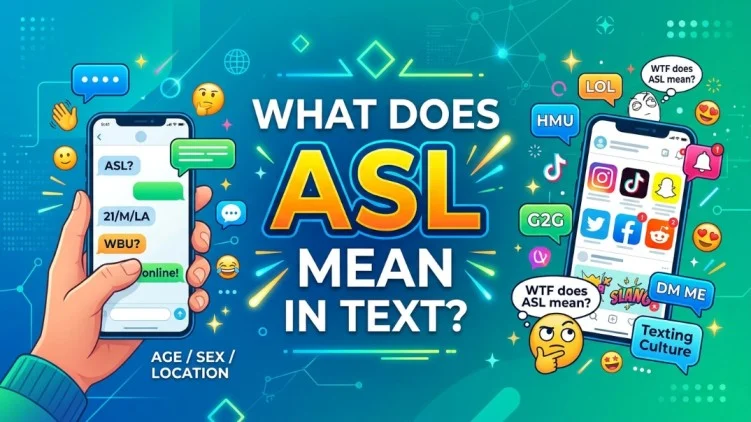
If you’ve spent time on TikTok, Instagram, X (formerly Twitter), Snapchat, Discord, or in online chat communities, you’ve probably come across the acronym ASL and wondered what it means. Like many internet slang terms, its meaning isn’t immediately obvious, and the way people use it can vary dramatically depending on the context and who is using it.
Understanding modern internet abbreviations is becoming increasingly important because online conversations move fast, and slang evolves almost daily. Some abbreviations are harmless and straightforward, while others can be personal, outdated, or confusing across different generations. ASL falls into multiple categories, making it especially important to understand the different meanings before using it or interpreting it yourself.
This guide explains what does ASL mean in text, where it came from, why it became popular, how people use it across different contexts, and when you should use it appropriately. You’ll also find examples, comparisons with similar slang, professional alternatives, common mistakes, FAQs, and practical tips to help you navigate this classic and evolving internet abbreviation.
What Does ASL Mean in Text? Meaning & Definition
ASL is an internet abbreviation with two distinct primary meanings depending on context. The original and most traditional meaning is “Age, Sex, Location,” used as a question to quickly gather basic personal information about someone in an online chat. The newer and increasingly popular meaning, particularly among Gen Z, is “as hell,” used as an intensifier to add emphasis to a statement.
The abbreviation is commonly used in:
Text messages
TikTok videos and comments
Snapchat conversations
Instagram DMs and comments
X (Twitter) posts
Discord chats
Online gaming communities
Dating apps and chatrooms
Because the abbreviation has two completely different meanings, understanding context is essential for proper interpretation.
Definition
Pronunciation: Most users spell out the letters individually: A-S-L.
Origin
The exact origin of ASL can be traced back to the early days of internet chatrooms in the late 1990s. The term “asl” can be traced back to 1998, when the internet was starting to become more widespread and people were eager to chat with random strangers.
Several key points about its history:
The abbreviation likely originated with the rise of IRC chat rooms in the 1980s and became widespread through instant messaging services like AOL Instant Messenger and MSN Messenger in the 1990s. It was used as a quick and efficient way to find out basic personal details of a user in an online conversation. The abbreviation was first defined on Urban Dictionary in the early 2000s as the expression for gathering information about one’s brand new online friend.
Around 2010, a new meaning emerged for “asl” on social media sites. People started using the letters as an abbreviation for the phrase “as hell,” mostly due to similar pronunciation. The first known instance of someone linking “ASL” to “as hell” occurred in 2018 when an X user expressed confusion about the new usage.
The term gained broader recognition through several key developments:
Late 1990s internet chatrooms and instant messaging
Urban Dictionary definitions in the early 2000s
AOL Instant Messenger and MSN Messenger popularity
Decline of A/S/L usage with the rise of social media
2010s emergence of “as hell” meaning
TikTok and Gen Z adoption in the early 2020s
Intergenerational confusion and debates about usage
Like many classic internet slang terms, ASL has evolved significantly over time and continues to be used with completely different meanings across generations and platforms.
Popularity
ASL became exceptionally popular for different reasons across different eras. The original meaning dominated early internet chat culture, while the newer meaning gained traction through social media and Gen Z adoption.
Several factors contributed to its widespread recognition:
Early internet chatroom culture and AOL Instant Messenger
Need for quick personal information in anonymous chats
Urban Dictionary and online slang databases
TikTok and social media trends
Generational divide and slang evolution
Ease of use in texting and online communication
Versatility across multiple platforms
Nostalgia factor for millennials and Gen X
The term’s dual nature has made it one of the most confusing internet abbreviations, with different generations using it in entirely different ways. This has led to numerous viral moments where people from different age groups misinterpret each other’s usage.
Where You May See ASL
| Platform | Common Usage |
|---|---|
| TikTok | “As hell” meaning, intensifier in comments and videos |
| Snapchat | Both meanings depending on context |
| “As hell” in comments, “Age/Sex/Location” in DMs | |
| X (Twitter) | Both meanings, often with generational confusion |
| Discord | Gaming chats, “Age/Sex/Location” in introductions |
| Omegle | “Age/Sex/Location” as a standard greeting |
| Dating Apps | “Age/Sex/Location” for basic information |
| Text Messages | “As hell” as an intensifier |
How It Is Used
ASL is used in completely different ways depending on context. The intended meaning depends heavily on how it is being applied.
“Age, Sex, Location” Tone ❓
Used as a question to gather basic personal information.
Example:
“ASL?” (Asking for age, sex, and location)
Intensifier Tone 💪
Used to add emphasis to a statement, similar to “very” or “really.”
Example:
“I’m tired asl.” (I’m very tired)
Confusion Tone 😵
Used when someone misunderstands which meaning is intended.
Example:
“Wait, did you mean ‘as hell’ or ‘age, sex, location’?”
Nostalgic Tone 🕰️
Used by older internet users referencing early chatroom culture.
Example:
“Remember when everyone on AIM asked ASL?”
Examples
“Age, Sex, Location” Examples
These examples show how ASL is used to ask for personal information.
“Hey, ASL?” (What is your age, sex, and location?)
“ASL? I’m 25, Female, New York.”
“Before we start the campaign, ASL?”
“ASL?” “19, Male, France”
Important: Never share your exact address with strangers online. When asked ASL, only share general location like country or city.
“As Hell” Examples
These examples show how ASL is used as an intensifier.
“Your shirt looks cool asl.” (Your shirt looks very cool)
“I’m hungry asl.” (I’m really hungry)
“People think I’m joking, but I’m serious asl.” (I’m very serious)
“Did you see the new kid? They’re cute asl.” (They’re very cute)
Professional Examples
ASL is rarely appropriate in professional settings unless discussing internet culture or conducting demographic research with clear context.
Instead of using ASL, consider:
“May I ask for your age and location for demographic purposes?”
“I would appreciate your basic demographic information.”
“The survey asks for age, gender, and location.”
Confusion Examples
These examples show the potential for misunderstanding between generations.
Millennial: “ASL?” (Expecting age, sex, location)
Gen Z: “I’m tired asl.” (Meaning very tired)
Millennial: “Wait, what? I meant age, sex, location!”
Gen Z: “Oh no one says that anymore lol”
Comparison with Similar Terms
Many internet abbreviations ask for personal information or add emphasis. Here’s how ASL compares.
Among these terms, ASL is unique because it has two completely different meanings that can lead to significant confusion across generations.
Alternate Meanings
Unlike some acronyms that have one primary definition, ASL has several distinct meanings depending on context.
Age, Sex, Location (Original Meaning)
Used as a question to quickly gather basic personal information in online chats.
As Hell (Modern Meaning)
Used as an intensifier to add emphasis to a statement, similar to “very” or “really”.
American Sign Language
A completely unrelated meaning referring to the sign language used in the United States.
Above Sea Level
A technical abbreviation used in geography and aviation.
When you encounter ASL in any context, rely on the surrounding conversation, platform, and generation of the user to determine the intended meaning.
Professional or Polite Alternatives
If you want to ask for personal information or add emphasis in professional or formal settings, here are better alternatives.
| Situation | Better Alternative |
|---|---|
| Demographic question | “May I ask for your age and general location?” |
| Adding emphasis | “I am very tired” or “I am extremely serious” |
| Professional introduction | “Could you share a bit about yourself?” |
| Formal communication | “I would appreciate some basic information.” |
These alternatives communicate your message professionally without relying on casual abbreviations.
Common Mistakes
Many people misunderstand or misuse ASL. Here are the most common mistakes.
Assuming Everyone Knows the Same Meaning
Some people assume ASL only means one thing.
It does not.
ASL has completely different meanings depending on generation and context.
Using “Age, Sex, Location” with Strangers Today
While this was common in early internet culture, asking ASL to strangers today can come across as creepy or outdated.
Confusing the Two Meanings
A millennial might ask “ASL?” expecting personal information, while a Gen Z user might respond with “I’m tired asl,” leading to confusion.
Using It Inappropriately
Using ASL in professional settings without understanding the context can lead to confusion or appear unprofessional.
Ignoring Generational Differences
The meaning of ASL varies significantly across generations. Millennials and Gen X are more likely to use it for “Age, Sex, Location,” while Gen Z uses it for “as hell”.
Quick Tips
Keep these practical guidelines in mind when encountering or using ASL.
Consider the context carefully before interpreting ASL.
In chatrooms or with strangers, it likely means “Age, Sex, Location.”
In casual texts or on TikTok, it likely means “as hell.”
Don’t assume everyone knows the same meaning.
When in doubt, ask for clarification.
Never share your exact address with strangers online.
Respect that different generations use the term differently.
Use the “as hell” meaning with friends in casual conversation.
FAQ
What does ASL mean in text?
In text messages, ASL most commonly means “as hell” when used as an intensifier. However, it can also mean “Age, Sex, Location” depending on the context and who is using it.
What does ASL mean on TikTok?
On TikTok, ASL almost always means “as hell.” It is used as an intensifier to add emphasis to statements, similar to saying “very” or “really”.
What does ASL mean on Snapchat?
On Snapchat, ASL can mean either “Age, Sex, Location” when used as a standalone question, or “as hell” when used in a sentence.
What does ASL mean in dating?
In dating contexts, ASL typically means “Age, Sex, Location.” It is used as a quick way to gather basic information about a potential match.
Is ASL offensive?
Generally no, but asking for “Age, Sex, Location” can be seen as outdated or invasive. The “as hell” meaning is completely harmless.
Where did ASL originate?
ASL originated in late 1990s internet chatrooms as a way to quickly gather basic information from strangers. The “as hell” meaning emerged around 2010 and gained popularity on social media.
What is the difference between ASL and A/S/L?
A/S/L is an older version of the same abbreviation, typically used with slashes. Both mean “Age, Sex, Location”.
Should I use ASL at work?
No. It is generally inappropriate for professional communication and may be considered too casual or confusing.
Why do people use abbreviations like ASL?
Internet users shorten phrases to type faster, fit character limits, and create casual conversation flow. Abbreviations like ASL make interactions feel more relaxed and informal.
Conclusion
So, what does ASL mean in text? The answer depends entirely on context and generation. For older internet users, ASL means “Age, Sex, Location,” a classic chatroom question used to gather basic personal information. For Gen Z and TikTok users, ASL means “as hell,” a casual intensifier used to add emphasis to statements. This remarkable shift in meaning over time makes ASL one of the most confusing and fascinating abbreviations in internet culture.
Understanding terms like ASL can help you navigate online conversations more effectively and avoid embarrassing misunderstandings across generations. The abbreviation’s journey from 1990s chatrooms to modern TikTok demonstrates how language evolves with technology and culture. you encounter ASL in a text message, on social media, or in an online chat, knowing both meanings helps you interpret the message correctly and respond appropriately. When in doubt, simply ask for clarification, and remember that different generations and communities may use this versatile abbreviation in entirely different ways.
Discover More Post:
What Does the Green Dot Mean on Snapchat – Punzelo.com
What Does It Mean When You Dream About Someone
What Does Collate Mean When Printing – Punzelo.com