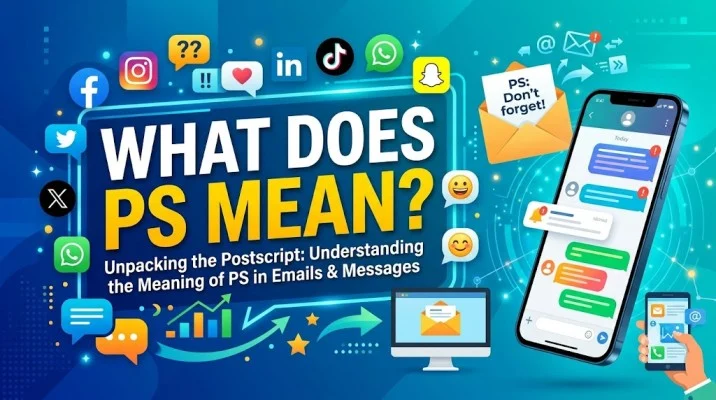
If you’ve spent time reading emails, letters, text messages, or social media posts, you’ve probably come across the abbreviation “PS” and wondered what it means. Like many common abbreviations, its meaning isn’t immediately obvious to everyone, and the way people use it can vary depending on the context and communication style.
Understanding common abbreviations is becoming increasingly important because written communication has evolved significantly in the digital age. Some abbreviations are formal and traditional, while others are casual and modern. PS falls into the category of traditional abbreviations that have stood the test of time, making it especially important to understand its proper usage and various applications.
This guide explains what does PS mean, where it came from, why it became so widely used, how people use it in different contexts, and when you should use it appropriately. You’ll also find examples, comparisons with similar abbreviations, professional alternatives, common mistakes, FAQs, and practical tips to help you master this classic communication tool.
What Does PS Mean? Meaning & Definition
PS is an abbreviation that most commonly stands for “postscript.” It comes from the Latin word “postscriptum,” which means “written after.” A postscript is an additional thought or message added after the main body of a letter, email, or document has been completed.
The abbreviation is commonly used in:
Letters and personal correspondence
Emails and professional communication
Text messages and casual conversations
Social media posts and captions
Academic and formal writing
Business documents and memos
Creative writing and storytelling
Because PS is so widely recognized, it has become a standard part of written communication across various contexts and platforms.
Definition
| Term | Meaning |
|---|---|
| PS | An abbreviation for “postscript,” from the Latin “postscriptum” meaning “written after.” It is used to add an additional thought or message after the main body of a letter, email, or document has been completed. |
Pronunciation: Most people say the letters individually: P-S. Some may say “postscript” in formal contexts.
Origin
The exact origin of PS can be traced back to ancient Rome and the Latin language. The abbreviation has been used in written communication for centuries, making it one of the oldest abbreviations still in common use.
Several key points about its history:
The term comes from the Latin word “postscriptum,” which combines “post” meaning “after” and “scribere” meaning “to write.” This literally translates to “written after.” The abbreviation has been used in letter writing since at least the Middle Ages. In the days before instant communication, people would often remember something they forgot to include after finishing a letter. Adding a PS allowed them to include this additional thought without rewriting the entire letter.
The term gained broader recognition through several key developments:
Ancient Roman writing practices
Medieval letter writing traditions
Renaissance correspondence
Printing press and publishing
Modern business communication
Digital and email communication
Like many traditional abbreviations, PS has evolved from handwritten letters to digital communication while maintaining its core meaning and purpose.
Popularity
PS became and remains popular because it provides a practical solution for adding information after completing a written message. The abbreviation has survived centuries of communication changes.
Several factors contributed to its widespread recognition:
Long history in written communication
Practicality for adding forgotten thoughts
Adoption in professional correspondence
Versatility across communication types
International recognition
Ease of use and understanding
Consistent meaning across contexts
The abbreviation’s longevity demonstrates its enduring usefulness. Even in the age of digital communication, PS remains relevant and widely used.
Where You May See PS
| Platform | Common Usage |
|---|---|
| Personal Letters | Additional thoughts after main message |
| Professional Emails | Important additions or reminders |
| Text Messages | Casual afterthoughts |
| Social Media | Post captions, additional comments |
| Academic Writing | Footnotes, additional notes |
| Business Documents | Memos, formal correspondence |
| Creative Writing | Author’s notes, character letters |
How It Is Used
PS is used to add an additional thought or message after completing the main content. The intended tone depends heavily on context.
Formal Tone 📝
Used in professional and formal writing.
Example:
“Please find the attached document. PS: The deadline has been extended to Friday.”
Casual Tone 😊
Used in personal letters and casual messages.
Example:
“Looking forward to seeing you this weekend! PS: Don’t forget to bring the cake.”
Humorous Tone 😂
Used for playful or funny afterthoughts.
Example:
“Thanks for the wonderful gift! PS: I may have already eaten all the chocolate.”
Urgent Tone ⚠️
Used for important additions needing attention.
Example:
“Meeting is at 3 PM. PS: Please bring the updated report.”
Examples
Formal Examples
These examples show how PS is used in professional communication.
“Thank you for your prompt response regarding the project timeline. PS: I will send the revised budget by Wednesday.”
“Please review the attached contract at your earliest convenience. PS: Our legal team has already approved the final version.”
“The conference has been rescheduled to November. PS: Registration closes next week.”
Important: In professional emails, consider whether the PS is necessary or if the information should be in the main body.
Personal Examples
These examples show how PS is used in personal correspondence.
“Had a wonderful time at the party! PS: Your cake recipe was amazing.”
“Miss you already! PS: Call me when you get this message.”
“Can’t wait to see you next month! PS: I found that book you wanted.”
“Hope you’re doing well. PS: The flowers you sent were beautiful.”
Professional Examples
PS is appropriate in professional settings when adding an afterthought.
“The quarterly report is attached for your review. PS: Please note the updated formatting guidelines.”
“All team members should attend the meeting. PS: Please confirm your attendance.”
“The new policy takes effect next month. PS: Training sessions will be scheduled.”
Text Message Examples
These examples show how PS is used in casual digital communication.
“Running late, will be there in 10. PS: Grab me a coffee?”
Thanks for the ride home! PS: Left my jacket in your car.”
“Movie starts at 7. PS: I already bought the tickets.”
“Great hanging out! PS: Let’s do this again soon.”
Comparison with Similar Abbreviations
Many abbreviations add extra information or notes. Here’s how PS compares.
| Abbreviation | Meaning | Usage |
|---|---|---|
| PS | Postscript | Additional thought after main message |
| PPS | Post Postscript | Additional thought after PS |
| FYI | For Your Information | Informative note |
| NB | Nota Bene (Note Well) | Important note |
| CC | Carbon Copy | Copy recipient |
| BCC | Blind Carbon Copy | Hidden copy recipient |
| RE | Regarding | Subject reference |
Among these abbreviations, PS is unique because it specifically indicates information added after the main content is complete.
Alternate Meanings
Unlike some abbreviations that have multiple unrelated definitions, PS has one primary meaning related to postscript.
Postscript
The most common and traditional meaning, adding afterthoughts.
PlayStation
In gaming contexts, PS can refer to PlayStation gaming consoles.
Public School
In educational contexts, PS can refer to public schools.
Power Steering
In automotive contexts, PS can refer to power steering.
Polystyrene
In manufacturing, PS can refer to the plastic material.
When you encounter PS in any context, the surrounding conversation usually makes the meaning clear. In written communication, it almost always means postscript.
Professional or Polite Alternatives
If you want to add additional information without using PS, here are some alternatives.
| Situation | Better Alternative |
|---|---|
| Professional email | “Additionally, I would like to note…” |
| Formal letter | “I would also like to add…” |
| Business document | “Furthermore, please consider…” |
| Academic writing | “It should also be noted that…” |
| Casual communication | “By the way…” or “Also…” |
| Formal correspondence | “In addition to the above…” |
These alternatives communicate additional information without using the PS abbreviation.
Common Mistakes
Many people misunderstand or misuse PS. Here are the most common mistakes.
Using PS in the Main Body
Some people mistakenly place PS within the main body of the message.
It should not.
PS is specifically for information added after the main content is complete.
Using Multiple PS Incorrectly
Some people use PPS (post postscript) but may not know the proper sequence.
The correct sequence is: PS for the first afterthought, PPS for the second, PPPS for the third, and so on. However, using more than one or two is often seen as unprofessional or poorly organized.
Capitalizing Incorrectly
PS is typically written with both letters capitalized, though “p.s.” is also acceptable in informal writing.
Using PS When Information Should Be in the Main Body
If information is important, it should generally be in the main body of the message. PS is best for minor afterthoughts, not critical information.
Forgetting to Include the Colon
While not always required, the colon after PS (as in “PS:”) is traditional and recommended.
Quick Tips
Keep these practical guidelines in mind when using PS.
PS stands for postscript, meaning “written after.”
Use PS to add afterthoughts to written messages.
Place PS after your signature or closing.
Keep the content brief and relevant.
Use PS sparingly to maintain professionalism.
Consider if the information belongs in the main body.
Remember that PPS is used for additional afterthoughts.
PS is acceptable in both formal and casual communication.
FAQ
What does PS mean in a letter?
In a letter, PS means postscript. It is used to add an additional thought or message after the letter has been completed and signed.
What does PS stand for?
PS stands for postscript, which comes from the Latin “postscriptum” meaning “written after.”
What does PS mean in email?
In email, PS means the same thing as in letters: postscript. It is used to add an afterthought or additional information after the main message.
How do you use PS correctly?
Use PS by placing it after your signature or closing. Write “PS:” followed by your additional message. Keep it brief and relevant to the main content.
What does PPS mean?
PPS stands for “post postscript” and is used for an additional afterthought after the PS. It comes from the Latin “post postscriptum.”
Is PS still used today?
Yes, PS is still widely used in both personal and professional communication, including letters, emails, text messages, and social media.
Can you use PS in a text message?
Yes, PS can be used in text messages as a casual way to add an afterthought. However, it is more common in formal and personal correspondence.
Should I use PS in professional emails?
Yes, PS can be used in professional emails for minor afterthoughts. However, ensure that critical information is in the main body of the email.
Conclusion
So, what does PS mean? It stands for postscript, derived from the Latin “postscriptum,” meaning “written after.” This traditional abbreviation has been used for centuries to add additional thoughts or messages after the main body of a letter, email, or document has been completed. While it originated in handwritten correspondence, PS has successfully transitioned to modern digital communication, remaining relevant and widely understood across all platforms.
Understanding abbreviations like PS helps us communicate more effectively and maintain traditional practices in modern contexts. The abbreviation’s enduring popularity demonstrates the value of having a simple way to add afterthoughts without rewriting entire messages. Whether you are writing a formal business letter, sending a professional email, or chatting with friends, knowing how and when to use PS enhances your communication skills. When using PS, remember its traditional purpose and use it to add brief, relevant afterthoughts that complement your main message.
Discover More Post:
- What Does Sigma Mean| Complete Meaning, Origin, Usage …
- What Does PMO Mean| Complete Meaning, Origin, Usage …
- What Does Huzz Mean| Complete Meaning, Origin, Usage …