If you’ve spent time in math class, geometry lessons, or educational discussions, you’ve probably come across the word “perpendicular” and wondered what it means. Like many academic terms, its meaning isn’t immediately obvious to everyone, and the way people use it can vary depending on the context and subject area.
Understanding mathematical and geometric terminology is becoming increasingly important because these concepts appear in everyday life, construction, design, and standardized tests. Some terms are used only in specific contexts, while others have broader applications. Perpendicular falls into the category of widely used geometric vocabulary, making it especially important to understand its precise meaning and various applications.
This guide explains what does perpendicular mean, where it came from, why it became important in mathematics and other fields, how people use it in different contexts, and when you should use it appropriately. You’ll also find examples, comparisons with similar terms, professional alternatives, common mistakes, FAQs, and practical tips to help you master this important geometric concept.
What Does Perpendicular Mean? Meaning & Definition
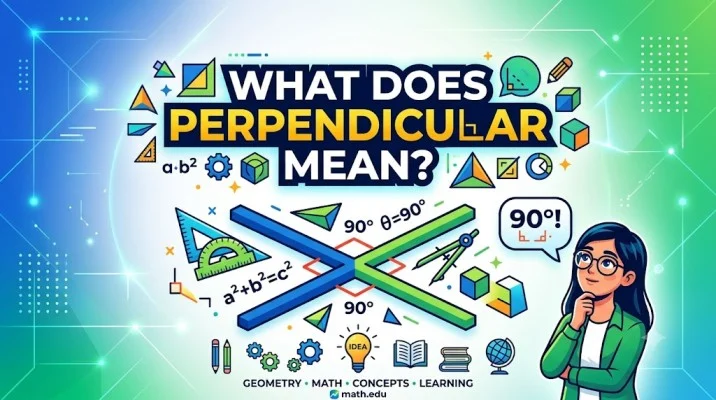
Perpendicular is an adjective that most commonly describes two lines or surfaces that intersect at a right angle of exactly 90 degrees. In mathematics and geometry, perpendicular lines form four right angles at their point of intersection. The term can also be used figuratively to describe things that are completely upright or vertical.
The term is commonly used in:
Mathematics and geometry classes
Construction and architecture
Engineering and design
Standardized tests and assessments
Educational materials
Everyday language about verticality
Professional and technical writing
Because the term has both precise mathematical and general meanings, understanding context is essential for proper interpretation.
Featured Snippet Definition
| Term | Meaning |
|---|---|
| Perpendicular | An adjective meaning intersecting at a right angle of 90 degrees. In geometry, perpendicular lines form four right angles at their intersection. It can also mean completely upright or vertical. |
Pronunciation: Per-pen-dic-u-lar (per-pen-DIK-yoo-lar)
Origin
The exact origin of perpendicular can be traced back to Latin. The word originates from the Latin term “perpendicularis,” which means “vertical” or “plumb line.” This Latin root reflects the core meaning of the word: something that is straight up and down or forms a right angle.
Several key points about its history:
The word entered English from Latin through Old French during the Middle Ages. “Perpendicularis” came from “perpendiculum,” meaning “plumb line,” which combined “per-” meaning “through” with “pendere” meaning “to hang.” This connection to hanging lines explains why perpendicular refers to vertical alignment and right angles. The term has been used in geometry for centuries.
The term gained broader recognition through several key developments:
Latin language and Roman influence
Evolution of English from Latin and French
Development of Euclidean geometry
Mathematical education and curriculum
Construction and architectural applications
Everyday language adoption
Like many academic terms with Latin roots, perpendicular has evolved over time and continues to be used in both specialized and general contexts.
Popularity
Perpendicular became an important term primarily because of its widespread use in mathematics education and practical applications. Geometry students around the world encounter the term when learning about lines, angles, and shapes.
Several factors contributed to its recognition:
Mathematics education worldwide
Geometry curriculum requirements
Construction and building standards
Architecture and design principles
Standardized testing
Engineering applications
Everyday language about verticality
The term’s importance in educational and practical contexts ensures that millions of people encounter it each year, making it one of the most recognized geometric terms globally.
Where You May See Perpendicular
| Platform | Common Usage |
|---|---|
| Math Class | Geometry lessons, angle concepts |
| Textbooks | Mathematics, physics, engineering |
| Construction Sites | Building design, structural elements |
| Architecture | Design principles, structural integrity |
| Standardized Tests | Math sections, reasoning questions |
| Everyday Language | Describing vertical objects |
| Professional Writing | Technical documents, engineering reports |
How It Is Used
Perpendicular is used in various ways depending on the context. The intended meaning depends heavily on how it is being applied.
Mathematical Tone 📐
Used to describe lines intersecting at right angles.
Example:
“Line AB is perpendicular to line CD, forming a 90 degree angle.”
Construction and Design Tone 🏗️
Used to describe structural elements.
Example:
“The walls must be perpendicular to the floor for proper construction.”
Descriptive Tone 📏
Used to describe vertical or upright objects.
Example:
“The pole stands perpendicular to the ground.”
Professional Tone 💼
Used in academic and professional writing.
Example:
“The perpendicular lines were measured with precision instruments.”
Examples
Mathematical Examples
These examples show how perpendicular is used in mathematics.
“Two lines are perpendicular if they intersect at a right angle of 90 degrees.”
“The perpendicular bisector of a line segment divides it into two equal parts.”
“In a rectangle, adjacent sides are perpendicular to each other.”
“The height of a triangle is perpendicular to its base.”
Important: In mathematics, perpendicular specifically means intersecting at exactly 90 degrees, not just vertical.
Construction and Design Examples
These examples show how perpendicular is used in building and design.
“The carpenter ensured the beams were perpendicular to the floor.”
“The columns must stand perpendicular to the foundation for structural stability.”
“Perpendicular lines in architecture create a sense of stability and order.”
“The walls were constructed perpendicular to the ceiling joists.”
Everyday Language Examples
These examples show how perpendicular is used in general conversation.
“The flagpole stands perpendicular to the ground.”
“The street intersects the main road at a perpendicular angle.”
“Her posture was perfectly perpendicular, like a soldier standing at attention.”
Professional Examples
Perpendicular is appropriate in professional settings when discussing geometry, construction, or design.
“The structural engineer verified that all supporting walls were perpendicular.”
“Our measurements confirmed that the angles were perfectly perpendicular.”
“The perpendicular alignment of the beams ensures the building’s stability.”
Comparison with Similar Terms
Many terms describe angles, lines, or positions. Here’s how perpendicular compares.
| Term | Meaning | Context |
|---|---|---|
| Perpendicular | Intersecting at 90 degrees | Geometry, construction |
| Parallel | Lines that never intersect | Geometry, comparisons |
| Vertical | Straight up and down | General description |
| Horizontal | Side to side, level | General description |
| Right Angle | Exactly 90 degrees | Geometry |
| Orthogonal | Mathematically perpendicular | Advanced mathematics |
| Normal | Perpendicular to a surface | Geometry, physics |
Among these terms, perpendicular is unique because it specifically describes the relationship between two lines or surfaces forming a right angle.
Alternate Meanings
Unlike some words that have multiple unrelated definitions, perpendicular has related meanings that all connect to right angles or verticality.
Mathematical Perpendicular
Lines or planes that intersect at a right angle of 90 degrees.
Vertical Alignment
Standing straight up and down, perpendicular to the ground.
Symbolic Meaning
Used figuratively to describe something that is completely upright or correct.
Geometric Property
A fundamental concept in geometry and spatial reasoning.
When you encounter perpendicular in any context, the surrounding conversation usually makes the meaning clear. In mathematics, it always refers to right angle intersections.
Professional or Polite Alternatives
If you want to describe right angles or verticality in professional or formal settings, here are some alternatives.
| Situation | Better Alternative |
|---|---|
| Technical writing | “The lines intersect at a 90 degree angle.” |
| Construction planning | “The beams must be at a right angle.” |
| General description | “The structure stands upright.” |
| Academic writing | “The perpendicular relationship between the lines” |
| Professional recommendation | “The surfaces must form right angles.” |
| Everyday conversation | “The pole stands straight up.” |
These alternatives communicate similar meanings in various contexts.
Common Mistakes
Many people misunderstand or misuse perpendicular. Here are the most common mistakes.
Confusing Perpendicular with Vertical
Some people mistakenly believe perpendicular and vertical mean the same thing.
They are related but different.
Vertical means straight up and down. Perpendicular specifically means intersecting at a right angle, which can be horizontal to vertical or other angles.
Confusing Perpendicular with Parallel
Some people mistakenly confuse perpendicular with parallel.
They are opposites.
Perpendicular lines intersect at right angles. Parallel lines never intersect.
Mispronouncing the Word
The correct pronunciation places emphasis on the third syllable: per-pen-DIK-yoo-lar.
Using It Incorrectly in Sentences
Perpendicular is an adjective and should be used to describe nouns, not as a noun itself.
Assuming It Only Applies to Lines
Perpendicular can describe lines, planes, surfaces, and even walls or structures.
Quick Tips
Keep these practical guidelines in mind when using or encountering perpendicular.
Perpendicular means intersecting at a right angle of 90 degrees.
It is an adjective used to describe lines, surfaces, or structures.
Pronounce it as per-pen-DIK-yoo-lar.
Vertical means straight up and down, while perpendicular is about right angles.
Parallel lines never intersect, perpendicular lines intersect at right angles.
Use it in geometry, construction, architecture, and design.
When in doubt, “right angle” is a simpler alternative.
FAQ
What does perpendicular mean in math?
In mathematics, perpendicular means intersecting at a right angle of exactly 90 degrees. Perpendicular lines form four right angles at their point of intersection.
What does perpendicular mean in simple terms?
In simple terms, perpendicular means two lines or surfaces that meet at a right angle, like the corner of a square or the letter L.
What is the difference between perpendicular and parallel?
Perpendicular lines intersect at a right angle of 90 degrees. Parallel lines never intersect and remain the same distance apart.
How do you pronounce perpendicular?
Perpendicular is pronounced “per-pen-DIK-yoo-lar.” The emphasis is on the third syllable.
What are examples of perpendicular lines?
The sides of a square are perpendicular to each other. The floor and walls of a room are perpendicular. A vertical flagpole is perpendicular to the horizontal ground.
Can perpendicular be used as a noun?
No, perpendicular is an adjective. The noun form is perpendicularity. For example, “The perpendicularity of the walls was verified.”
What does perpendicular mean in construction?
In construction, perpendicular means structural elements that meet at right angles. Walls are typically perpendicular to floors and ceilings for stability.
Why is perpendicular important in geometry?
Perpendicular is important in geometry because it helps define shapes, angles, and relationships between lines. It is a fundamental concept in Euclidean geometry.
Can two lines be perpendicular and not touch?
No. By definition, perpendicular lines must intersect at a right angle. If they do not intersect, they are parallel or skew lines.
Conclusion
So, what does perpendicular mean? In mathematics and geometry, it means intersecting at a right angle of exactly 90 degrees. Perpendicular lines form four right angles at their point of intersection, making them a fundamental concept in geometry, construction, architecture, and design. The word comes from the Latin “perpendicularis,” meaning “vertical” or “plumb line,” and has been used for centuries to describe right angle relationships.
Understanding terms like perpendicular helps bridge academic and practical knowledge, enriching our ability to understand and describe the world around us. The word’s journey from Latin through geometry to everyday usage demonstrates how fundamental concepts become part of common language. Whether you’re studying for a test, working on a construction project, or simply trying to describe how things meet, knowing the meaning and proper usage of perpendicular enhances your understanding of spatial relationships and communication skills.
Discover More Post:
- What Does Sigma Mean| Complete Meaning, Origin, Usage …
- What Does PMO Mean| Complete Meaning, Origin, Usage …
- What Does Huzz Mean| Complete Meaning, Origin, Usage …