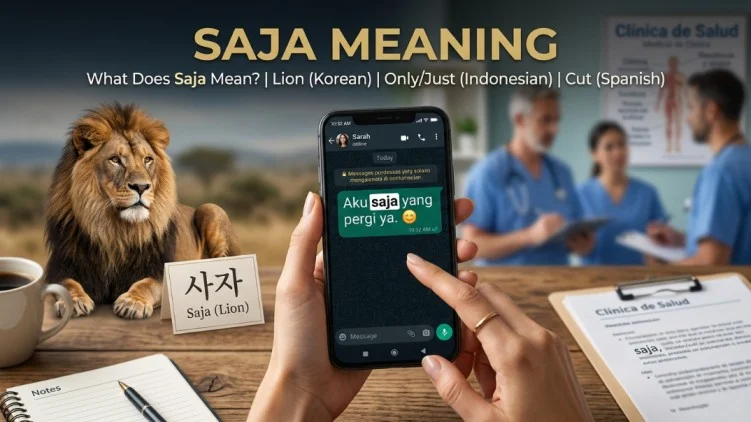
Quick answer:
“Saja” has different meanings depending on the language and context. It can mean “lion” in Korean, “just” or “only” in Indonesian, and it also appears as a Spanish word related to making an incision.
One short word can carry very different meanings when it travels between languages. Saja is a good example. You may have seen it in a Korean show, heard it in a conversation, noticed it as a name, or come across it while browsing social media. The meaning is not always the same because saja belongs to more than one language and context.
For Korean culture fans, the word may be familiar because saja, written 사자, means “lion.” In Indonesian, saja is commonly used with meanings such as “just,” “only,” or “simply.” In Spanish, saja can refer to an incision or lancing, and it can also be a form of the verb sajar. These meanings are separate and should not be mixed together.
If you are learning a language, watching Korean entertainment, using social media, or researching the name Saja, understanding the context will help you choose the correct meaning.
Definition & Meaning
The meaning of saja depends on the language in which it appears.
Saja in Korean
In Korean, 사자 (saja) means “lion.” The word refers to the large wild animal and can also carry symbolic ideas connected with strength, courage, power, and fierceness.
For example:
사자는 강합니다.
This means:
“The lion is strong.”
Korean words can have different meanings when written with different Chinese characters, known as Hanja. This is one reason context is important when looking at Korean vocabulary.
The word saja has also become more recognizable among international audiences because of Korean entertainment and popular culture.
Saja in Indonesian
In Indonesian, saja is a common word with meanings such as “just,” “only,” “simply,” “merely,” or expressions of preference depending on the sentence.
For example:
Saya di rumah saja.
This can mean:
“I am just staying at home.”
Another example is:
Air saja.
This can mean:
“Just water.”
The Indonesian word can also appear in expressions where its meaning is not best translated word for word. Wiktionary lists meanings including “just,” “only,” “as you like,” “preferably,” and an emphatic sense such as “very” depending on usage.
Saja in Spanish
Spanish has another use of saja. As a noun, saja can mean “lancing” or an incision, especially in a medical context. SpanishDictionary gives the example of lancing a boil.
It can also be a conjugated form of the Spanish verb sajar, meaning to make an incision or cut open. WordReference lists saja as a third person singular present form and an affirmative informal command of sajar.
So, if you see saja in Korean, Indonesian, or Spanish, do not automatically assume that it has the same meaning.
Background & History
The history of saja is not one single story because the word exists independently in different languages.
Korean Background
The Korean word 사자 is commonly translated as lion. In Korean culture, lions can represent strength and power, even though actual lions are not native to the Korean Peninsula.
The word has become especially visible outside Korea through Korean dramas, music, web content, and international entertainment. People who are not Korean speakers may encounter saja first through subtitles, character names, group names, or Korean cultural references.
The word can also appear in compound expressions.
One well-known example is:
저승사자 (jeoseung saja)
This refers to a traditional Korean supernatural figure associated with guiding the dead to the afterlife. The word saja in this expression is not simply being used as the everyday word for a lion. Korean vocabulary can contain words that sound alike but have different meanings depending on their written form and context.
Indonesian Background
Indonesian saja has a completely different history and function. It is a grammatical word used to add meanings such as “just,” “only,” or “simply.”
It is also related to the form aja, which is commonly used in informal Indonesian. Wiktionary lists aja as a colloquial alternative and sahaja as an older form.
This means you may see both forms online:
saja
and
aja
The shorter form is especially common in casual digital communication.
Spanish Background
- Spanish saja comes from the verb sajar, which relates to making an incision or cutting into something. Spanish dictionaries identify saja as a conjugated form of that verb.
As a noun, la saja refers to the act of lancing or making an incision.
The important point is that these histories developed separately. There is no reason to assume that the Korean, Indonesian, and Spanish words share the same origin simply because they are spelled the same in English letters.
Usage in Various Contexts
You can understand saja more easily by looking at real situations.
Saja in Korean Conversation
If someone is talking about animals, saja probably means lion.
Minji: “사자 좋아해?”
Joon: “응, 정말 좋아해.”
A natural translation is:
Minji: “Do you like lions?”
Joon: “Yes, I really like them.”
Saja in Korean Entertainment
You may also encounter saja in Korean fantasy stories or folklore.
For example:
“저승사자가 나타났다.”
Depending on the context, this refers to a grim reaper or underworld messenger figure, not an ordinary lion.
This is a good example of why translating a word without reading the full expression can cause confusion.
Saja in Indonesian Texting
Indonesian speakers may use saja casually in messages.
Rina: “Kamu makan apa?”
Dina: “Nasi saja.”
Here, saja gives the idea of:
“Just rice.”
Another example:
“Di rumah saja.”
This can mean:
“Just stay at home.”
Saja in Social Media
Indonesian users may shorten saja to aja in casual posts and messages.
For example:
“Santai aja.”
This can be understood as:
“Just relax.”
The informal version makes the message feel more casual.
Saja in Spanish
If the word appears in a medical Spanish context, its meaning can be completely different.
Doctor: “La saja debe realizarse de forma adecuada.”
The word here relates to an incision or lancing.
This is not a slang meaning and has nothing to do with the Korean or Indonesian uses.
Common Misconceptions & Clarifications
Because saja appears in several languages, it is easy to make incorrect assumptions.
Misconception 1: Saja Always Means Lion
Not necessarily.
Saja means “lion” in Korean when written as 사자, but the same spelling in Indonesian can mean “just” or “only.” Spanish has another meaning connected with an incision.
Misconception 2: Saja Is Always a Name
Saja can be used as a personal name, but it is also an ordinary word in several languages.
If someone introduces themselves as Saja, you should not automatically assume that their name has one specific meaning.
Misconception 3: Saja Is Korean Only
This is another common mistake.
Korean popular culture has made saja more recognizable worldwide, but the word exists in other linguistic contexts too.
Misconception 4: All Saja Meanings Are Connected
They are not necessarily connected.
The Korean 사자 meaning “lion” and Indonesian saja meaning “just” are different words with different linguistic histories.
Spanish saja has its own meaning related to an incision.
Misconception 5: Saja Is Offensive
The word itself is not generally an offensive expression.
However, any word can be used in a rude, sarcastic, or mocking sentence. Context and tone always matter.
Similar Terms & Alternatives
There are several words that can look or sound similar to saja, but their meanings can be very different.
Korean Alternatives for Lion
In Korean, 사자 means lion.
A related word is:
숫사자
This means male lion.
Another expression can describe a lioness:
암사자
This means lioness.
Indonesian Alternatives
Indonesian has several words that may overlap with the meaning of saja depending on the sentence.
hanya can mean only or just.
cuma is commonly used in informal contexts with a meaning similar to only or just.
For example:
“Saya cuma bercanda.”
This means:
“I was just joking.”
Spanish Alternatives
For the Spanish medical meaning, related words include expressions involving:
incisión
which means incision, and
corte
which can mean cut.
These are not perfect synonyms in every situation, but they help explain the medical sense.
| Term | Language | Main meaning |
|---|---|---|
| Saja | Korean | Lion |
| Saja | Indonesian | Just, only, simply |
| Saja | Spanish | Lancing, incision |
| Hanya | Indonesian | Only, just |
| Cuma | Indonesian | Just, only |
| Incisión | Spanish | Incision |
| Corte | Spanish | Cut |
How to Respond to This Term
Your response depends on where you saw saja.
If Someone Says Saja in Korean
If they are talking about animals, they probably mean lion.
You could respond:
“Oh, you mean lion?”
Or, if you already understand Korean:
“사자를 좋아해?”
If Someone Uses Saja in Indonesian
If someone writes:
“Aku di rumah saja.”
You could respond:
“Oh, kamu mau tinggal di rumah?”
The exact response depends on the rest of the conversation.
If Someone Uses It as a Name
If a person says:
“Hi, I’m Saja.”
You can simply say:
“Nice to meet you, Saja!”
There is no need to ask about the meaning unless you are curious.
If You Are Unsure
The safest response is:
“What does Saja mean in this context?”
That is much better than confidently guessing.
Funny Response
If someone is talking about the Korean meaning and you want to joke:
“Wait, are we talking about a lion now? 😂”
Use humor only when the conversation is casual and the other person is likely to understand the joke.
Regional or Cultural Differences
The meaning of saja can change dramatically across cultures.
Korea
In Korean, 사자 is the everyday word for lion. It may also appear in cultural or traditional expressions.
Korean pronunciation is important. Romanization can make different Korean words look similar to English speakers, even though their Korean spelling and meanings differ.
Indonesia
In Indonesian, saja is a common grammatical word. Informal speakers may use aja, especially in texting and casual conversation.
For example:
“Makan saja.”
Depending on context, this can convey the idea of “just eat” or “go ahead and eat.”
Spanish-Speaking Regions
In Spanish, saja is much less likely to appear in ordinary casual conversation than Indonesian saja or Korean 사자. Its noun meaning is associated with lancing or an incision, while its verb-related use comes from sajar.
This means the surrounding vocabulary is especially important.
Cultural Takeaway
If you see saja online, ask yourself:
- Is the person Korean?
- Is the person Indonesian?
- Is the conversation in Spanish?
- Is it being used as a personal name?
- Is it part of a title, character name, or pop culture reference?
These clues can usually reveal the intended meaning.
Comparison with Similar Terms
The easiest way to avoid confusion is to compare the meanings directly.
| Word or phrase | Language | Meaning | Typical context |
|---|---|---|---|
| 사자 | Korean | Lion | Animals, culture, entertainment |
| saja | Indonesian | Just, only | Everyday speech and texting |
| aja | Indonesian | Just, only | Casual speech and texting |
| hanya | Indonesian | Only | General conversation |
| cuma | Indonesian | Just, only | Informal conversation |
| saja | Spanish | Lancing or incision | Medical language |
| sajar | Spanish | To make an incision | Medical or formal context |
| 저승사자 | Korean | Underworld messenger / grim reaper | Folklore and fantasy |
Notice that the same Romanized spelling does not guarantee the same pronunciation, spelling, or meaning.
This is common when words from different languages are written using the Latin alphabet.
Usage in Online Communities & Dating Apps
The word saja can appear online for several reasons.
Korean Pop Culture
International fans may encounter saja while discussing Korean music, dramas, films, animation, or fantasy stories.
For example:
“I finally understand why they called them Saja Boys.”
In this type of conversation, the Korean meaning of saja may be relevant.
The phrase Saja Boys has also become widely recognized through the popular Netflix film KPop Demon Hunters. In discussions about the group, fans often explain saja as “lion,” connecting it with the group’s image and the idea of a pride. Fan discussions also point out additional Korean cultural wordplay, although those interpretations should be separated from the basic dictionary meaning.
Indonesian Online Communities
In Indonesian chats, saja and aja are much more ordinary.
You might see:
“Santai saja.”
or:
“Santai aja.”
Both communicate a casual idea similar to “Just relax.”
Dating Apps
If you see Saja capitalized on Tinder or another dating app, it may simply be someone’s name.
For example:
“Hi, I’m Saja.”
Do not automatically translate it as “lion” or “just.”
If the profile mentions Korea, Indonesia, or another relevant cultural background, the name may have a particular linguistic connection. But the safest approach is to treat it as a name unless the person explains otherwise.
Social Media
On Instagram, TikTok, X, Reddit, or Discord, context can be even more important because users often mix languages.
Someone might use saja because they are Indonesian, while another person might use Saja because they are discussing Korean entertainment.
Hidden or Offensive Meanings
There is no single widely accepted offensive meaning of “saja.”
Most uses are neutral.
The Korean word 사자 is a normal word for lion. The Indonesian word saja is a normal grammatical word. Spanish saja has a specialized medical meaning.
Still, context can create confusion.
Sarcasm
Someone could use a normal word sarcastically.
For example:
“Yeah, just do that saja.”
If the speaker is mixing languages jokingly, the tone may matter more than the dictionary definition.
Nicknames and Jokes
Online communities sometimes turn ordinary words into usernames, memes, or nicknames. In that case, the intended meaning may be personal rather than linguistic.
Korean Cultural References
If you see saja in a Korean fantasy context, it may refer to something connected with death or the afterlife, especially when it appears in 저승사자.
That does not mean saja itself is an offensive word.
Important Rule
Never assume that a word is offensive simply because it has an unfamiliar meaning in another language.
Check the language, sentence, and cultural context first.
Suitability for Professional Communication
Whether saja is appropriate in professional communication depends entirely on which language and meaning you are using.
Korean Professional Communication
Using 사자 to mean lion is completely normal when the subject requires it.
For example, a professional article about wildlife could say:
“사자는 아프리카의 대표적인 대형 포유류입니다.”
The word itself is not informal.
Indonesian Professional Communication
Saja can appear in normal Indonesian writing, but the exact sentence structure matters.
For example:
“Perusahaan hanya menyediakan layanan ini untuk pelanggan tertentu.”
In formal Indonesian, hanya may be preferred in some contexts where casual speakers might use saja.
The best choice depends on the sentence and level of formality.
Spanish Professional Communication
The Spanish medical use of saja is specialized. If you are writing a medical document, use the terminology that fits the clinical context.
For general English communication, do not randomly insert saja unless your audience understands the language.
Professional Tip
If you are writing for an international audience, translate the word or explain it on first use.
For example:
“Saja, the Korean word for lion, appears in the character’s name.”
This removes confusion and helps readers understand your point immediately.
FAQs
What does saja mean in Korean?
In Korean, saja (사자) means “lion.” It is the normal Korean word used for the animal.
What does saja mean in Indonesian?
In Indonesian, saja can mean “just,” “only,” “simply,” or related meanings depending on the sentence and context.
What does saja mean in Spanish?
In Spanish, saja can refer to lancing or making an incision, especially in a medical context. It is also a form of the verb sajar.
Does Saja mean lion?
Yes, when referring to the Korean word 사자. However, the spelling “saja” can represent different words in other languages.
Is Saja a name?
Yes. Saja can be used as a personal name, but the meaning of the name depends on its cultural and linguistic background.
What does Saja Boys mean?
In the Korean context, saja means lion, so “Saja Boys” can be understood as “Lion Boys.” The phrase also has additional cultural and fictional context in KPop Demon Hunters.
Is saja a bad word?
No. Saja is not generally a bad or offensive word. Its normal meanings are neutral, but a specific sentence or online joke can change the tone.
Conclusion
The saja meaning is not limited to one definition. In Korean, 사자 means “lion,” while Indonesian saja can mean “just,” “only,” or “simply.” Spanish has a separate use connected with lancing or making an incision.
That is why context is the key to understanding this word. If you saw saja in a Korean entertainment discussion, “lion” may be the intended meaning. If you saw it in Indonesian texting, “just” or “only” may make more sense. In Spanish medical writing, it can have a specialized meaning.
So, before translating saja, check the language, sentence, and situation. A single Romanized spelling can represent completely different words, and recognizing that difference will help you avoid confusion while communicating across cultures.
Discover More Post:
What Does UwU Mean| Complete Meaning, Origin, Usage …
What Does Collate Mean| Complete Meaning, Origin, Usage …
What Does WTW Mean| Complete Meaning, Origin, Usage …