Quick Answer:
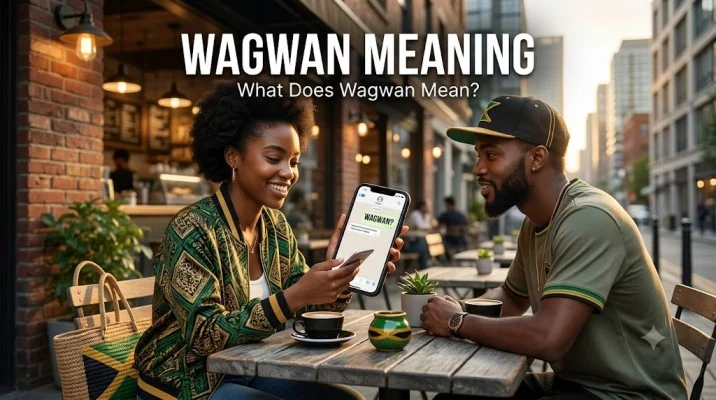
“Wagwan” is Jamaican slang for “What’s going on?” or “What’s up?” It is a casual greeting used to ask how someone is doing or what is happening.
A short message like “Wagwan?” can look confusing if you have never heard the word before. You may see it in a text, TikTok comment, social media post, gaming chat, song, or casual conversation and wonder what the person is actually asking.
If you are learning internet slang, chatting with friends, using dating apps, or simply trying to understand modern British and Jamaican-influenced slang, knowing the wagwan meaning can make conversations much easier to follow. The word is friendly, informal, and often used in the same way as “What’s up?”, “What’s going on?”, or “How are you?”
You may also notice different spellings, such as “wagwan,” “wah gwaan,” or “wah gwan.” They point to the same general expression. The exact tone depends on the speaker, their culture, and the situation.
Definition & Meaning
Wagwan is a casual slang greeting that comes from Jamaican English and Jamaican Creole, commonly called Jamaican Patois or Patwa.
The expression is related to “Wah gwaan?”, which literally asks something close to “What is going on?” In everyday English, however, people usually understand it as:
- What’s up?
- What’s going on?
- How are you?
- What’s happening?
- What are you doing?
It is generally informal and friendly.
For example:
Jay: “Wagwan, bro?”
Mike: “Not much. Just chilling. You?”
Here, “wagwan” is simply a greeting.
It does not always require a detailed answer. Just as someone can say “What’s up?” without expecting a long explanation, “Wagwan?” can work as a quick way to start a conversation.
What Does “Wagwan” Literally Mean?
The expression comes from the phrase “Wah gwaan?”
“Wah” is related to “what,” while “gwaan” comes from a form of “going.” The full expression is therefore connected to the idea of asking what is happening.
But slang is not always best translated word for word. In normal conversation, “Wagwan?” is closer to “What’s up?” than a formal question such as “What is currently happening?”
Example
A: “Wagwan?”
B: “I’m good, fam. How about you?”
The conversation sounds casual and relaxed.
Background & History
The expression wagwan has strong roots in Jamaican language and culture. It is commonly associated with Jamaican Patois, a language variety shaped by English and several African and other linguistic influences.
The phrase “Wah gwaan?” became a familiar Jamaican greeting. Over time, it spread beyond Jamaica through music, migration, television, film, and popular culture.
Reggae and dancehall music played an important role in introducing Jamaican expressions to wider audiences. Later, British urban culture also helped popularize words and phrases influenced by Jamaican English and Caribbean communities.
This is one reason you may hear wagwan frequently in parts of the United Kingdom, especially in informal speech and youth culture.
The spelling wagwan is often used online because it represents how the phrase sounds when spoken quickly. Other spellings include:
- Wah gwaan
- Wah gwan
- Wagwan
- Wag one
These spellings do not always represent different meanings. Online writing is flexible, so people may spell slang according to pronunciation or personal style.
Today, the word can appear in text messages, social media comments, memes, music, gaming communities, and casual conversations.
However, it is important to remember that wagwan is not simply a random internet word. It has cultural and linguistic roots, particularly in Jamaican speech.
Usage in Various Contexts
The meaning of wagwan usually stays close to “What’s up?”, but its tone can change depending on the setting.
1. Texting
A friend might text:
“Wagwan?”
You could reply:
“Nothing much. Just got home.”
It is short, casual, and friendly.
2. Social Media
Someone might comment:
“Wagwan 😂”
This can simply be a playful greeting.
Another person might write:
“Wagwan everyone? Who’s online?”
Here, it means something like “What’s up, everyone?”
3. Gaming
In an online gaming chat, someone could say:
“Wagwan, team?”
A natural response could be:
“All good. Ready for the next match.”
It works as an informal way to greet teammates.
4. Casual Conversation
Person 1: “Wagwan, mate?”
Person 2: “I’m good. What are you saying?”
This is a relaxed exchange between friends.
5. Music and Pop Culture
You may hear wagwan in lyrics, interviews, videos, or entertainment content connected with Jamaican or British urban culture.
In these settings, it often helps create a casual, culturally specific voice.
6. Dating Apps
Someone might open a chat with:
“Wagwan 👋”
They are probably just saying:
“What’s up?”
It is not automatically a romantic or sexual phrase.
Common Misconceptions & Clarifications
Because wagwan is slang, people sometimes misunderstand it.
Misconception 1: It Means Something Rude
Usually, it does not.
Wagwan is generally a casual greeting. It can sound bold or playful, but the word itself is not normally offensive.
Misconception 2: It Always Means “What Are You Doing?”
Not exactly.
It can ask what someone is doing, but it can also simply mean “What’s up?” or “How are things?”
The context tells you which interpretation makes the most sense.
Misconception 3: It Is Only an Internet Word
No.
The expression existed in spoken Jamaican language long before social media. The internet helped spread it to a wider audience.
Misconception 4: Every Jamaican Person Uses It
You should not assume that every Jamaican speaker uses the expression in exactly the same way.
Language varies by person, region, age, community, and situation.
Misconception 5: Any Spelling Is Completely Correct
You may see several spellings online. Wagwan and wah gwaan are common forms, but spelling slang phonetically can vary.
Similar Terms & Alternatives
English has many casual greetings that can replace wagwan depending on the audience.
“What’s up?”
This is probably the closest everyday American English equivalent.
“What’s up, man?”
“What’s going on?”
This is slightly more literal.
“What’s going on with you?”
“How are you?”
This focuses more directly on someone’s condition.
“What’s happening?”
This asks about current events or activities.
“How’s it going?”
A very common casual greeting.
“You good?”
This can mean “Are you okay?” or simply work as an informal greeting in some contexts.
| Expression | Meaning | Tone |
|---|---|---|
| Wagwan | What’s up? / What’s going on? | Casual |
| What’s up? | What’s happening? | Casual |
| How are you? | How are you doing? | Neutral |
| How’s it going? | How are things? | Casual |
| What’s happening? | What is going on? | Casual |
| Hello | Greeting | Neutral/formal |
| Hi | Greeting | Casual/neutral |
How to Respond to This Term
The easiest way to respond to wagwan is to treat it like “What’s up?”
You do not need a complicated answer.
Casual Response
“Not much! You?”
This is one of the safest responses.
Friendly Response
“I’m good, bro. Wagwan with you?”
You can mirror the slang if you feel comfortable using it.
Funny Response
“Wagwan? My Wi-Fi is finally working 😂”
A playful answer works well with friends.
Short Response
“All good!”
Perfect for a quick text.
If You Want to Continue the Conversation
“I’m good! Just finished work. What are you up to?”
This turns the greeting into a real conversation.
If You Do Not Know the Expression
You can simply ask:
“Haha, what does wagwan mean?”
There is nothing wrong with asking.
If you are not familiar with Jamaican or Caribbean slang, it is better to ask than to force yourself to use expressions you do not fully understand.
Regional or Cultural Differences
Wagwan has strong Jamaican roots, but its use has spread into other communities.
In Jamaica, expressions connected to “Wah gwaan?” are part of everyday language and cultural speech. Outside Jamaica, the word may be used differently.
For example, in the United Kingdom, you may hear wagwan in informal conversations influenced by Caribbean communities and British urban culture.
Social media has also pushed the expression into global online spaces.
However, there is an important cultural point: using Jamaican expressions does not automatically make someone a speaker of Jamaican Patois.
If you use the word, be aware of where it comes from. Avoid exaggerated accents or mocking imitations. A normal, respectful use is very different from making someone’s language into a joke.
Different Spellings
You may see:
“Wah gwaan?”
“Wagwan?”
“Wah gwan?”
The spelling can change because the phrase is often written based on pronunciation.
Comparison with Similar Terms
Although wagwan and other greetings can overlap, they are not identical in tone or cultural background.
| Term | Basic Meaning | Cultural Background | Formality |
|---|---|---|---|
| Wagwan | What’s up? | Jamaican / Caribbean influence | Very casual |
| What’s up? | What’s happening? | American/English | Casual |
| How are you? | How are you doing? | General English | Neutral |
| Yo | Hey / hello | Informal English slang | Very casual |
| What’s good? | What’s up? | Informal English | Casual |
| How’s it going? | How are things? | General English | Casual |
| Hello | Greeting | General English | Neutral/formal |
The biggest difference is cultural origin.
“Wagwan” carries Jamaican linguistic and cultural roots, while expressions such as “What’s up?” are broader English slang.
Usage in Online Communities & Dating Apps
You may see wagwan on platforms such as TikTok, Instagram, X, Discord, Reddit, and gaming chats.
On social media, it may appear as a quick comment:
“Wagwan 😂”
Someone might use it simply to greet a friend.
On dating apps, the meaning is usually just as simple.
Person A: “Wagwan 👋”
Person B: “Hey! I’m good, how are you?”
There is no hidden romantic meaning built into the word.
Dating Tip
Do not automatically interpret wagwan as flirting.
The person’s other messages matter more.
For example:
“Wagwan 😊”
is simply a casual greeting.
But:
“Wagwan, you look amazing 😏”
has a more flirtatious tone because of the rest of the message.
Gaming Communities
In gaming, it can be used as a quick greeting:
“Wagwan guys, ready?”
A simple response like:
“Yeah, let’s go!”
works perfectly.
Hidden or Offensive Meanings
There is no standard offensive meaning attached to the word wagwan.
Its normal use is friendly and conversational.
Still, context matters.
Someone could use it sarcastically:
“Wagwan, genius 🙄”
The greeting itself is not offensive. The sarcasm comes from the surrounding words and tone.
There is another issue worth understanding: cultural misuse.
Because the expression comes from Jamaican language and culture, deliberately copying a Jamaican accent or using the term to stereotype Jamaican people can be disrespectful.
The best approach is simple: understand the origin and use the word naturally rather than turning it into a caricature.
If someone uses wagwan with you online, there is usually no reason to assume anything negative.
Suitability for Professional Communication
Wagwan is generally too informal for professional communication.
You would usually avoid it in:
- Business emails
- Job applications
- Formal reports
- Academic writing
- Customer-service messages
- Professional presentations
- Official workplace communication
Instead of:
“Wagwan, can you send the report?”
use:
“Hi, could you please send the report?”
Instead of:
“Wagwan team!”
in a formal work email, use:
“Hello everyone,”
or:
“Hi team,”
However, professional communication is not always stiff. If you work in a relaxed environment and know your colleagues well, informal slang may occasionally appear in casual chats.
For example, a private team chat may be much less formal than an official client email.
The key is to match the language to the audience and setting.
FAQs
What does wagwan mean?
Wagwan means “What’s up?”, “What’s going on?”, or “How are you?” It is a casual greeting with Jamaican linguistic roots.
Is wagwan Jamaican slang?
Yes. Wagwan comes from the Jamaican expression “Wah gwaan?” and is strongly associated with Jamaican English and Jamaican Patois.
How do you respond to wagwan?
You can respond with “Not much, you?”, “I’m good!”, “All good,” or another casual greeting.
Is wagwan rude?
Usually, no. It is generally a friendly and informal greeting. The tone can change depending on the speaker and context.
Does wagwan mean “what are you doing”?
It can ask about what someone is doing, but it more broadly means “What’s up?” or “What’s going on?”
Is wagwan appropriate at work?
It is usually too informal for professional communication, especially in emails, reports, and formal business settings.
What is the difference between wagwan and what’s up?
They have very similar meanings, but wagwan has Jamaican linguistic and cultural roots, while “what’s up?” is a broader English expression.
Conclusion
Wagwan is a friendly, informal greeting that comes from Jamaican language and culture. It is commonly understood as “What’s up?”, “What’s going on?”, or “How are you?” The phrase “Wah gwaan?” is closely connected to its origin, while spellings such as wagwan are common online.
You may see the word in texts, social media comments, gaming chats, music, and dating-app conversations. In most cases, it is simply a casual way to start talking.
If someone messages you “Wagwan?”, you can answer naturally with “Not much, you?” or “I’m good!” Just remember that the word has Jamaican cultural roots, so it is best used respectfully and without exaggerated imitation.
Read More Related Articles:
What Does OFC Mean| Complete Meaning, Origin, Usage …
What Does Sigma Mean| Complete Meaning, Origin, Usage …
What Does TBH Mean| Complete Meaning, Origin, Usage …