Have you ever read a news headline saying that a politician was censured or heard someone say a person faced public censure? If so, you may have wondered what that actually means. You’re not alone. Many students, professionals, writers, and even social media users come across this word but aren’t always sure how to use it correctly.
If you’re part of my target audience you’re learning English, improving your vocabulary, preparing for exams, reading the news, or simply curious about new words this guide is for you. I’ll explain everything in simple language and speak directly to you so the meaning becomes easy to remember. While censure appears most often in politics, workplaces, schools, and formal discussions, you may also see it mentioned on social media when people criticize public figures. Understanding this word helps you communicate more clearly and understand important conversations with confidence.
Definition & Meaning
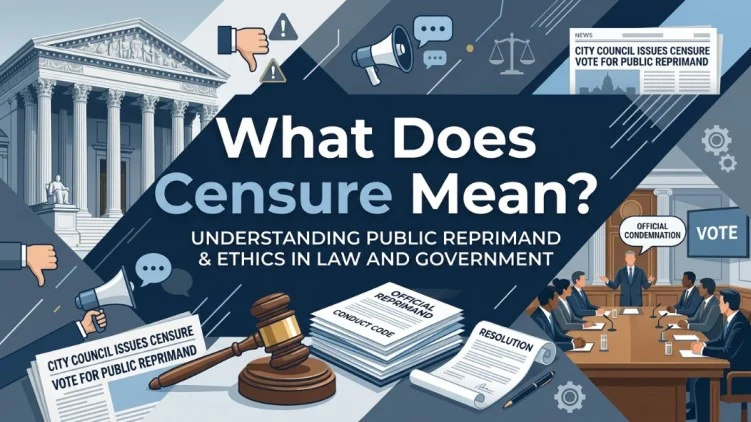
Censure means strong official criticism or formal disapproval of a person’s behavior or actions.
It can be used as both a noun and a verb.
- As a noun: formal criticism.
- As a verb: to officially criticize someone.
Unlike casual criticism, censure usually comes from a group, organization, government, workplace, or authority.
Simple Definition
Censure means expressing strong official disapproval of someone’s actions without necessarily removing them from their position.
Examples
- The school board issued a censure against the principal.
- The council voted to censure the member.
- The company faced public censure after the incident.
Everyday Examples
- A teacher may censure a student for cheating.
- A company may censure an employee for breaking policy.
- A government may censure an official for unethical behavior.
Although the word sounds serious, it does not automatically mean punishment. Often it is an official statement showing disapproval.
Background & History
The word censure comes from the Latin word censura, which referred to the judgment made by Roman officials known as censors. These officials reviewed public behavior and maintained moral standards.
During the Middle Ages, the word entered French before becoming part of English in the 1500s. At first, it simply meant “judgment.” Over time, its meaning shifted toward negative judgment or official criticism.
Today, the word is common in:
- Politics
- Government
- Law
- Business
- Education
- News reporting
Modern news frequently reports that lawmakers, judges, or officials have been censured after violating ethical standards.
Although the word is old, it remains highly relevant because organizations still use formal criticism instead of immediate dismissal in many situations.
Usage in Various Contexts
Although censure is mainly a formal word, it appears in several different situations.
Professional Workplace
Manager: “The employee ignored safety rules.”
HR: “The company decided to issue a formal censure.”
Politics
Reporter: “Why was the senator censured?”
Analyst: “The senate officially criticized the senator’s conduct.”
School
Teacher: “The committee issued a censure after repeated misconduct.”
Social Media
Someone might post:
“The celebrity received widespread public censure online.”
Here, the criticism may not be official, but people borrow the word because it sounds formal.
Gaming
The word is uncommon in gaming, but players may jokingly say:
Player A: “You stole all the loot.”
Player B: “The guild officially censures you!”
This is usually humorous rather than serious.
Texting
Because censure is formal, people rarely use it in everyday texting. Most people simply say:
- criticized
- called out
- condemned
- blamed
Common Misconceptions & Clarifications
Many people confuse censure with similar words.
Misconception 1: It Means Being Fired
Not necessarily.
A person can be censured and still keep their job.
Misconception 2: It’s the Same as Censor
This is one of the biggest mistakes.
| Word | Meaning |
|---|---|
| Censure | Official criticism |
| Censor | Remove or block information |
Example:
❌ The government censured the movie.
✅ The government censored the movie.
Misconception 3: It Means Punishment
Sometimes it comes with consequences.
Sometimes it’s simply an official statement of disapproval.
Misconception 4: It Is Always Political
No.
Schools, companies, organizations, and professional groups also use the word.
Similar Terms & Alternatives
Several words have meanings close to censure, but each has a different tone.
| Word | Meaning | Strength |
|---|---|---|
| Criticize | Point out faults | Mild |
| Reprimand | Official warning | Medium |
| Condemn | Strong disapproval | Strong |
| Rebuke | Sharp criticism | Medium |
| Admonish | Gentle warning | Mild |
| Denounce | Public condemnation | Very Strong |
| Scold | Informal criticism | Mild |
Choose the word that best matches the situation.
How to Respond to This Term
If someone says a person has been censured, your response depends on the situation.
Casual
“I didn’t know it was that serious.”
Funny
“Sounds like someone got an official timeout.”
Professional
“I understand the organization formally expressed its disapproval.”
Privacy-Conscious
“I’d rather wait until all the facts are available.”
Example Dialogue
Friend: “The board censured the manager.”
You: “Was it just criticism, or did they lose their job?”
Regional or Cultural Differences
The word censure exists in English-speaking countries worldwide, but usage differs.
United States
Often heard in Congress, politics, and legal discussions.
United Kingdom
Appears in parliamentary debates and official reports.
Canada
Used in government, education, and workplace policies.
Australia
Mostly appears in legal and political reporting.
Other Languages
Many languages have similar words meaning official criticism, although the exact vocabulary differs.
Because censure is formal English, learners may encounter it in academic reading before hearing it in daily conversation.
Comparison with Similar Terms
| Term | Formal? | Official? | Means Criticism? | Means Removal? |
|---|---|---|---|---|
| Censure | Yes | Yes | ✅ | ❌ |
| Criticism | No | Sometimes | ✅ | ❌ |
| Reprimand | Yes | Usually | ✅ | ❌ |
| Condemn | Yes | Sometimes | ✅ | ❌ |
| Punishment | Yes | Yes | Sometimes | Often |
| Censor | Yes | Yes | ❌ | ❌ |
The biggest confusion remains between censure and censor.
Usage in Online Communities & Dating Apps
Unlike slang terms, censure is uncommon on dating apps like Tinder.
However, you may see it on:
- Reddit discussions
- X (Twitter)
- Political forums
- News comments
Example:
“The company deserves public censure.”
On social media, the word often describes widespread public criticism rather than official discipline.
Tips
- Read the surrounding conversation.
- Notice whether the criticism is official or public opinion.
- Don’t confuse it with internet slang.
Hidden or Offensive Meanings
The word censure is not offensive.
It has no hidden slang meaning.
However, because it expresses serious criticism, using it incorrectly may sound dramatic.
For example:
Instead of saying:
“My friend censured my haircut.”
You would naturally say:
“My friend criticized my haircut.”
Tone matters.
Formal situations make the word sound natural.
Casual conversations usually do not.
Suitability for Professional Communication
Yes.
Censure is highly appropriate in professional writing.
Common places include:
- Legal documents
- HR reports
- Government statements
- Academic papers
- News articles
Professional Alternatives
- Formal criticism
- Official reprimand
- Statement of disapproval
- Disciplinary action (when appropriate)
Workplace Example
“The committee issued a formal censure following the ethics investigation.”
This sounds clear, professional, and accurate.
FAQs
What does censure mean in simple words?
It means expressing official or formal disapproval of someone’s actions.
Is censure a punishment?
Not always. It is usually an official criticism but doesn’t necessarily remove someone from their position.
What’s the difference between censure and censor?
Censure means official criticism, while censor means blocking or removing content.
Is censure a legal term?
It can be used in legal, governmental, and organizational settings, but it is also a general English word.
Is censure negative?
Yes. It always expresses disapproval.
Can a person be censured without being fired?
Yes. Many organizations formally censure people while allowing them to remain in their role.
Conclusion
Understanding censure is easier once you know that it simply refers to official or formal criticism. Unlike everyday complaints, censure usually comes from an authority such as a government body, workplace, school, or professional organization. It does not automatically mean someone is fired or punished, although it can have serious consequences. It’s also important to remember that censure and censor are completely different words, despite their similar spelling. Whether you’re reading political news, writing professionally, studying English, or expanding your vocabulary, knowing how and when to use censure will help you communicate with greater accuracy and confidence. The next time you encounter this word, you’ll understand both its meaning and the context in which it is most appropriately used.
Discover More Post:
What Does the Green Dot Mean on Snapchat – Punzelo.com
What Does OFC Mean| Complete Meaning, Origin, Usage …