A restaurant menu caught my attention after a small symbol appeared beside several dishes, and a quick conversation with the server introduced the phrase what does kosher mean. It turned out to be one of those expressions people often notice without fully understanding. The same word can appear on food packaging, in travel guides, news stories, and everyday conversations, making it more familiar than many people realize.
The interesting part is that its meaning goes beyond a simple label, and the context often shapes how people use it. Some encounter it while shopping for groceries, while others hear it in cultural discussions or casual conversations. Understanding what does kosher mean becomes much easier once you see how it is used in real situations, where its background, everyday usage, and practical meaning naturally come together.
What Does Kosher Mean?
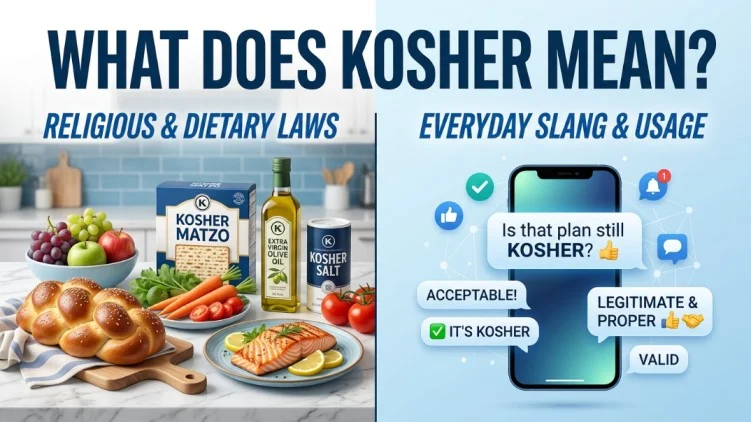
The word kosher most commonly describes food that follows Jewish dietary laws, known as kashrut. Outside of religion, people often use the word informally to mean something is acceptable, proper, legitimate, or above board.
| Detail | Explanation |
|---|---|
| Most Common Meaning | Food prepared according to Jewish dietary laws |
| Full Form | Not an abbreviation |
| Tone | Neutral |
| Common Platforms | Everyday conversation, text messages, social media |
| Formal or Informal | Both, depending on context |
Main Meaning of Kosher
The primary meaning of kosher comes from Jewish religious tradition. Foods labeled kosher have been prepared and handled according to the dietary laws of Judaism. These rules cover which foods may be eaten, how animals are prepared, and how certain foods should be kept separate.
For example:
“This restaurant serves only kosher meals.”
Here, the speaker is talking about food that follows Jewish dietary requirements.
Outside religious discussions, people often hear the word without realizing its original meaning. Because kosher is associated with following established rules, it gradually became an English expression describing something that is honest or acceptable.
Example:
“Everything about that deal looks kosher.”
This means the speaker believes the deal appears legitimate and trustworthy rather than suspicious.
Alternative Meanings of Kosher
Although the religious definition remains the most accurate meaning, the word also has a common figurative use in everyday English.
| Meaning | Context | Tone | Example |
|---|---|---|---|
| Food following Jewish dietary laws | Religion and food | Neutral | “These snacks are kosher.” |
| Acceptable or legitimate | Casual conversation | Neutral | “That plan sounds kosher.” |
| Ethical or fair | Workplace or daily speech | Neutral | “The process was completely kosher.” |
Unlike many internet slang terms, kosher does not have a special meaning on most social media platforms. People usually use the same figurative meaning wherever they post online.
How Context Changes the Meaning
Context is the easiest way to understand what someone means when they say kosher.
If people are discussing restaurants, groceries, holidays, or religion, they are almost certainly referring to Jewish dietary laws.
If they are talking about business, school, friendships, or decisions, they probably mean something is acceptable or legitimate.
Consider these examples.
Example 1
“I only buy kosher meat.”
Meaning: The speaker is referring to food prepared according to Jewish dietary laws.
Example 2
“That explanation doesn’t sound kosher.”
Meaning: The speaker thinks something seems suspicious or dishonest.
Example 3
“Is everything kosher with the project?”
Meaning: Someone is asking whether everything is going smoothly and appropriately.
Even punctuation and tone matter. A serious discussion about food usually points to the religious meaning, while casual conversations often use the figurative one.
What Does Kosher Mean on Different Platforms?
Although kosher is not internet slang, you may still see it across different online platforms.
Text Messages and WhatsApp
In private chats, kosher usually means acceptable or okay.
Example:
“Is our meeting time still kosher?”
The sender simply wants to know whether the plan still works.
Reddit and Online Forums
People often use kosher literally when discussing food, religion, travel, or cooking. In general discussions, it commonly means legitimate or reasonable.
Example:
“Is this seller kosher?”
The question asks whether the seller appears trustworthy.
TikTok and Instagram
On social media, kosher usually keeps its everyday English meaning rather than becoming new slang.
Example:
“That challenge isn’t exactly kosher.”
This suggests the challenge may not be fair or appropriate.
Workplace Chats
In professional messaging apps, people sometimes use kosher informally.
Example:
“Is it kosher to share this document yet?”
The speaker is asking whether sharing the document is appropriate according to company expectations.
Real Conversation Examples
Person A: “Can we eat here?”
Person B: “Yes, it’s a kosher restaurant.”
Meaning: The restaurant follows Jewish dietary laws.
Person A: “Does this business deal look okay?”
Person B: “Yeah, it seems kosher.”
Meaning: The deal appears legitimate.
Person A: “I changed the schedule without asking.”
Person B: “I’m not sure that’s kosher.”
Meaning: The action may not have been appropriate.
Person A: “Can I share your presentation?”
Person B: “Yes, that’s kosher.”
Meaning: Permission has been given.
Person A: “Why is this package labeled kosher?”
Person B: “It meets Jewish dietary requirements.”
Meaning: The label refers to religious food standards.
Tone and Emotional Meaning
Kosher is generally a neutral word. It is not normally emotional or expressive. However, its tone changes depending on how it is used.
Is Kosher Rude?
No. Kosher is not considered rude when used respectfully. Most people use it as another way of saying something is acceptable or legitimate.
However, because the word has religious origins, some people prefer that it not be used casually in situations unrelated to Judaism. Being aware of your audience is always a good idea.
Is Kosher Offensive?
The word itself is not offensive. Problems arise only if someone uses it to mock religious beliefs or stereotypes. When used respectfully and accurately, it is perfectly appropriate.
Is Kosher Funny?
Kosher is not naturally a humorous word. It may appear in jokes because of its figurative meaning, but the humor usually comes from the situation rather than the word itself.
How to Reply to “Kosher”
How you reply depends on how the word is being used. If someone is talking about food, respond based on the dietary meaning. If they are using it informally, reply to whether something seems acceptable or appropriate.
Friendly Replies
If someone says, “Is this kosher?” you could reply with:
- “Yes, everything looks fine.”
- “I think it’s completely okay.”
- “It seems legitimate to me.”
- “No problems from what I can see.”
Polite Replies
When you’re unsure, it’s better to answer carefully.
- “I believe so, but let’s double check.”
- “It appears acceptable.”
- “I’m not entirely certain, so let’s verify first.”
- “From what I know, it should be fine.”
Replies When You Are Confused
If you are unsure which meaning the speaker intends, ask for clarification.
- “Do you mean kosher food or just acceptable?”
- “Are you talking about the religious meaning?”
- “Could you explain what you mean by kosher?”
When to Use the Term
The word kosher is appropriate in several situations when used with the correct meaning.
You can use it:
- When discussing Jewish dietary laws.
- When talking about certified food products.
- In casual conversations to describe something as acceptable or legitimate.
- During friendly discussions where everyone understands the expression.
- In workplace conversations if the tone is informal and the meaning is clear.
Using the word correctly shows that you understand both its religious significance and its common figurative use.
When to Avoid the Term
Although kosher is widely understood, there are situations where clearer wording is better.
Avoid using it:
- In formal business documents where words like appropriate or authorized are clearer.
- In academic writing unless discussing Judaism or food laws.
- When speaking with people who may not understand the figurative meaning.
- In sensitive conversations where the expression could be misunderstood.
- As a joke about religion or religious practices.
If clarity matters, choosing more direct language can prevent confusion.
Common Mistakes
| Common Mistake | Correct Understanding |
|---|---|
| Thinking kosher is only slang | Its primary meaning relates to Jewish dietary laws. |
| Assuming it is an abbreviation | Kosher is a complete word, not an acronym. |
| Believing it always refers to food | It can also mean acceptable or legitimate. |
| Using it in every formal situation | More precise words are often better in professional writing. |
Similar Terms
| Term | Meaning | Main Difference |
|---|---|---|
| Halal | Food permitted under Islamic law | Based on Islamic dietary rules rather than Jewish law. |
| Legit | Genuine or lawful | Informal slang with no religious meaning. |
| Appropriate | Suitable or proper | A standard English word used in formal settings. |
| Acceptable | Allowed or satisfactory | More general and works in almost every context. |
Origin and Popularity
The word kosher comes from the Hebrew word kasher, meaning fit or proper. Its religious use has existed for centuries as part of Jewish dietary law.
Over time, English speakers adopted the word as an everyday expression meaning something is honest, acceptable, or legitimate. While its figurative meaning is common in casual conversation, the religious definition remains the original and most important one.
Quick Recap
- Kosher primarily refers to food prepared according to Jewish dietary laws.
- In everyday English, it can also mean acceptable, proper, or legitimate.
- Context tells you which meaning is intended.
- The word is generally neutral and respectful when used correctly.
- If you’re unsure what someone means, asking for clarification is the best response.
Frequently Asked Questions
What does kosher mean in text?
In text messages, kosher usually means something is acceptable, legitimate, or okay rather than referring to religious food laws.
What does kosher stand for?
Kosher is not an acronym and does not have a full form because it is a standalone word.
What does kosher mean on TikTok?
On TikTok, kosher usually keeps its everyday meaning of acceptable or legitimate unless the content discusses Jewish food or traditions.
Is kosher rude?
No, kosher is generally respectful when used appropriately and with awareness of its religious origin.
Can kosher have different meanings?
Yes, kosher can describe Jewish dietary compliance or, in everyday English, something considered proper, honest, or acceptable.
Final Thoughts
Understanding what does kosher mean is easier once you recognize the context. Its primary meaning relates to Jewish dietary laws, while its everyday English use describes something as acceptable, fair, or legitimate. Both meanings are widely recognized, but they serve different purposes. Paying attention to the conversation, the setting, and the people involved will help you interpret the word correctly. Whether you see it on a food label or hear it in casual conversation, knowing the difference allows you to use the term accurately and respectfully.
Discover More Post:
What Does 67 Mean | Complete Guide to Its Slang, Love, and …
What Does ISTG Mean| Complete Meaning, Origin, Usage …