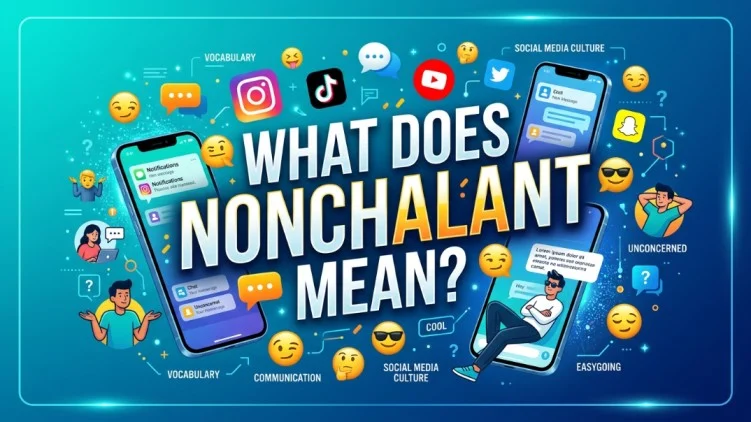
The word what does nonchalant mean has quietly become part of everyday conversations, especially across social media, movies, and casual chats. I first noticed it while reading comments about someone who looked completely calm in a stressful situation. Everyone seemed to understand the term differently, which made it clear that a single word can carry more than one shade of meaning depending on how it’s used.
As I paid closer attention, I found what does nonchalant mean appearing in everything from workplace discussions to celebrity interviews and online memes. Sometimes it describes confidence, while other times it suggests indifference or emotional distance. The context makes all the difference, and that’s what makes this word so interesting. Once you see it used in real-life examples, its meaning becomes much easier to recognize and remember in everyday English.
What Does Nonchalant Mean? Meaning & Definition
Nonchalant is an adjective that describes a person who appears calm, relaxed, and unconcerned, often in a way that suggests they are not worried or excited about something that would normally cause anxiety or enthusiasm. It refers to a casual, indifferent, or seemingly careless attitude toward situations that others might find stressful or significant.
The term is commonly used in:
Everyday conversations
Literature and creative writing
Professional and academic contexts
Social media posts and captions
Personality descriptions
Fashion and style commentary
Psychology and counseling
Because the term has both positive and negative connotations depending on context, understanding its nuance is essential for proper usage.
Definition
| Term | Meaning |
|---|---|
| Nonchalant | An adjective describing someone who appears calm, relaxed, and unconcerned. It suggests an attitude of casual indifference or lack of anxiety, often in situations that might normally cause stress or excitement. |
Pronunciation: Non-sha-lant (NAHN-shuh-lahnt)
Origin
The exact origin of nonchalant can be traced back to French. The word comes from the Old French term “nonchaloir,” which means “to neglect” or “to disregard.” It combines the prefix “non-” meaning “not” with “chaloir” meaning “to be concerned” or “to care.”
Several key points about its history:
The word entered English from French in the 17th century. During this period, French was the language of the English court and high society, and many French words were adopted into English. The term has been used in English literature for centuries to describe characters who remain composed and detached in various situations.
The term gained broader recognition through several key developments:
French language and culture
Adoption into English in the 1600s
Literary usage by prominent authors
Widespread use in everyday English
Modern social media and cultural commentary
Like many words borrowed from French, nonchalant has retained its sophisticated feel while becoming a common part of everyday English vocabulary.
Popularity
Nonchalant became and remains popular because it captures a specific attitude that is widely recognized and valued in various contexts. The concept of appearing calm under pressure has universal appeal.
Several factors contributed to its recognition:
Versatility across different contexts
Descriptive power for personality traits
Use in literature and media
Everyday conversation and writing
Popular culture references
Memes and social media content
Fashion and style commentary
The term’s ability to describe a complex attitude in a single word makes it valuable in both casual and formal communication.
Where You May See Nonchalant
| Platform | Common Usage |
|---|---|
| TikTok | Personality descriptions, fashion content |
| Captions, fashion posts, lifestyle content | |
| X (Twitter) | Personality discussions, commentary |
| Literature | Character descriptions, narrative writing |
| Professional Writing | Personality assessments, performance reviews |
| Everyday Conversation | Describing people’s attitudes and behavior |
| Fashion Media | Describing poses, attitudes, and styles |
How It Is Used
Nonchalant is generally used to describe someone’s attitude or demeanor in various situations.
The intended tone depends heavily on context.
Positive Tone 😎
Used to describe someone who is impressively calm under pressure.
Example:
“She remained nonchalant throughout the entire interview.”
Negative Tone 🙄
Used to describe someone who appears indifferent or uncaring.
Example:
“His nonchalant attitude toward the project was frustrating.”
Fashion and Style Tone ✨
Used to describe a relaxed, effortlessly cool appearance.
Example:
“She struck a nonchalant pose for the camera.”
Descriptive Tone 📝
Used to simply describe someone’s demeanor.
Example:
“He gave a nonchalant shrug and walked away.”
Examples
Positive Examples
These examples show how nonchalant is used positively.
“She handled the crisis with a nonchalant grace that impressed everyone.”
“Despite the pressure, he remained nonchalant and focused.”
“Her nonchalant confidence made her a natural leader.”
“He answered the difficult questions with nonchalant ease.”
Neutral Examples
These examples show neutral usage of the term.
“He shrugged nonchalantly and continued walking.”
“His nonchalant demeanor made it hard to read his emotions.”
“She gave a nonchalant wave and left the room.”
Negative Examples
These examples show how nonchalant can be used negatively.
“His nonchalant attitude toward his work was concerning.”
“Her nonchalant response to the serious issue seemed inappropriate.”
“The teacher was frustrated by the student’s nonchalant approach to studying.”
Fashion and Style Examples
These examples show how nonchalant is used in fashion contexts.
“She posed with a nonchalant look that made the outfit look effortless.”
“The model’s nonchalant attitude added to the cool vibe of the photo shoot.”
“His nonchalant style is what makes him so fashionable.”
Professional Examples
Nonchalant is appropriate in professional settings when used carefully.
“Her nonchalant handling of the crisis demonstrated remarkable composure.”
“We need to address his nonchalant approach to deadlines.”
“The candidate’s nonchalant confidence was impressive during the interview.”
Comparison with Similar Terms
Many words describe calmness or indifference. Here’s how nonchalant compares.
| Term | Meaning | Connotation |
|---|---|---|
| Nonchalant | Calm, relaxed, unconcerned | Can be positive or negative |
| Casual | Relaxed, informal | Neutral, positive |
| Indifferent | Not caring, unconcerned | Often negative |
| Composed | Calm, in control | Positive |
| Unconcerned | Not worried or anxious | Neutral |
| Aloof | Distant, detached | Often negative |
| Blasé | Unimpressed, indifferent | Often negative |
| Relaxed | Free from tension | Positive |
Among these terms, nonchalant is unique because it captures a specific blend of calmness and casual indifference that can be interpreted positively or negatively depending on context.
Alternate Meanings
Unlike some words that have multiple unrelated definitions, nonchalant has one primary meaning related to calm indifference.
However, the term can be interpreted differently depending on context:
Positive Nonchalance
Impressive calmness and composure under pressure.
Negative Nonchalance
Disrespectful indifference or lack of care.
Stylish Nonchalance
Effortless coolness or relaxed style.
Feigned Nonchalance
Pretended indifference masking genuine concern.
When you encounter nonchalant in any context, the surrounding conversation usually indicates whether the usage is positive, negative, or neutral.
Professional or Polite Alternatives
If you want to describe someone’s calm demeanor or attitude in professional settings, here are some alternatives.
| Situation | Better Alternative |
|---|---|
| Performance review | “She maintains composure under pressure.” |
| Professional recommendation | “He demonstrates calm confidence.” |
| Formal writing | “Their demeanor was consistently composed.” |
| Positive feedback | “She handles challenges with remarkable poise.” |
| Constructive feedback | “A more engaged approach would be beneficial.” |
| Personality description | “He has an even-tempered and steady disposition.” |
These alternatives communicate similar meanings in more formal or specific contexts.
Common Mistakes
Many people misunderstand or misuse nonchalant. Here are the most common mistakes.
Confusing Nonchalant with Indifferent
Some people believe nonchalant and indifferent mean the same thing.
They are related but different.
Nonchalant suggests calmness and lack of anxiety. Indifferent suggests a complete lack of interest or concern.
Using It Only Negatively
Some people assume nonchalant is always negative.
It is not.
Nonchalant can be a positive quality, especially when describing someone who remains calm under pressure.
Mispronouncing the Word
The correct pronunciation places emphasis on the final syllable: NAHN-shuh-lahnt.
Using It to Describe Inanimate Objects
Nonchalant describes people and their attitudes, not objects.
Assuming It Means Lazy
Nonchalant does not mean lazy. It means calm and unconcerned, not unwilling to work.
Quick Tips
Keep these practical guidelines in mind when using or encountering nonchalant.
- Nonchalant means calm, relaxed, and unconcerned.
- It can be used positively or negatively depending on context.
- Pronounce it as NAHN shuh lahnt.
- Use it to describe people and their attitudes.
- Remember that nonchalance can be impressive or frustrating.
- Consider whether you mean calm composure or careless indifference.
- When in doubt, use more specific language.
- Respect the nuance of the word in different contexts.
FAQ
What does nonchalant mean in simple terms?
In simple terms, nonchalant means calm and relaxed, not showing worry or excitement. A nonchalant person appears cool and unbothered by things that might stress others.
Is nonchalant positive or negative?
Nonchalant can be both positive and negative. Positively, it describes impressive calmness under pressure. Negatively, it can describe frustrating indifference or lack of care.
What does nonchalant mean in a relationship?
In a relationship, nonchalant can describe a partner who appears calm and unbothered. This might be positive if it shows security and confidence, or negative if it suggests a lack of investment or care.
How do you pronounce nonchalant?
Nonchalant is pronounced “NAHN-shuh-lahnt.” The emphasis is on the first syllable.
What is the difference between nonchalant and indifferent?
Nonchalant suggests calmness and lack of anxiety. Indifferent suggests a complete lack of interest or concern. Nonchalant people may still care; they just don’t show anxiety.
What are synonyms for nonchalant?
Common synonyms include casual, composed, relaxed, unconcerned, and cool. More formal synonyms include imperturbable and unflappable.
What is the noun form of nonchalant?
The noun form is nonchalance. For example, “She handled the situation with impressive nonchalance.”
Is nonchalant a good thing?
It depends on the situation. Nonchalance can be a positive quality when it shows composure and self-confidence. It can be negative when it suggests lack of care or effort.
Can nonchalant be used as an adverb?
Yes, the adverb form is nonchalantly. For example, “He shrugged nonchalantly and walked away.”
Conclusion
So, what does nonchalant mean? It describes someone who appears calm, relaxed, and unconcerned, often in situations that might normally cause stress or excitement. The word comes from French and has been part of English vocabulary for centuries. Whether used positively to describe impressive composure or negatively to describe frustrating indifference, nonchalant captures a specific and recognizable attitude.
Understanding words like nonchalant enriches your vocabulary and helps you communicate more precisely. The term’s journey from French through literature to modern everyday usage demonstrates how language evolves to capture complex human experiences. Whether you’re describing someone’s behavior in a professional context, writing a character in a story, or simply choosing the right word for a social media caption, knowing the meaning and proper usage of nonchalant enhances your ability to express yourself effectively.
When using nonchalant, consider the context and whether you intend to convey admiration for calm composure or criticism of careless indifference. The word’s nuance makes it both valuable and potentially ambiguous, so clear communication requires attention to tone and context. By understanding these subtleties, you can use nonchalant with confidence and precision.
Discover More Post:
What Does It Mean When You Dream About Someone
What Does ISTG Mean| Complete Meaning, Origin, Usage …