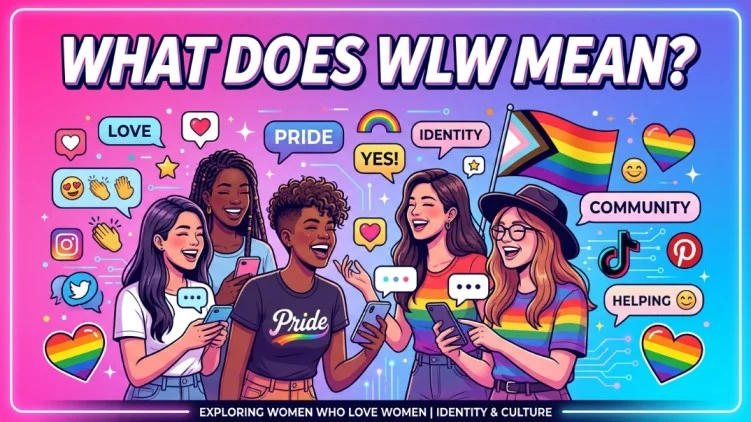
If you’ve spent time on TikTok, Instagram, X (formerly Twitter), Tumblr, or in LGBTQ+ communities online, you’ve probably come across the acronym WLW and wondered what it means. Like many identity-related terms, its meaning isn’t immediately obvious to everyone, and the way people use it can vary depending on the context and community.
Understanding modern LGBTQ+ terminology is becoming increasingly important as conversations about identity and sexuality evolve. Some abbreviations are simple labels, while others serve as inclusive umbrella terms that help people find community and representation. WLW falls into the latter category, making it especially important to understand its meaning, origins, and appropriate usage.
This guide explains what does WLW mean, where it came from, why it became popular, how people use it online, and when you should use it appropriately. You’ll also find examples, comparisons with similar terms, common mistakes, FAQs, and practical tips to help you understand this important identity acronym.
What Does WLW Mean? Meaning & Definition
WLW is an internet acronym that stands for “women loving women” or “women who love women.” It is an inclusive umbrella term used to describe women and non-binary people who are romantically or sexually attracted to other women.
The term is commonly used in:
- TikTok videos and hashtags
- Instagram posts and bios
- X (Twitter) conversations
- Tumblr communities
- Discord servers
- Dating apps
- LGBTQ+ content and discussions
Because the acronym is sometimes misunderstood, some users may not immediately recognize what it means. For example, TikTok user @ihatebodhi once thought WLW meant “winners love winning” and was confused when masculine lesbians started DMing him after he used the hashtag.
Definition
| Term | Meaning |
|---|---|
| WLW | Internet acronym meaning “women loving women” or “women who love women.” It is an inclusive umbrella term for women and non-binary people attracted to women, encompassing lesbians, bisexual women, pansexual women, and other queer identities. |
Pronunciation: Most users spell out the letters individually: W-L-W. Some pronounce it as “wuh-luh-wuh.”
Origin
The origin of WLW can be traced back to the early 20th century, with deep roots in Black American communities. The phrase “woman-loving woman” emerged during the Harlem Renaissance (1919–1939), a culturally significant period for Black people in the 1920s and 1930s.
Several key points about its history:
The term “woman-loving woman” was used exclusively by and for women within the Black community during the Harlem Renaissance. It was notably used by Ruth Ellis, a Black lesbian activist who lived in the twentieth century, to describe women who engaged in same-sex sexual relations.
The term has deep connections to Black female blues artists like Bessie Smith. During this era, being a lesbian was taboo, though bisexuality was somewhat more accepted. The acronym helped maintain secrecy in a culture filled with prejudice against women, Black people, and especially Black women.
The term gained broader recognition through several key developments:
- Harlem Renaissance and Black queer culture
- Black American Vernacular English
- Rise of the LGBTQ+ movement
- First Urban Dictionary entry in 2004
- LGBTQ+ representation and advocacy
- Social media platforms like Tumblr and TikTok
Like many identity terms with deep cultural roots, WLW has evolved over time and continues to be understood and used in various ways across different communities.
Popularity
WLW became increasingly popular in recent years, particularly on social media platforms like TikTok and Tumblr. The term has partially replaced “gay and lesbian” as common terminology amongst Gen Z users.
Several factors contributed to its widespread recognition:
- TikTok hashtag culture and viral content
- Increased LGBTQ+ representation and visibility
- Inclusivity of bisexual, pansexual, and non-binary individuals
- Tumblr communities and queer content creation
- Gen Z adoption of more inclusive terminology
- Social media discussions and educational content
- Hashtag activism and community building
- Growing acceptance of diverse identities
The term has become particularly significant on TikTok, where #WLW functions as an identity marker and connection tool in online queer communities. It has even spread beyond Western platforms, with the #wlw hashtag rising in the Chinese lesbian community on RedNote following user migration from TikTok.
Where You May See WLW
| Platform | Common Usage |
|---|---|
| TikTok | Hashtags, video descriptions, community content |
| Bios, posts, LGBTQ+ content | |
| X (Twitter) | Identity discussions, community conversations |
| Tumblr | Queer content creation, community building |
| Discord | LGBTQ+ community servers, identity sharing |
| Dating Apps | Profile orientation selection |
| Identity discussions, community forums |
How It Is Used
WLW is used as an inclusive identity label for women and non-binary people who love women. The term functions as an umbrella that covers multiple sexual orientations.
Identity Label Tone 💜
Used when someone describes their attraction.
Example:
“I identify as WLW, which means I’m attracted to women regardless of their gender identity.”
Inclusive Tone 🏳️🌈
Used to encompass diverse identities under one term.
Example:
“WLW includes lesbians, bisexual women, pansexual women, and other queer women.”
Community Tone 💬
Used within LGBTQ+ spaces and discussions.
Example:
“The WLW community on TikTok is incredibly supportive and diverse.”
Educational Tone 📚
Used when explaining the term to others.
Example:
“WLW stands for women loving women. It’s different from lesbian because it’s more inclusive.”
Examples
Self-Identification Examples
These examples show how people describe themselves as WLW.
“I’m a WLW, which means I’m attracted to other women regardless of their gender identity.”
“She identifies as WLW and has dated people of various gender identities.”
“Being WLW means I center my love for women and femmes.”
Important: Always respect how individuals choose to identify themselves.
Community Examples
These examples show how WLW is used in community contexts.
“The WLW hashtag on TikTok has millions of posts.”
“WLW spaces are incredibly welcoming to all women who love women.”
“Finding the WLW community online helped me understand my identity better.”
“WLW content creators are making amazing educational videos.”
Professional Examples
WLW is appropriate in professional settings when discussing identity respectfully.
“The WLW community represents a diverse range of sexual orientations.”
“Our training session will cover inclusive terminology, including WLW.”
“The research focused on WLW experiences in online communities.”
Conversational Examples
These examples show how the term is used in everyday conversations.
“I learned that WLW means women loving women, not winners love winning.”
“The WLW community on TikTok is so supportive.”
“She uses WLW as an inclusive term for her attraction to women.”
Comparison with Similar Terms
Many identity terms describe attraction to women. Here’s how WLW compares.
| Term | Meaning | Focus |
|---|---|---|
| WLW | Women loving women | Inclusive umbrella term |
| Sapphic | Women who love women | Historical, literary roots |
| Lesbian | Women attracted exclusively to women | Specific orientation |
| Bisexual | Attraction to more than one gender | Multiple genders |
| Pansexual | Attraction regardless of gender | All genders |
| Queer | Broad term for non-heteronormative identities | Diverse identities |
Among these terms, WLW is unique because it serves as an inclusive umbrella that centers love for women without specifying exclusive attraction.
Alternate Meanings
Unlike some acronyms with multiple unrelated definitions, WLW has one primary meaning related to identity.
Women Loving Women
The primary meaning, describing attraction between women.
Women Who Love Women
An alternative phrasing of the same meaning.
When you encounter WLW in any context, it almost always refers to the identity term. The acronym’s specificity makes it relatively unambiguous compared to other internet slang.
Professional or Polite Language
If you are discussing WLW in professional or formal settings, here are some respectful language options.
| Situation | Appropriate Language |
|---|---|
| Professional discussion | “WLW is an inclusive term for women who love women.” |
| Educational context | “WLW encompasses lesbians, bisexual women, and pansexual women.” |
| Workplace training | “We respect all identities, including WLW individuals.” |
| Healthcare setting | “Our practice is inclusive of WLW individuals.” |
| Formal writing | “WLW individuals represent a diverse range of orientations.” |
These examples communicate information respectfully and professionally.
Common Mistakes
Many people misunderstand or misuse WLW. Here are the most common mistakes.
Confusing WLW with Lesbian
Some people mistakenly believe WLW and lesbian mean the same thing.
They are different.
Lesbian refers to women exclusively attracted to women. WLW is an inclusive umbrella term that also includes bisexual, pansexual, and other queer women.
Assuming It Only Refers to Cisgender Women
Some people assume WLW only applies to cisgender women.
It does not.
WLW can include non-binary people and transgender individuals.
Misunderstanding the Pronunciation
The acronym is typically spelled out as W-L-W, not pronounced as a word.
Using It Incorrectly
Using WLW as a joke or inappropriately is disrespectful.
It is a valid identity term, not a punchline.
Not Respecting Individual Definitions
Different WLW individuals may define their identity slightly differently.
Always respect how individuals choose to describe themselves.
Quick Tips
Keep these practical guidelines in mind when discussing WLW.
- WLW means women loving women or women who love women.
- It is an inclusive umbrella term, not a specific orientation.
- Respect how individuals choose to identify themselves.
- Avoid confusing WLW with lesbian or other specific orientations.
- Use the term respectfully and appropriately.
- Educate yourself about WLW and other LGBTQ+ identities.
- Support WLW individuals and the LGBTQ+ community.
- Remember that identity is personal and individual.
FAQ
What does WLW mean?
WLW stands for “women loving women” or “women who love women.” It is an inclusive term for women and non-binary people attracted to women.
What does WLW mean on TikTok?
On TikTok, WLW means “women loving women.” It is used as a hashtag and identity label within the LGBTQ+ community on the platform.
What is the difference between WLW and lesbian?
Lesbian typically refers to women exclusively attracted to women. WLW is a broader umbrella term that includes lesbians, bisexual women, pansexual women, and other queer women.
What does WLW mean in LGBTQ+ slang?
In LGBTQ+ slang, WLW is an acronym for “women loving women.” It is used to refer to women or non-binary people who are romantically or sexually attracted to women.
Is WLW the same as sapphic?
WLW and sapphic have similar meanings and are often used interchangeably. Both are umbrella terms for women who love women, though sapphic has historical roots in the poet Sappho.
Where did WLW originate?
WLW originated in the Black community during the Harlem Renaissance (1919–1939). The term “woman-loving woman” was used by Black women, including activist Ruth Ellis, to describe same-sex attraction.
Conclusion
So, what does WLW mean? It stands for “women loving women” or “women who love women,” an inclusive umbrella term for women and non-binary people who are romantically or sexually attracted to women. The term has deep roots in Black American history, emerging during the Harlem Renaissance and being used by Black lesbian activist Ruth Ellis. While it is sometimes confused with lesbian, WLW is a broader term that encompasses lesbians, bisexual women, pansexual women, and other queer identities.
Understanding identity terms like WLW helps create more inclusive and respectful spaces for everyone. The term has gained significant recognition in recent years through social media platforms like TikTok and Tumblr, where it serves as a hashtag and community marker for LGBTQ+ individuals. Whether you are WLW yourself or seeking to understand the identity better, knowing the correct definition and usage is essential for respectful communication.
Discover More Post:
What Does the Green Dot Mean on Snapchat – Punzelo.com
What Does It Mean When You Dream About Someone