Quick Answer:
Fisheye usually refers to an extremely wide angle view or lens that captures a very large area and creates a curved, distorted look. It can also describe a visual effect that resembles the wide, rounded field of view associated with a fish’s eye.
If you have seen the word “fisheye” in a text, comment, or social media post, its meaning may not be as obvious as it seems. The fisheye meaning slang users intend can depend on the conversation and the way the word is used. In everyday English, “fisheye” commonly describes something related to a fish’s eye, while “fisheye” can also refer to a wide-angle visual effect that creates a curved or distorted view.
In informal speech, fisheye slang may describe a particular look or expression, especially when someone appears to be staring. So, what does fisheye mean when you see it online? This guide explains the fisheye meaning in English, its possible uses, and the meaning of fisheye in different contexts. You will also see how phrases such as “big fish eye” can change the meaning.
Definition & Meaning of Fisheye
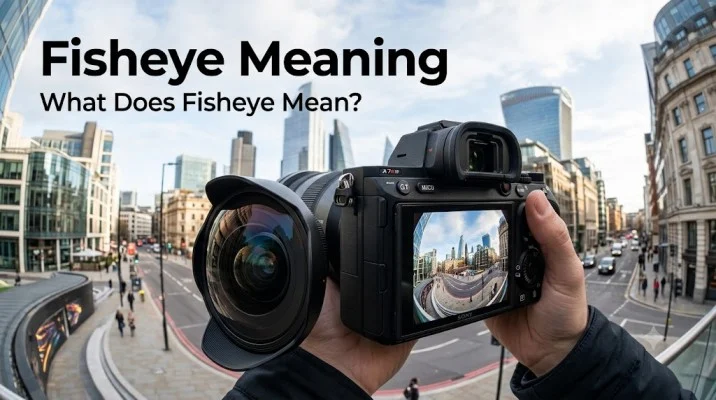
Fisheye is a term used mainly in photography and optics to describe an extremely wide angle view.
A fisheye lens is designed to capture a much wider field of view than a normal camera lens. Some fisheye lenses can capture views approaching or reaching 180 degrees, depending on the lens design. Because such a large area has to fit into a single image, the picture often has strong visual distortion.
For example, imagine standing in the center of a small room.
With a normal lens, you may capture the wall directly in front of you.
With a fisheye lens, you might capture:
- The wall in front of you
- Parts of both side walls
- More of the ceiling
- More of the floor
- A much wider surrounding scene
But there is a trade-off.
The wider the view, the more curved the image may appear.
A straight building may look slightly bent. A person’s face near the edge of the frame may look stretched. A doorway can appear curved instead of perfectly straight.
For example:
Photographer: “Why does the room look curved?”
Friend: “That photo was taken with a fisheye lens.”
The word can also describe the effect itself.
“This video has a cool fisheye look.”
That means the video has the exaggerated wide-angle appearance associated with fisheye photography.
The term comes from the idea that certain lenses provide a field of view similar to the extremely broad visual coverage associated with a fish’s eye.
So, in simple terms:
Fisheye = an extremely wide view that often produces a curved or distorted appearance.
Background & History of Fisheye
The idea behind fisheye optics is much older than modern smartphones and social media filters.
Scientists and optical engineers have long been interested in creating systems that can capture very wide fields of view. The name “fisheye” became associated with lenses designed to produce an unusually broad perspective.
Early fisheye optical systems were useful for scientific and technical purposes because they could capture a large portion of the surrounding environment in one image.
This made the technology useful in areas such as:
- Meteorological photography
- Astronomy
- Scientific imaging
- Surveillance
- Architecture
- Experimental photography
Later, fisheye lenses became popular among creative photographers.
Instead of treating distortion as a problem, photographers began using it as a visual style.
A person could stand close to the camera and appear dramatically larger than the background. Buildings could curve around the frame. Skateboarders could be photographed from unusual perspectives. Interior spaces could look extremely wide.
The style later became popular in music videos, action sports, advertising, filmmaking, and digital media.
Today, fisheye effects are easier to create than ever.
Many smartphones, cameras, editing apps, and social-media filters can reproduce a similar appearance digitally.
This means you do not always need a physical fisheye lens to create the effect.
However, a real fisheye lens produces its appearance through optical design, while an app may create a similar effect through software.
That distinction is useful when someone says:
“This camera has a fisheye lens.”
They are talking about actual camera hardware.
But if someone says:
“I added a fisheye effect to the photo.”
They may simply be describing a digital editing effect.
Usage in Various Contexts
The word fisheye can appear in several different situations. Its meaning depends on what people are discussing.
In Photography
Photography is probably the most common context.
A photographer might say:
“I used a fisheye lens for this shot.”
This means the photographer used an ultra-wide lens designed to create a broad perspective.
Another example:
“The fisheye effect makes the room look enormous.”
Here, fisheye describes the visual appearance.
In Videography
Fisheye lenses are also used for video.
Action sports creators may use them to capture skateboarding, cycling, skiing, or other fast-moving activities.
Filmmaker: “Why is the camera so close to the skateboarder?”
Creator: “The fisheye lens lets us capture the rider and the surrounding scene.”
In Smartphones
Some phones and camera apps offer ultra-wide or fisheye-style effects.
A user might say:
“This camera filter gives the picture a fisheye look.”
That usually means software is creating the appearance rather than a dedicated physical lens.
In Gaming
Fisheye can also describe an exaggerated camera perspective in games.
For example:
“The game feels weird with the fisheye effect turned on.”
This could mean the game’s field of view has been altered, causing objects near the edges to appear stretched or curved.
In Security Cameras
Wide-angle and fisheye cameras can monitor large areas.
For example:
“The store installed a fisheye camera in the center of the ceiling.”
The goal is usually to cover as much space as possible with one camera.
Common Misconceptions & Clarifications
The word fisheye sounds simple, but several misunderstandings are common.
Fisheye Does Not Mean “Blurry”
A fisheye image can be extremely sharp.
The defining feature is wide perspective and distortion, not poor image quality.
Fisheye Does Not Always Mean a Perfect Circle
Some fisheye lenses produce a circular image, while others produce a full-frame image with strong curvature.
So, not every fisheye photo looks like a perfect circle.
Fisheye Is Not the Same as Ultra-Wide
These terms are related, but they are not always identical.
An ultra-wide lens may capture a very large field of view while keeping straight lines relatively controlled.
A fisheye lens usually embraces much stronger distortion.
Fisheye Does Not Mean the Camera Is Broken
If a straight wall looks curved, that may be intentional.
Friend: “Why does the building bend in your photo?”
Photographer: “It’s a fisheye lens.”
The curved appearance is often part of the lens design.
Fisheye Is Not a Specific Camera Brand
“Fisheye” describes a type of optical effect or lens design, not one particular camera manufacturer.
Different companies make fisheye lenses.
Similar Terms & Alternatives
Several terms are related to fisheye photography.
| Term | Meaning | Main Difference |
|---|---|---|
| Fisheye | Extremely wide view with strong distortion | Curved perspective is common |
| Ultra-wide | Very wide camera view | Usually less distortion |
| Wide-angle | Wider than a standard lens | More natural perspective |
| Panorama | Wide scene created from multiple images or a wide capture | May cover a very large area |
| Barrel distortion | Lines curve outward from the center | Describes a type of distortion |
| 360° camera | Captures surroundings in multiple directions | Can record an almost complete environment |
| Perspective distortion | Objects change appearance based on position and viewpoint | Broader optical concept |
The most important distinction is between fisheye and ultra-wide.
An ultra-wide lens tries to give you more of the scene while often maintaining a relatively natural appearance.
A fisheye lens goes much further and often creates a deliberately exaggerated look.
How to Respond to the Term Fisheye
If someone mentions “fisheye,” your response depends on the conversation.
Casual Response
Friend: “I want to buy a fisheye lens.”
You: “Nice! What kind of photos do you want to shoot?”
Photography Response
Photographer: “The fisheye effect works well here.”
You: “Yeah, the curved edges make the shot feel much wider.”
Curious Response
If you do not know the term:
“What does fisheye do to the picture?”
That is a perfectly natural question.
Funny Response
Friend: “Why does my face look huge in this photo?”
You: “The fisheye lens decided you needed a close-up.”
Professional Response
If you are discussing a camera project:
“Are you looking for a true fisheye lens or an ultra-wide lens with lower distortion?”
This question is useful because the two styles can produce very different results.
Regional or Cultural Differences
Unlike internet slang, fisheye does not have a major regional slang difference.
The basic photography meaning is broadly understood across English-speaking photography communities.
However, people may use slightly different terms depending on their field.
Photographers may say:
- Fisheye lens
- Fisheye effect
- Fisheye distortion
- Circular fisheye
- Full-frame fisheye
Video creators may simply say:
- Fisheye look
- Fisheye style
- Wide fisheye
People speaking other languages may translate the concept differently, but the optical idea remains similar.
The word also appears in technical discussions where it may have a more precise meaning than in casual photography.
For example, an engineer discussing a camera system may focus on field of view, projection, distortion, and optical mapping, while a casual photographer may simply say:
“I like the fisheye look.”
So, the meaning stays stable, but the level of technical detail changes with the audience.
Comparison with Similar Terms
Understanding the difference between fisheye, wide-angle, and ultra-wide lenses can prevent confusion.
Fisheye vs. Wide-Angle
A wide-angle lens gives you more of the scene than a standard lens.
A fisheye lens pushes that idea much further.
Wide-angle: More natural perspective.
Fisheye: Much wider perspective with noticeable distortion.
Fisheye vs. Ultra-Wide
An ultra-wide lens can provide a very broad field of view while keeping lines more controlled.
A fisheye lens usually creates a more dramatic curved appearance.
Fisheye vs. Panorama
A panorama is about capturing a wide scene.
A fisheye lens is about how the scene is optically projected into the image.
You can create a panorama without a fisheye lens.
Fisheye vs. 360° Camera
A 360° camera is designed to capture the environment in many directions.
A fisheye lens can have an extremely wide view, but it does not automatically make a camera a 360° camera.
Fisheye in Online Communities & Dating Apps
Fisheye is not normally a dating-app slang term. However, the visual style can appear in online profiles, creative photos, memes, videos, and social-media posts.
On platforms such as Instagram, TikTok, and other visual communities, users may intentionally use fisheye effects to create a dramatic or retro appearance.
For example:
“This profile picture has a fisheye effect.”
That means the image has a very wide, curved perspective.
Why Creators Use It
Fisheye photography can make an ordinary image look more unusual.
It can create:
- A playful appearance
- A dramatic perspective
- A retro camera feel
- An action-sports look
- A surreal visual style
In dating photos, however, heavy fisheye distortion can change the appearance of a person’s face.
A person close to the camera may look very different from how they normally appear.
So if you are using the effect in a profile photo, keep the distortion intentional and moderate.
Hidden or Offensive Meanings
Fisheye is not generally an offensive slang term.
Its primary meanings relate to photography, optics, vision, and visual effects.
However, context still matters.
Someone could use “fisheye” as a joke about how a person looks in a heavily distorted photograph.
For example:
“That fisheye filter made your head look huge 😂.”
That is usually a comment about the camera effect, not a hidden meaning of the word.
There is also a separate phrase, “fish-eye,” that can refer to certain visual or physical appearances in other contexts. Therefore, if you encounter the term outside photography, it is worth checking the surrounding sentence.
The key point is simple:
Fisheye itself is normally neutral.
It becomes potentially insulting only if someone uses the visual distortion to mock another person’s appearance.
Suitability for Professional Communication
Fisheye is completely acceptable in professional communication when you are discussing photography, cameras, video, design, or optics.
For example:
“We used a fisheye lens to capture the entire interior.”
That is perfectly professional.
You can also use terms such as:
- Fisheye lens
- Fisheye distortion
- Fisheye projection
- Ultra-wide lens
- Wide-angle lens
- Field of view
However, if you are speaking to someone unfamiliar with photography, a short explanation can make your message clearer.
Instead of:
“Use a fisheye.”
You could write:
“Use a fisheye lens to capture a very wide field of view with noticeable curved distortion.”
This makes the instruction clear to both beginners and professionals.
FAQs
What does fisheye mean?
Fisheye usually describes an extremely wide-angle view or lens that captures a large field of view and often creates noticeable curved distortion.
Why is it called fisheye?
The name comes from the very broad visual coverage associated with the eye of a fish. The term became associated with optical systems designed to capture an extremely wide field of view.
What does a fisheye lens do?
A fisheye lens captures an unusually wide area of a scene. It often makes straight lines near the edges appear curved.
Is fisheye the same as ultra-wide?
No. Both provide a wide field of view, but fisheye lenses usually create much stronger distortion. Ultra-wide lenses generally aim for a more natural-looking perspective.
Is fisheye distortion bad?
Not necessarily. It depends on your goal. For realistic architecture, distortion may be unwanted. For creative photography, action sports, or artistic videos, it can be exactly what you want.
Can I create a fisheye effect without a fisheye lens?
Yes. Many photo and video editing apps can digitally imitate a fisheye appearance. However, the result may differ from the optical effect created by a real fisheye lens.
Is fisheye a slang word?
Usually, no. Fisheye is mainly a photography and optics term, although people may use it casually when talking about visual effects, filters, cameras, or video games.
Conclusion
The fisheye meaning is simple once you connect it to its visual effect. A fisheye lens captures an extremely wide view and often makes straight lines curve near the edges of the image. Photographers and video creators use this effect for creative shots, action sports, interiors, experimental images, and dramatic videos.
Fisheye is closely related to terms such as wide-angle, ultra-wide, distortion, and 360° imaging, but these concepts are not exactly the same. A real fisheye lens creates its look through optical design, while apps can reproduce a similar effect digitally.
Most importantly, fisheye is not normally slang or an offensive term. In most conversations, it simply refers to a wide-angle visual style, lens, or distortion effect.
Read More Related Articles:
- What Does OFC Mean| Complete Meaning, Origin, Usage …
- What Does Sigma Mean| Complete Meaning, Origin, Usage …
- What Does TBH Mean| Complete Meaning, Origin, Usage …