Quick answer:
“Marple” is mainly a proper name linked to Miss Marple, Agatha Christie’s famous fictional amateur detective. It can also refer to places and surnames, so context matters.
A word can look simple but still leave you wondering what it means. Marple is a good example. You may have seen it in a book, movie title, social media post, username, or conversation and wondered whether it is a normal English word, a name, or some kind of slang.
If you are a fan of mystery stories, you may already know Miss Marple, the clever detective created by Agatha Christie. She is known for noticing small details and understanding human behavior. The name Marple can also refer to real places, family names, and the British television series Agatha Christie’s Marple.
For students, English learners, mystery fans, social media users, and anyone who has come across this unusual word, understanding the context makes the meaning much easier. In this guide, you will learn what marple meaning can refer to, where the name comes from, how people use it, and what similar terms can mean.
Definition & Meaning
Marple is not normally used as a common English word with one simple dictionary definition. It is mainly used as a proper name.
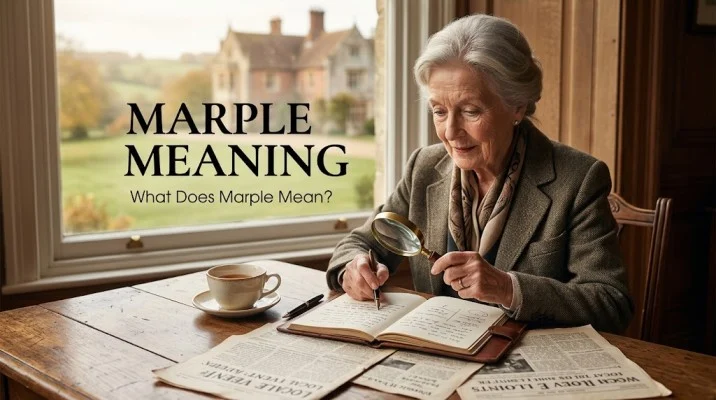
One of its best-known references is Miss Jane Marple, the fictional amateur detective created by Agatha Christie. Oxford describes Miss Marple as a character in several Christie novels who is known for solving mysteries and crimes through her remarkable observations and understanding of people.
The name can also refer to Marple, a town in Greater Manchester, England, as well as Marple Township in Pennsylvania and people with the surname Marple.
This means that the meaning depends on the sentence.
For example:
“I just finished a Miss Marple mystery.”
Here, Marple refers to the fictional detective.
“She lives near Marple.”
Here, Marple may refer to the town in England.
“Mr. Marple joined the meeting.”
Here, Marple is being used as a surname.
You may also see Marple used as the shortened title of Agatha Christie’s Marple, a British television series that aired from 2004 to 2013.
It is important not to automatically assume that marple is internet slang. Some websites describe a supposed modern slang use connected with being clever or mysterious, but this is not a standard, widely established English meaning. The safer interpretation is to look at the surrounding context.
So, if you encounter Marple without any context, think about these possibilities:
| Use | Meaning |
|---|---|
| Miss Marple | Agatha Christie’s fictional detective |
| Marple | A town in Greater Manchester |
| Marple Township | A township in Pennsylvania |
| Marple | A surname |
| Marple | A television title connected with Miss Marple |
Background & History
The most famous meaning of Marple comes from Agatha Christie’s fictional detective, Miss Jane Marple.
Christie introduced Miss Marple in her mystery stories, where she appears as an intelligent amateur detective. Her first appearance was in “The Tuesday Night Club,” and she later became one of Christie’s most recognizable characters. Oxford notes that she first appeared in The Murder in the Vicarage in 1930.
Miss Marple is different from many fictional detectives. She is not presented as a police officer or professional investigator. Instead, she often uses careful observation and her understanding of human nature to solve complicated cases.
Her quiet appearance can make other characters underestimate her.
For example:
Police officer: “I don’t think there’s much she can tell us.”
Miss Marple: “Perhaps I noticed something rather interesting.”
That contrast became an important part of the character.
The origin of the name itself has been discussed in connection with places around England. Sources on the character’s history note possible links between Christie and the name Marple, including Marple Hall and the town of Marple.
Over time, Marple became strongly associated with mystery fiction. The character appeared in novels and short stories and was later adapted for film and television.
The name also became familiar through television. Agatha Christie’s Marple was a British ITV series that ran from 2004 through 2013, featuring Geraldine McEwan and later Julia McKenzie as Miss Marple.
Today, when people mention Marple in a mystery-related conversation, they are often referring to Miss Marple or an adaptation of her stories.
Usage in Various Contexts
The meaning of Marple changes depending on where you see it.
Books and Literature
In literature, Marple usually points to Miss Jane Marple.
“I’m reading a Marple mystery tonight.”
This means the speaker is reading a mystery featuring Miss Marple.
Movies and Television
You may see Marple as a short reference to a television adaptation.
“Have you watched Marple?”
A person may be asking whether you have watched a Miss Marple television adaptation.
Everyday Conversation
People may use the name to describe someone who is unusually good at noticing clues.
“You figured that out before everyone else. You’re basically Miss Marple.”
This is a playful comparison. It suggests that the person is observant or good at solving mysteries.
Social Media
A mystery fan might post:
“Miss Marple remains one of my favorite detectives. 🕵️♀️”
Another person might comment:
“Total Marple energy!”
In this case, the phrase is informal and probably refers to being clever, observant, or interested in solving a mystery. However, this should be understood as a creative reference to the character rather than a fixed dictionary definition.
Gaming
A player might jokingly call another player “Marple” after they discover an enemy’s location.
- Player 1: “How did you know where they were hiding?”
- Player 2: “Pure detective work.”
- Player 1: “Okay, Miss Marple! 😂”
Here, the name is being used as a humorous nickname.
Common Misconceptions & Clarifications
One of the biggest misunderstandings about Marple is assuming that it is a regular English vocabulary word like happy, clever, or mysterious.
It generally is not.
Marple is mainly a proper name. It can refer to a person, place, television title, or fictional character.
Another misconception is that marple automatically means “smart.”
Because Miss Marple is famous for her intelligence and observation skills, people may use her name jokingly to describe someone clever. But that does not mean Marple officially means “smart.”
For example:
“You’re such a Marple.”
This could be a playful way of saying:
“You’re really good at figuring things out.”
However, the meaning comes from the cultural reference to Miss Marple.
Another possible confusion is with similar-looking words such as maple, marble, or marvel.
These words have completely different meanings.
Maple refers to a type of tree.
Marble can refer to a type of stone or a small glass ball used as a toy.
Marvel can mean to feel great surprise or admiration, and it is also associated with the Marvel entertainment brand.
So, always check the spelling before deciding what someone means.
Similar Terms & Alternatives
Several words and names can appear similar to Marple or relate to its most common meaning.
Miss Marple
This is the clearest alternative when talking about the fictional detective.
“Miss Marple solved another mystery.”
Detective
A detective is someone who investigates crimes or mysteries.
This is a general term, while Miss Marple is one specific fictional detective.
Sleuth
A sleuth is another word for a detective or someone who investigates mysteries.
Example:
“She became a real sleuth when the necklace disappeared.”
Investigator
An investigator is someone who examines facts and evidence to discover what happened.
Mystery Solver
This is a casual phrase for someone who enjoys finding answers to puzzles or mysteries.
| Term | Meaning | Connection to Marple |
|---|---|---|
| Marple | Proper name | Commonly linked with Miss Marple |
| Miss Marple | Fictional amateur detective | Main cultural reference |
| Detective | Person who investigates crimes | General category |
| Sleuth | Detective or mystery solver | Similar idea |
| Investigator | Person who examines evidence | Broader term |
| Mystery solver | Person who figures out mysteries | Informal description |
How to Respond to This Term
If someone uses Marple in conversation, your response should depend on what they mean.
If They Mention Miss Marple
You can respond naturally:
“Yes, I know her. She’s one of Agatha Christie’s most famous detectives.”
If They Call You “Miss Marple”
They are probably complimenting your ability to notice details.
You could say:
“Haha, I do like solving mysteries.”
Or:
“Someone has to notice the clues!”
Funny Response
“Give me five minutes and I’ll solve the whole case. 😂”
Casual Response
“Are you talking about Miss Marple?”
This is useful when you are not sure what the person means.
If They Mention the Town
You can ask:
“Do you mean Marple in Greater Manchester?”
This helps separate the place from the fictional character.
If You See It Online
Look at the words around it. If the post mentions books, murder mysteries, detectives, or Agatha Christie, the reference is probably to Miss Marple.
Regional or Cultural Differences
The name Marple does not have a completely different meaning in different English-speaking regions, but people may recognize different references.
In the United Kingdom, Marple can refer to the town in Greater Manchester. It is also strongly recognizable to fans of British mystery fiction because of Miss Marple.
In the United States, people may be more likely to recognize Marple as a reference to Miss Marple or as a surname. There is also Marple Township in Delaware County, Pennsylvania.
For international English speakers, recognition may depend on whether they have encountered Agatha Christie’s stories.
A mystery fan may immediately understand:
“She’s acting like Miss Marple.”
Someone unfamiliar with Christie may simply wonder who Marple is.
This is why cultural references can feel like slang even when they are not actually slang.
The same thing happens with names such as Sherlock, Poirot, or Watson. A person might use these names jokingly because of what the characters represent.
For example:
“Stop being Sherlock.”
This can mean:
“Stop trying to figure everything out.”
Likewise:
“You’re turning into Miss Marple.”
can suggest:
“You’re noticing every little detail.”
Comparison with Similar Terms
If someone uses Marple to describe a person, it is usually an indirect reference to Miss Marple rather than a literal synonym.
| Expression | What it suggests | Tone |
|---|---|---|
| Miss Marple | Clever and observant detective | Playful or complimentary |
| Sherlock | Very good at finding clues | Casual |
| Sleuth | Someone investigating a mystery | Neutral or playful |
| Detective | Person who investigates cases | Neutral |
| Investigator | Person examining facts | Formal |
| Nosy | Someone too interested in others’ business | Often negative |
| Observant | Someone who notices details | Positive |
The distinction between observant and nosy is especially important.
If someone says:
“You’re very observant.”
That is usually a compliment.
If someone says:
“You’re being nosy.”
That suggests the person is asking questions or looking into matters that do not concern them.
Calling someone Miss Marple can fall somewhere between these ideas, depending on tone. It can be a compliment when the person solved a puzzle, but it can also be teasing if they are investigating everyone’s business.
Usage in Online Communities & Dating Apps
You may occasionally see Marple used as a cultural reference on social media, dating apps, forums, and gaming communities.
On a dating profile, someone might write:
“I notice everything. Basically Miss Marple.”
This is likely meant as a humorous statement about being observant.
A person might also say:
“My detective skills are dangerously good.”
Someone replying could joke:
“Okay, Miss Marple, what have you discovered?”
On X, Instagram, Reddit, Discord, or other online communities, the reference may appear in discussions about mystery books, detective shows, or someone uncovering information.
Dating Context
If someone calls you Miss Marple on a dating app, do not immediately assume it is romantic slang.
It most likely means they think you are:
- Observant
- Curious
- Good at noticing details
- Interested in mysteries
- Asking lots of questions
The tone matters.
“You really are Miss Marple 😂”
is likely playful.
“Why are you investigating me like Miss Marple?”
could mean the person feels you are asking too many questions.
A simple response can clear things up:
“Haha, should I take that as a compliment?”
Hidden or Offensive Meanings
There is no widely established offensive meaning of Marple in standard English.
The name itself is generally neutral.
However, the way someone uses it can change the feeling of a sentence.
For example:
“You’re basically Miss Marple.”
This can be positive if someone is praising your observation skills.
But:
“Stop acting like Miss Marple and mind your own business.”
is clearly negative because the speaker is using the detective comparison to criticize someone’s curiosity.
This is an important distinction.
The word Marple is not offensive by itself. The surrounding sentence and tone create the meaning.
You should also be careful with claims that marple is a widespread modern slang word meaning “cool,” “mysterious,” or “smart.” There are online pages making such claims, but these meanings are not supported by the standard references checked here. The established uses are much more closely connected with the proper name, places, and Miss Marple.
Suitability for Professional Communication
Marple is appropriate in professional communication when it is being used as a proper name.
For example:
“The meeting will take place in Marple.”
That is completely normal if Marple refers to the location.
You can also mention Miss Marple in professional writing about literature, television, film, or popular culture.
For example:
“The study examines the portrayal of Miss Marple in British television.”
However, using Marple as informal slang for a clever person may not be suitable in a formal report.
Instead of:
“Sarah is basically Marple.”
a professional document could say:
“Sarah demonstrated strong observational and analytical skills.”
Instead of:
“He’s acting like Miss Marple.”
you could write:
“He is investigating the matter in considerable detail.”
Professional Alternatives
Depending on what you mean, use:
- Observant
- Analytical
- Perceptive
- Investigative
- Detail-oriented
- Thorough
- Careful
These words communicate the idea clearly without relying on a cultural reference.
FAQs
What does Marple mean?
Marple is mainly a proper name. It can refer to Miss Marple, a fictional detective created by Agatha Christie, as well as places and surnames.
Is Marple a slang word?
Not in the standard sense. Some online sources claim informal slang meanings, but the established use of Marple is mainly as a name, place name, or reference to Miss Marple.
Who is Miss Marple?
Miss Jane Marple is a fictional amateur detective created by Agatha Christie. She is famous for solving mysteries through careful observation and an understanding of human behavior.
What does it mean when someone calls you Miss Marple?
It usually means you are being compared to the detective because you are observant, curious, or good at figuring things out. Depending on tone, it can be either playful or teasing.
Is Marple a real place?
Yes. Marple is a town in Greater Manchester, England. There is also Marple Township in Pennsylvania, United States.
Is Marple the same as Sherlock?
No. They are different fictional detective characters. Sherlock Holmes was created by Arthur Conan Doyle, while Miss Marple was created by Agatha Christie.
How is Marple pronounced?
It is commonly pronounced roughly like “MAR-puhl.” The exact pronunciation can vary slightly depending on the speaker and accent.
Conclusion
The meaning of Marple depends on context, but it is most strongly associated with Miss Jane Marple, Agatha Christie’s famous fictional amateur detective. The name can also refer to real places, surnames, and television adaptations.
Unlike ordinary slang, Marple does not have one widely accepted everyday definition such as “cool” or “smart.” When people use the name creatively, they are often borrowing Miss Marple’s qualities, especially her sharp observation and mystery-solving ability.
If someone calls you Miss Marple, they may simply be teasing you for noticing details or asking many questions. In a book or television discussion, however, the reference is almost certainly to the character herself.
The easiest way to understand marple meaning is to check the context. Once you know whether the word refers to a person, place, show, or fictional detective, its meaning becomes much clearer.
Discover More Post:
- What Does FYM Mean in Text and Social Media – Punzelo.com
- What Does “Habibti” Mean in English in 2026 – Punzelo.com
- What Does TTYL Mean| Complete Meaning, Origin, Usage …