Quick answer:
“Salud” is a Spanish word that means “health.” In English-speaking settings, you may also hear “salud!” as a toast, similar to saying “Cheers!” It is often used when people raise their glasses to celebrate, wish someone well, or show good wishes.
You may have heard someone say “salud!” while raising a glass, or you may have seen the word in a text, social media post, or Spanish conversation. But what does it really mean? The simple answer is “health,” although its meaning can change slightly depending on how and where it is used.
If you are learning Spanish, chatting with Spanish-speaking friends, traveling, dating online, or simply trying to understand a phrase you heard in a movie or video, knowing the salud meaning can help you follow the conversation without guessing.
The word is especially common in everyday Spanish. It can refer to physical health, appear in polite expressions, or be used as a friendly toast. You might even hear it after someone sneezes. That makes this small word more useful than it first appears.
Let’s look at its meanings, history, cultural use, online examples, and the best ways to respond.
Definition & Meaning
The Spanish word salud most directly translates to “health” in English.
It comes from the Latin word salus, which was connected with ideas such as health, safety, well-being, and welfare. In modern Spanish, salud is a common everyday noun.
For example:
- La salud es importante. — “Health is important.”
- Cuida tu salud. — “Take care of your health.”
- Buena salud. — “Good health.”
- Por tu salud. — “For your health.”
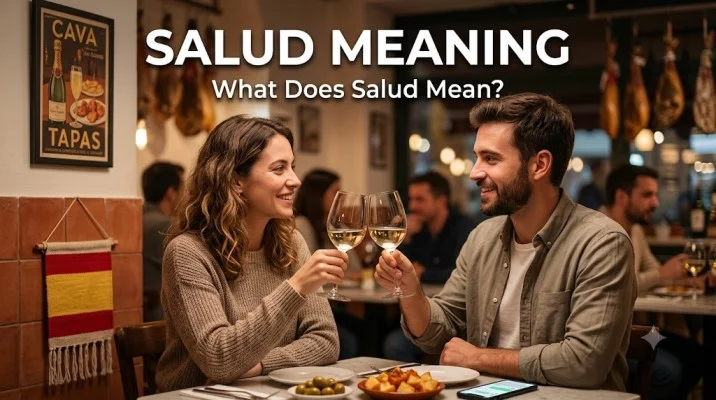
However, salud has another very familiar use. When someone raises a glass and says “¡Salud!”, the word works as a toast.
In this setting, the literal idea is still connected to health and well-being, but the natural English equivalent is often “Cheers!”
Example
Alex: “To our new home!”
Maria: “¡Salud!”
Alex: “Cheers!”
The word can also be heard after someone sneezes. In many Spanish-speaking communities, saying “¡Salud!” after a sneeze is similar to saying “Bless you!” in English.
Another example
- Person 1: “Achoo!”
- Person 2: “¡Salud!”
- Person 1: “Gracias.”
So, the exact meaning depends on context:
| Context | Meaning of “salud” |
|---|---|
| Talking about wellness | Health |
| Raising a glass | Cheers / good health |
| After someone sneezes | Bless you / good health |
| Wishing someone well | Health / well-being |
| Spanish conversation | Health or a related good wish |
This is why translating salud as only one English word can sometimes miss the real meaning.
Background & History
The history of salud goes back to Latin. The Spanish language developed from varieties of spoken Latin, and many common Spanish words still show their Latin roots.
Salud is related to the Latin word salus, which referred to health, safety, welfare, and well-being. The same root is connected to words in other languages, including English words such as salutary.
Over time, the Spanish word developed into the familiar noun salud, with health remaining its central meaning.
The idea of connecting health with good wishes is also very old. When people raise a glass and say “¡Salud!”, they are traditionally wishing health and well-being to others. The practice is not simply about drinking. It carries a social message of friendship, celebration, and goodwill.
The word also became connected with responses to sneezing. Different cultures have developed their own expressions for this situation. In English, people often say “Bless you.” In Spanish, “¡Salud!” is common in many places.
Today, you can hear the word across Spanish-speaking communities in Europe, Latin America, and among Spanish speakers around the world.
Its use is not limited to one age group or social class. You may encounter it at a family dinner, a restaurant, a party, a medical conversation, or a casual chat.
Modern social media has also made the word easy to recognize outside Spanish-speaking communities. Someone may write “¡Salud!” in a caption, comment, meme, or message, especially when talking about celebrations or Spanish culture.
Usage in Various Contexts
The meaning of salud depends heavily on the situation.
1. Everyday Conversation
The most basic use is to talk about health.
Luis: “¿Cómo está tu salud?”
Ana: “Mucho mejor, gracias.”
Here, salud simply means health.
2. Toasting
At a celebration, someone may raise a glass and say:
“¡Salud!”
The closest natural English translation is “Cheers!”
It can be used at birthdays, weddings, dinners, family gatherings, and other celebrations.
3. After a Sneeze
You may hear:
- Person 1: “¡Achís!”
- Person 2: “¡Salud!”
- Person 1: “Gracias.”
Here, the expression is similar to “Bless you.”
4. Texting
In a text, someone might write:
“¡Salud! 🥂”
This could mean “Cheers!” or simply express good wishes.
5. Social Media
A person might post a picture from dinner with:
“Una noche increíble. ¡Salud! 🥂”
The meaning is closer to “Cheers to an amazing night!”
6. Gaming Communities
Spanish-speaking gamers may use salud in casual messages, especially when celebrating a victory or joking with friends.
Player 1: “Ganamos la partida.”
Player 2: “¡Salud! 🎮”
Here, it may function as a playful celebration rather than a literal reference to health.
7. Professional Conversations
In a medical or workplace context, salud normally has its literal meaning.
For example:
“La salud de los empleados es una prioridad.”
This means:
“The health of employees is a priority.”
The same word can therefore move from a serious professional setting to a casual party without changing its basic spelling.
Common Misconceptions & Clarifications
One common mistake is assuming that salud always means “cheers.” It does not.
Its primary dictionary meaning is health. The toast meaning comes from the idea of wishing someone good health.
Another misconception is that salud is only used when drinking. That is also incorrect.
You can use it when talking about:
- Physical health
- Well-being
- Medical matters
- Healthy living
- Sneezing
- Celebrations
- Good wishes
Does “salud” mean “bless you”?
Sometimes, yes.
When someone sneezes, “¡Salud!” can serve a similar social purpose to “Bless you!” However, the literal word itself means health, not “God bless you.”
Does it always have a religious meaning?
No.
Although some English sneeze responses have religious roots, salud itself is a normal Spanish word and does not automatically express a religious belief.
Is “salud” offensive?
Generally, no.
It is an ordinary and widely understood Spanish word. Problems usually arise only when someone uses it sarcastically, mocks an accent, or places it in an inappropriate context.
Is it pronounced like “salute”?
Not exactly.
English speakers may recognize the similar Latin connection, but Spanish pronunciation is different. A rough pronunciation is:
sah-LOOD
The final d is softer than an English “d” in many varieties of Spanish.
Similar Terms & Alternatives
Several Spanish expressions are related to salud, but they are not interchangeable in every situation.
“Bienestar”
Bienestar means well-being or welfare.
Example:
“El bienestar de los niños es importante.”
Translation: “The well-being of children is important.”
“Sano” and “Sana”
These mean healthy.
- sano — masculine
- sana — feminine
Example:
“Es una comida sana.”
Translation: “It is a healthy meal.”
“Saludable”
Saludable means healthy or healthful.
Example:
“Una dieta saludable puede ayudarte.”
Translation: “A healthy diet can help you.”
“Ánimo”
Ánimo can mean encouragement, spirits, or “hang in there,” depending on context. It is not a direct synonym for salud.
“¡Brindemos!”
This means “Let’s toast!” It is more specifically connected to making a toast than salud.
| Spanish expression | Basic English meaning | Main use |
|---|---|---|
| Salud | Health | Health, toast, sneeze |
| Bienestar | Well-being | General welfare |
| Saludable | Healthy | Describing something healthy |
| Sano/Sana | Healthy | Describing a person or thing |
| Ánimo | Cheer/encouragement | Encouraging someone |
| ¡Brindemos! | Let’s toast | Making a toast |
How to Respond to This Term
Your response should depend on why someone said salud.
If Someone Says “¡Salud!” During a Toast
The simplest response is:
“¡Salud!”
You can also say:
“¡Cheers!”
or
“¡Por nosotros!”
If Someone Says “¡Salud!” After You Sneeze
A polite response is:
“Gracias.”
That is the natural answer.
If Someone Uses It in a Text
You can match their tone.
Casual:
“¡Salud! 😄”
Funny:
“¡Salud y felicidad! 😂”
Friendly:
“¡Salud! Hope you’re having a great night.”
If You Are Unsure
You can simply ask:
“Do you mean cheers?”
That avoids guessing and keeps the conversation easy.
Privacy-Conscious Response
If the conversation is about your health and you do not want to share details, you can say:
“Thanks for asking. I’d rather keep the details private, but I appreciate it.”
Understanding the context is more important than memorizing one fixed reply.
Regional or Cultural Differences
Spanish is spoken across many countries, so small differences in expression, pronunciation, and social habits are normal.
The word salud itself is widely understood throughout the Spanish-speaking world. Its basic meaning remains health.
As a toast, ¡salud! is also widely recognized. However, the surrounding customs can vary.
In one country, a group may simply raise glasses and say “¡Salud!” In another, people may use a longer toast or a regional expression.
The same is true after sneezing. ¡Salud! is common, but people may also use other expressions depending on their family, region, or cultural background.
For English speakers learning Spanish, this is an important lesson: Spanish is not exactly the same everywhere.
Mexican Spanish, Argentine Spanish, Spanish from Spain, Colombian Spanish, Puerto Rican Spanish, and other varieties all have their own vocabulary and social habits.
Still, salud is one of the safer words to recognize because its core meaning is broadly understood.
Cultural Tip
If someone says “¡Salud!” while raising a glass, responding with “¡Salud!” is usually a simple and friendly choice.
If someone says it after you sneeze, “Gracias” is more natural.
Comparison with Similar Terms
English has several expressions that can overlap with the different uses of salud.
| Expression | Meaning | When it is used |
|---|---|---|
| Salud | Health / cheers | Health, toast, sneeze |
| Cheers | Good wishes / toast | Drinking or celebration |
| Bless you | Good wishes after sneeze | After someone sneezes |
| Good health | Wish for wellness | Health-related situations |
| Well-being | General health and happiness | Formal or general contexts |
| Take care | Wish someone well | Saying goodbye or showing concern |
| Congratulations | Celebration | Achievement or special event |
The key difference is that salud can cover several social situations while keeping the idea of health or well-being at its center.
For example:
“¡Salud!” during a toast → “Cheers!”
“¡Salud!” after a sneeze → “Bless you!”
“La salud es importante.” → “Health is important.”
The English translation changes because the context changes.
Usage in Online Communities & Dating Apps
You may encounter salud online when people mix Spanish and English.
On platforms such as Tinder, X, Instagram, Discord, and gaming communities, users often switch between languages casually.
Someone might write:
“Long day. ¡Salud! 🥂”
Here, they are probably using the word as a playful way to say “Cheers!”
A dating-app user might write:
“Wine, good music, and ¡salud! 🥂”
That gives the profile a social and celebratory tone.
In gaming communities, a Spanish-speaking player could use it after a successful match:
“¡Ganamos! Salud, equipo.”
The meaning is roughly a celebratory “Cheers, team.”
How Should You Respond?
If you understand the context, matching the energy is usually best.
“¡Salud! 🥂”
“Cheers!”
“Haha, ¡salud!”
If you do not understand what the person means, ask:
“What does salud mean here?”
That is especially useful on dating apps because slang and cultural expressions can sometimes carry different meanings between communities.
Avoid assuming that every Spanish word is flirtatious or suggestive. Most of the time, salud is completely ordinary.
Hidden or Offensive Meanings
The word salud does not have a widely recognized hidden offensive meaning in standard Spanish.
Its normal meanings are positive or neutral:
- Health
- Well-being
- Cheers
- Good wishes
- A response to sneezing
However, tone can change almost any ordinary word.
Someone could use “salud” sarcastically. For example, if a friend makes a ridiculous decision, another friend might jokingly raise a glass and say:
“Bueno… ¡salud! 😂”
The word itself is not offensive. The humor comes from the situation.
There is also a risk of misunderstanding when people translate expressions word-for-word.
If someone says “¡Salud!” after you sneeze, translating it literally as only “health” may sound strange in English. The intended social meaning is closer to “Bless you.”
Likewise, translating a toast as only “health” may miss the natural English equivalent, “Cheers!”
So, context matters more than the single-word translation.
Suitability for Professional Communication
Salud is absolutely appropriate in professional Spanish when it means health.
For example:
“La salud y seguridad de nuestros empleados son una prioridad.”
Translation:
“The health and safety of our employees are a priority.”
It can appear in:
- Medical documents
- Workplace policies
- Public health information
- Academic writing
- News reports
- Business communication
- Government information
However, using “¡Salud!” as a casual toast depends on the setting.
At a formal business dinner, it may be perfectly acceptable if people are making a toast. In a formal email about workplace health, you would not normally use ¡Salud! as a casual sign-off.
Professional Alternatives
Depending on your meaning, use:
- Salud — health
- Bienestar — well-being
- Seguridad y salud — health and safety
- Buena salud — good health
- Cuidar la salud — take care of one’s health
When writing professionally, choose the phrase that clearly expresses your intended meaning.
FAQs
What does “salud” mean in English?
Salud usually means “health.” In a toast, it can naturally mean “Cheers!” After someone sneezes, it can mean something similar to “Bless you.”
Why do Spanish speakers say “salud” when drinking?
They say “¡Salud!” to wish health and well-being to the people taking part in the toast. It is similar to saying “Cheers!” in English.
Does “salud” mean “bless you”?
After a sneeze, “¡Salud!” can serve the same social function as “Bless you.” The literal meaning, however, is related to health.
Is salud Spanish or Portuguese?
Salud is Spanish. The common Portuguese equivalent is “saúde.”
How do you respond to “salud”?
If someone says it as a toast, you can say “¡Salud!” or “Cheers!” If they say it after you sneeze, “Gracias” is the usual response.
Is “salud” a formal word?
Yes. Salud is a standard Spanish word and is suitable for formal contexts when referring to health. Its use as a casual toast is more social.
How do you pronounce “salud”?
It is roughly pronounced “sah-LOOD,” with the stress on the second syllable. Pronunciation can vary slightly by region.
Conclusion
Salud is a simple Spanish word with several useful meanings. Its main translation is “health,” but context can turn it into “Cheers!” during a toast or “Bless you” after someone sneezes.
The word is common in everyday Spanish and appears in conversations about health, celebrations, family life, social media, dating, and online communities. Its basic meaning stays connected to health and well-being, even when the natural English translation changes.
If someone says “¡Salud!” while raising a glass, respond with “¡Salud!” or “Cheers!” If they say it after you sneeze, simply say “Gracias.”
Once you understand the context, this small Spanish word becomes very easy to recognize and use.
Read More Related Articles:
What Does OFC Mean| Complete Meaning, Origin, Usage …
What Does Sigma Mean| Complete Meaning, Origin, Usage …
What Does TBH Mean| Complete Meaning, Origin, Usage …