Quick Answer:
Starling usually means a small to medium sized songbird, especially the European starling. It can also appear as a name or surname, depending on the context.
Have you ever seen the word starling and wondered whether it means a bird, a name, or something more symbolic? You may come across it in a nature article, a book, a social media post, a baby name list, a poem, or even someone’s username. Understanding the context makes the word much easier to understand.
If you are a student, English learner, bird lover, writer, parent choosing a name, or simply someone who came across the word online, this guide will help you understand the starling meaning in simple English. The most common meaning is a bird, but the word can carry different ideas depending on how it is being used.
You may also see starling used in literature and nature writing because the bird is known for living in groups and creating impressive movements in the sky. So, while the word looks simple, it has an interesting history and several uses worth knowing.
Definition & Meaning
The word starling most commonly refers to a type of bird belonging to the starling family, Sturnidae. One of the best known examples is the European starling, scientifically called Sturnus vulgaris.
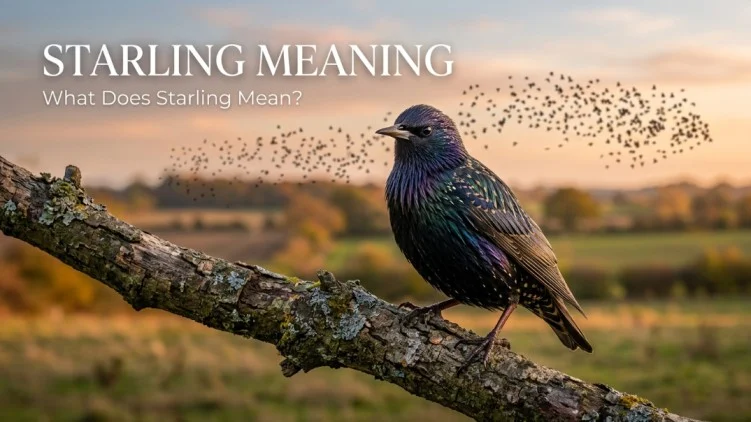
A starling is generally a small to medium sized bird with a pointed bill, strong legs, and glossy feathers. European starlings can appear black from a distance, but their feathers often show purple, green, blue, or other shiny tones when light hits them. They may also have small pale spots, especially during parts of the year.
The word can be used in both singular and plural forms.
Example:
“I saw a starling sitting on the fence.”
Here, starling clearly refers to the bird.
Another example is:
“A group of starlings flew over the field.”
In this sentence, starlings refers to multiple birds.
The word is also connected with the idea of a bird that often gathers in groups. Large groups of starlings can create remarkable formations in the sky. These displays are sometimes called murmurations.
The basic meaning can therefore be summarized as:
| Word | Meaning |
|---|---|
| Starling | A type of songbird |
| Starlings | More than one starling |
| European starling | A common species of starling |
| Starling family | Sturnidae |
| Murmuration | A large group of birds moving together |
However, starling can also be used as a surname, given name, character name, business name, or symbolic word. In those situations, the word does not necessarily refer directly to a living bird.
For example:
“Starling is her last name.”
Here, Starling is a surname.
So, the safest way to understand the word is to look at the sentence around it.
Background & History
The history of starling is quite old. The English word comes from Old English stærlinc, which referred to the bird. Historical sources connect it with older Germanic words for the starling. The word ultimately traces back to an ancient Indo European root associated with the bird.
This means that starling is not a modern internet word or recent slang term. It has been part of the English language for many centuries.
The Old English form was stærlinc. Over time, languages naturally change their pronunciation and spelling, and the modern English form starling developed.
The word is also related to names for similar birds in several older Germanic languages. For example, related forms appear in Old Norse and Old High German. The Latin word sturnus also referred to the starling, which is why the scientific name Sturnus vulgaris reflects the same ancient connection.
How the Meaning Developed
The central meaning has remained surprisingly stable.
Centuries ago, starling referred to the bird.
Today, starling still primarily means the bird.
What has changed is how widely the word is used in modern culture. You may now see it in:
- Nature writing
- Birdwatching communities
- Children’s books
- Poetry
- Fantasy stories
- Character names
- Surnames
- Business names
- Social media usernames
- Baby name discussions
The bird itself has also become well known because of its flocking behavior. Large groups can move together in the sky, creating complex patterns that attract photographers, birdwatchers, and nature lovers.
So, while the dictionary meaning remains simple, starling has developed cultural and symbolic associations with movement, freedom, community, nature, and transformation.
Usage in Various Contexts
The meaning of starling becomes clearer when you look at where the word appears.
1. Everyday Conversation
In normal conversation, starling usually means the bird.
“There was a starling in our garden this morning.”
The speaker is talking about an actual bird.
2. Birdwatching
Birdwatchers often use the word when identifying birds.
“That looks like a European starling.”
Here, the speaker is identifying a specific species.
3. Nature Writing
Writers may use starling to describe movement, sound, or the natural environment.
“The starlings gathered in the trees before sunset.”
This gives the sentence a calm and visual feeling.
4. Literature
A writer may use a starling symbolically.
“She watched the starling disappear into the evening sky.”
The bird could simply be part of the scene, or it could represent freedom or change.
5. Social Media
Someone might post:
“Spotted a beautiful starling today. 🐦”
Here, the meaning is straightforward.
But someone could also use Starling as a username or profile name. In that case, it may have nothing to do with an actual bird.
6. Texting
If a friend sends:
“Look at this starling!”
They probably mean they saw the bird.
If they say:
“Starling is such a pretty name.”
They are talking about the word as a name.
7. Gaming
In a game, Starling may be the name of a character, creature, weapon, location, team, or fictional organization.
For example:
“Starling is my favorite character.”
In this context, you cannot assume the person is talking about a bird.
8. Professional Writing
Scientific, environmental, and educational writing may use the term in its literal sense.
“European starlings are widely recognized for their adaptability.”
Here, starling is being used as a biological term.
Common Misconceptions & Clarifications
One of the biggest misconceptions is that starling means “star like” because the word begins with “star.”
That is not the actual origin of the word.
The word comes from much older names for the bird. Its history is connected to Old English and Germanic bird names rather than the modern English word star.
Is a Starling the Same as a Sparrow?
No.
A starling and a sparrow are different types of birds. They can sometimes appear in similar environments, but they belong to different bird groups.
Is Starling a Type of Crow?
No.
Starlings are not crows. They are different birds with different physical features and classifications.
Is Starling a Bad Word?
No.
Starling is not normally an offensive word. It is an ordinary English noun referring to a bird.
Can Starling Be a Name?
Yes.
Starling can be used as a surname and can also appear as a given name or fictional name.
Does Starling Mean Freedom?
Not literally.
The dictionary meaning refers to the bird. However, writers and artists may use birds, including starlings, as symbols of freedom, movement, travel, or change.
That symbolic meaning depends on the writer.
Is Starling Slang?
No, not in its standard meaning.
Someone might use it creatively online, but starling is not generally considered internet slang.
Similar Terms & Alternatives
Several words are related to starling, especially when talking about birds.
Bird
Bird is the broadest term.
A starling is a bird, but not every bird is a starling.
Songbird
A songbird is a bird known for vocal communication and singing. Starlings belong to a group that is commonly described as songbirds.
Blackbird
Blackbird can refer to different birds depending on the country. In British English, it commonly refers to the Eurasian blackbird, while in North American contexts the term can refer to several different birds.
A starling is not the same species as a blackbird.
Myna
Mynas are members of the starling family and are especially associated with Asia and nearby regions. The common myna is a familiar example.
Sparrow
Sparrows are small birds, but they are not starlings.
| Word | What it means |
|---|---|
| Starling | A bird in the starling family |
| Sparrow | A different group of small birds |
| Blackbird | A common bird name with regional differences |
| Myna | A bird related to starlings |
| Songbird | A broad category of birds |
| Bird | The general category |
Understanding these differences helps prevent confusion when reading bird related content.
How to Respond to This Term
How you respond to starling depends on how someone uses it.
If Someone Talks About the Bird
You can respond naturally:
“Really? What did it look like?”
Or:
“I love watching birds too.”
If Someone Says It Is Their Favorite Bird
You could say:
“What do you like about starlings?”
This keeps the conversation going.
If Someone Says Starling Is a Name
You might respond:
“That is a unique name. I like how it sounds.”
If Someone Uses Starling as a Username
You do not need to assume it has a hidden meaning.
You can simply ask:
“Does your username have a story behind it?”
Funny Response
If a friend suddenly sends you a picture of a starling:
“Okay, bird expert, I see you!”
Or:
“That little guy looks like he owns the neighborhood.”
Professional Response
If the term appears in a work discussion, keep your response direct.
“Are you referring to the European starling?”
This is useful when accuracy matters.
Regional or Cultural Differences
The word starling is widely recognized in English, but the exact bird being discussed can vary depending on the region.
In many English speaking contexts, people use starling when talking about members of the starling family. The European starling is one of the most familiar species associated with the word.
In North America, the European starling is especially notable because it became established there after being introduced in the late nineteenth century. Today, it is a familiar bird across much of the continent.
In Britain and Ireland, people are also familiar with the European starling and its large winter flocks.
Different cultures may have their own names for related birds. For example, mynas are commonly known in South Asia, and they belong to the same broader family as starlings.
This is important because starling does not refer to exactly the same species everywhere. Sometimes the word describes the family, while other times it is being used specifically for the European starling.
Cultural Symbolism
Birds often carry symbolic meanings in literature and culture.
A starling may be associated with:
- Freedom
- Movement
- Community
- Adaptability
- Nature
- Travel
- Change
- Communication
These are symbolic associations, not fixed dictionary definitions.
Comparison with Similar Terms
It is easy to confuse starling with several other bird related words.
| Term | Main meaning | Same as starling? |
|---|---|---|
| Starling | A bird in the Sturnidae family | Yes |
| Sparrow | A small bird from a different family | No |
| Blackbird | A bird name with regional meanings | No |
| Myna | A member of the starling family | Related |
| Crow | A member of the crow family | No |
| Robin | A different bird group | No |
| Songbird | A broad bird category | Related category |
Starling vs Sparrow
A sparrow is generally smaller and belongs to a different bird family.
Starling vs Myna
Mynas are more closely related to starlings because both belong to Sturnidae.
Starling vs Blackbird
These are separate birds, although the names can sometimes create confusion because both may have dark looking feathers.
Starling vs Crow
Crows are much larger and belong to the crow family, Corvidae.
So, if someone says “I saw a starling,” they are identifying a bird, not simply describing any small dark bird.
Usage in Online Communities & Dating Apps
The word starling does not have a major dating slang meaning.
If you see it on Tinder, Bumble, Instagram, X, Reddit, Discord, or another online platform, the meaning usually depends on the profile or conversation.
For example, someone might write:
“Coffee, books, and watching starlings at sunset.”
Here, the person is talking about birds.
Another person might use:
“Starling”
as a username.
In that case, it could be a personal choice based on nature, literature, a favorite character, a family name, or simply the sound of the word.
Starling as a Username
People often choose animal names for usernames because they sound memorable.
A username such as StarlingSky, LittleStarling, or StarlingWrites may be creative rather than slang.
Dating Profile Example
“Quiet mornings, photography, and birdwatching. Starlings are my favorite.”
A good response could be:
“What makes starlings your favorite?”
That shows genuine interest without making assumptions.
Gaming Example
“My gamer tag is Starling.”
A natural response would be:
“Cool name. Why did you choose Starling?”
This gives the person a chance to explain the personal meaning.
Hidden or Offensive Meanings
There is no common offensive meaning attached to the ordinary word starling.
It is primarily the name of a bird.
Still, context can sometimes create a secondary meaning. A person may use the word as a nickname, username, fictional name, or private joke.
For example:
“Here comes Starling.”
If Starling is someone’s nickname, the meaning depends entirely on the people involved.
Could It Be an Insult?
It is possible for any ordinary word to become part of an insult when someone uses it sarcastically, but starling itself is not a standard insult.
If someone says:
“You little starling.”
That could be affectionate, playful, poetic, or sarcastic depending on the relationship and tone.
Is Starling Sexual Slang?
No. Starling is not commonly recognized as sexual slang.
If you encounter the word in an unusual online conversation, look at the surrounding messages before assuming it has a hidden meaning.
Suitability for Professional Communication
Starling is perfectly suitable for professional communication when you are talking about the bird, a species, a project, a surname, or an official name.
For example:
“The study examines European starling behavior.”
That is completely appropriate for academic or professional writing.
You may also see the word in:
- Environmental reports
- Wildlife research
- Academic papers
- Nature publications
- School projects
- Conservation programs
- News articles
- Birdwatching guides
Professional Example
“Researchers observed a large group of starlings near the wetland.”
This is clear and professional.
If Starling is someone’s surname, it should also be capitalized:
“Dr. Starling presented the research.”
If it is a company, product, organization, or fictional title, follow the official capitalization used by that entity.
When to Explain the Word
If your audience may not know what a starling is, simply define it once:
“A starling is a small to medium sized songbird commonly found in large groups.”
After that, you can use starling normally.
Starling as a Name
One interesting use of Starling is as a personal name.
It can have a nature inspired feeling because people naturally connect it with the bird.
As a name, it may suggest ideas such as:
- Nature
- Freedom
- Movement
- Individuality
- Curiosity
- Beauty
- Independence
However, these are symbolic associations rather than official meanings.
If someone names a character Starling, the writer may choose the name because it sounds unusual or because the bird has a role in the story.
Example
“Starling stood quietly beneath the old tree.”
Here, Starling could be the character’s name.
That is very different from:
“A starling landed on the branch.”
In the second sentence, it clearly refers to a bird.
Starling in Literature and Symbolism
Birds have been used as symbols in literature for centuries, and starlings can create especially strong imagery because of their flocking behavior.
A writer might use a starling to represent movement or freedom.
Another writer might focus on the bird’s ability to live among many others and use it as an image of community.
Someone else might use a lone starling to suggest isolation.
This means the symbolic meaning is not fixed.
For example:
“The lone starling waited for the flock.”
A reader might interpret this as a symbol of loneliness.
But:
“Thousands of starlings filled the evening sky.”
This might suggest unity, movement, or shared energy.
The surrounding story determines the deeper meaning.
Why Starlings Are Interesting
The word is especially interesting because the bird itself has a striking appearance and behavior.
European starlings can look almost black from a distance, but their feathers may show beautiful iridescent colors in sunlight.
They are also known for their vocal abilities. Starlings can produce a wide range of sounds and are capable of mimicking sounds from their surroundings.
Their flocking behavior is another reason people notice them.
Large groups can move together in coordinated patterns. These displays are called murmurations and can look like a flowing cloud in the sky.
That behavior has helped make the starling a popular subject in photography, documentaries, poetry, and nature writing.
Starling Meaning in Simple English
If you want the easiest possible explanation, remember these points:
Starling = a type of bird.
European starling = one well known species.
Starlings = more than one starling.
Starling as a name = a personal, fictional, or surname use.
Starling as symbolism = may suggest freedom, community, nature, or movement depending on context.
The word itself is not normally slang or offensive.
Common Examples of “Starling”
- Here are some natural examples to make the meaning even clearer.
“A starling landed on my balcony.”
- Meaning: A bird landed on the balcony.
“We watched a flock of starlings at sunset.”
- Meaning: The speakers watched many starlings.
“The starling has shiny feathers.”
- Meaning: The sentence describes the bird.
“Starling is an unusual surname.”
- Meaning: Starling is being discussed as a family name.
“She named her character Starling.”
- Meaning: Starling is being used as a fictional character name.
“The sky was filled with starlings.”
- Meaning: Many birds were flying together.
“I took a photo of a European starling.”
- Meaning: The speaker photographed a particular species.
FAQs
What does starling mean?
Starling usually means a type of songbird, especially the European starling. It can also be used as a name or surname.
Is starling a bird?
Yes. A starling is a bird belonging to the family Sturnidae. The European starling is one of the best known examples.
Is starling a good name?
It can be. Starling has a distinctive, nature inspired sound and may appeal to people who like unusual names.
Is starling a slang word?
No. The standard meaning of starling is a bird. It is not generally recognized as internet slang.
What does starling symbolize?
Depending on the context, a starling may symbolize freedom, movement, community, adaptability, or nature. These are symbolic interpretations rather than fixed meanings.
Is a starling the same as a sparrow?
No. Starlings and sparrows are different birds and belong to different groups.
Is starling an offensive word?
No. Starling is not normally offensive. It is an ordinary word for a type of bird and can also be used as a name or surname.
Conclusion
The word starling has a simple main meaning, but it can appear in several different situations. Most commonly, it refers to a bird in the starling family, especially the European starling. The word has a long history that reaches back to Old English and older Germanic bird names.
You may also encounter Starling as a surname, given name, fictional character, username, or symbolic reference. In literature, the bird may represent ideas such as freedom, movement, community, or change, but those meanings depend on the context.
The most important thing to remember is simple: starling normally means a bird. If it appears as a name or online username, check the surrounding conversation before assigning another meaning. Once you understand that distinction, the word becomes easy to recognize and use correctly.
Discover More Post:
What Does UwU Mean| Complete Meaning, Origin, Usage …
What Does Collate Mean| Complete Meaning, Origin, Usage …
What Does WTW Mean| Complete Meaning, Origin, Usage …