Quick Answer:
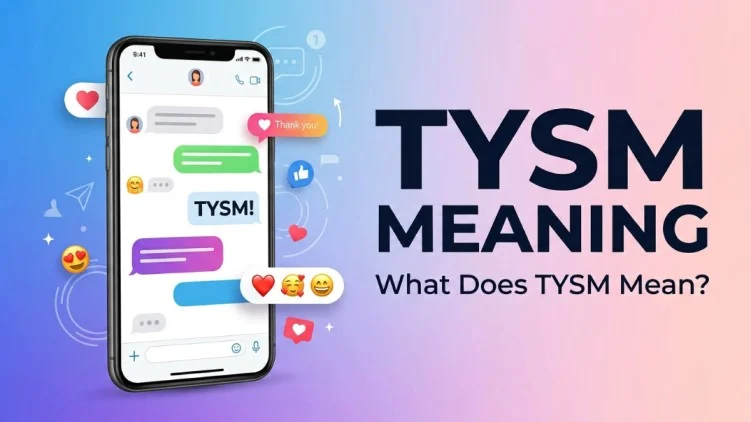
TYSM means “Thank You So Much.” It is a casual internet abbreviation used to show gratitude in texts, social media, gaming chats, and online conversations.
A short message can sometimes say more than a full sentence. If someone sends you “TYSM”, they are usually showing appreciation, but the abbreviation can feel confusing if you have never seen it before. So, what does it actually mean, and when should you use it?
If you text friends, use social media, play online games, or chat with people on apps, you may see TYSM quite often. It is especially common when someone wants to say thank you quickly without typing the full phrase “Thank you so much.”
Understanding this abbreviation can help you avoid awkward replies and make your online conversations feel more natural. Whether you are a student, social media user, gamer, parent learning internet slang, or someone chatting with people from different age groups, knowing common shortcuts like this one can make digital communication much easier.
Definition & Meaning
TYSM stands for “Thank You So Much.”
It is an internet abbreviation that people use to express gratitude. Instead of typing the complete phrase, they shorten it to four letters: T-Y-S-M.
The expression is generally friendly and positive. Someone might use it after receiving help, getting a compliment, receiving information, or being given something they appreciate.
For example:
Mia: “I sent you the notes from class.”
Jake: “TYSM! You saved me.”
Here, Jake is simply saying, “Thank you so much!”
Another example:
Sam: “Your photo came out really nice.”
Alex: “TYSM 😊”
In this conversation, TYSM shows appreciation for the compliment.
What Does Each Letter Mean?
The abbreviation is easy to understand:
| Letter | Word |
|---|---|
| T | Thank |
| Y | You |
| S | So |
| M | Much |
Together, they create:
TYSM = Thank You So Much
The abbreviation is usually informal. It works well in texts, DMs, comments, gaming chats, and messages between friends.
It is less suitable for formal emails, business letters, academic writing, or professional documents.
Is TYSM Positive?
Yes. In most situations, TYSM is a warm and polite expression of thanks.
However, like many internet abbreviations, tone can change depending on the conversation.
For example:
“TYSM!!! 😭❤️”
sounds very excited and emotional.
But:
“tysm.”
could feel more neutral, depending on the relationship and conversation.
The meaning stays the same, but punctuation, capitalization, emojis, and context can affect how the message feels.
Background & History
TYSM developed from the wider culture of internet and text-message abbreviations.
As texting and online messaging became popular, people began shortening common phrases to save time and effort. Expressions such as LOL, BRB, OMG, BTW, and TY became familiar parts of digital communication.
TYSM follows the same basic pattern. The phrase “Thank You So Much” is shortened by taking the first letters of its words.
There is no single confirmed person or exact date responsible for creating TYSM. It developed naturally as part of informal online communication rather than being invented by one known creator.
The abbreviation became easier to spread as texting, instant messaging, social media, and online communities grew.
Today, TYSM can appear on platforms such as:
- TikTok
- Snapchat
- X
- Discord
- YouTube
- Online gaming chats
- Private messaging apps
It is particularly common in casual conversations where people already understand internet shorthand.
Why Do People Use TYSM?
The main reason is convenience.
Typing:
“Thank you so much!”
takes more time than:
“TYSM!”
But speed is not the only reason. Abbreviations can also make conversations feel relaxed and informal.
A teenager might send:
“TYSM for helping me 😭”
A gamer might write:
“TYSM bro!”
A social media user might comment:
“TYSM for the support ❤️”
The abbreviation has become part of the informal language people use online.
Usage in Various Contexts
TYSM is flexible and can appear in many digital conversations.
TYSM in Texting
Text messages are one of the most common places to see it.
Emma: “I picked up your package.”
Lily: “TYSM! I really appreciate it.”
It works well when the conversation is casual.
TYSM on Social Media
People often use it in comments or replies.
Follower: “Your tutorial helped me so much!”
Creator: “TYSM! I’m glad it helped.”
It can also appear in responses to compliments.
Comment: “Your outfit looks amazing!”
Reply: “TYSM! 🥰”
TYSM in Gaming
Gamers often use short expressions because conversations move quickly.
Player 1: “I dropped some supplies for you.”
Player 2: “TYSM!”
It can also be combined with other slang:
“TYSM bro, you’re clutch!”
TYSM in Group Chats
Group conversations can move quickly, so abbreviations are useful.
Sara: “I found the restaurant address.”
Nina: “TYSM!”
TYSM in Comments
Someone may write:
“TYSM for sharing this!”
This is especially common when thanking another user for advice, information, or support.
Common Misconceptions & Clarifications
Although TYSM is simple, a few misunderstandings can happen.
TYSM Does Not Mean “Thanks You So Much”
The correct phrase is:
“Thank You So Much.”
The T represents Thank, not “Thanks.”
TYSM Is Not Formal Language
You should not normally use TYSM in a formal business email.
Instead of:
“TYSM for your response.”
a professional email would be better with:
“Thank you very much for your response.”
TYSM Is Not Always Super Emotional
The word “so” adds emphasis, but the person may still be using it casually.
For example:
“TYSM for sending the link.”
could simply mean:
“Thank you so much for sending the link.”
It does not necessarily mean the person is extremely emotional.
Capitalization Does Not Change the Meaning
These usually mean the same thing:
- TYSM
- tysm
- Tysm
The style may change the tone slightly, but the basic meaning remains “Thank you so much.”
Emojis Can Change the Feeling
Compare:
“TYSM 😊”
with:
“TYSM!!! 😭❤️”
Both express gratitude, but the second one feels much more emotional and enthusiastic.
Similar Terms & Alternatives
TYSM is only one way to express gratitude online.
TY
TY means “Thank You.”
It is shorter and usually less emphatic than TYSM.
THX
THX means “Thanks.”
It is another casual abbreviation, although it can feel more old-school or playful.
TIA
TIA means “Thanks in Advance.”
People use it when asking for something and thanking someone before they respond.
Example:
“Can someone help me fix this? TIA!”
TYVM
TYVM means “Thank You Very Much.”
It is similar to TYSM but uses “very much” instead of “so much.”
Thanks
The full word “Thanks” is simple and casual. It works in many everyday conversations.
| Term | Meaning | Tone |
|---|---|---|
| TYSM | Thank You So Much | Casual, warm |
| TY | Thank You | Very casual |
| THX | Thanks | Casual |
| TYVM | Thank You Very Much | Casual |
| TIA | Thanks in Advance | Casual |
| Thanks | Thanks | Casual and natural |
| Thank you | Thank you | Neutral and widely appropriate |
How to Respond to This Term
If someone sends you TYSM, the best response depends on your relationship and the situation.
Casual Response
You can keep it simple:
“You’re welcome!”
or:
“No problem!”
Friendly Response
If you are chatting with a friend:
“Of course! 😊”
or:
“Anytime!”
Funny Response
If the conversation is playful:
“You owe me one 😂”
or:
“Payment accepted in snacks.”
Warm Response
For someone who sounds genuinely grateful:
“Of course! I’m happy I could help ❤️”
Very Short Response
If the conversation is moving quickly:
“Np!”
Here, NP means “No Problem.”
Professional Response
If someone uses TYSM with you in a casual workplace chat, you could respond with:
“You’re very welcome.”
For a formal professional setting, avoid copying the slang unless the workplace culture is clearly informal.
Regional or Cultural Differences
TYSM is primarily a form of English internet shorthand, so its meaning stays fairly consistent across English-speaking online communities.
However, people from different countries may use different abbreviations or prefer different expressions.
For example, someone who frequently communicates in English online may easily recognize TYSM even if English is not their first language.
In international gaming communities, social media groups, and messaging platforms, abbreviations often cross language boundaries.
Still, not everyone knows internet slang. Older users, new internet users, or people who do not spend much time in English-speaking online communities may not immediately recognize TYSM.
Cultural Context Matters
Expressions of gratitude also vary between cultures.
Some people prefer:
“Thank you!”
Others may use:
“Thanks!”
“Thank you so much!”
“I really appreciate it!”
TYSM is simply the shortened digital version of one of these friendly expressions.
If you are speaking with someone from a different cultural background, using the full phrase can sometimes be clearer.
Comparison with Similar Terms
Several internet abbreviations can look similar because they are built from common English phrases.
| Abbreviation | Full Meaning | Main Difference |
|---|---|---|
| TYSM | Thank You So Much | Stronger gratitude |
| TY | Thank You | Short and simple |
| TYVM | Thank You Very Much | Similar to TYSM |
| THX | Thanks | Very brief |
| TIA | Thanks in Advance | Used before receiving help |
| NP | No Problem | Usually a response to thanks |
| YW | You’re Welcome | Direct response to thanks |
Consider this short conversation:
Person 1: “TYSM for helping me!”
Person 2: “YW!”
Here, YW means “You’re Welcome.”
Another example:
Person 1: “Can you send me the file? TIA!”
Person 2: “Sure.”
The important difference is that TIA is used before the person receives the requested help.
Usage in Online Communities & Dating Apps
TYSM is common in online communities because it is quick and friendly.
On dating apps such as Tinder, users may use it after receiving a compliment or helpful message.
Person 1: “You look great in that picture.”
Person 2: “TYSM 😊”
Here, TYSM simply expresses appreciation.
It does not automatically mean the person is flirting.
That is important because people sometimes read too much into short online messages.
TYSM on Social Platforms
You may see:
- “TYSM for following!”
- “TYSM for the kind words!”
- “TYSM everyone!”
Creators may also use it when responding to followers.
TYSM in Gaming Communities
Gamers often prefer short messages because they need to communicate quickly.
- “TYSM for the revive!”
- “TYSM for the loot!”
- “TYSM team!”
The tone is usually friendly and appreciative.
Dating Tip
If someone sends you TYSM, do not automatically treat it as a romantic signal.
Look at the full conversation.
“TYSM 😊”
could simply mean thanks.
But if the person continues the conversation, asks questions, uses playful language, or shows other signs of interest, the overall context may be different.
Hidden or Offensive Meanings
TYSM does not have a standard offensive meaning.
Its normal meaning is simply:
Thank You So Much.
However, people can use almost any phrase sarcastically.
For example:
“Wow, you deleted the whole project. TYSM 🙄”
Here, the speaker clearly does not mean genuine gratitude.
The sarcasm comes from the context and emoji, not from TYSM itself.
How to Recognize Sarcasm
Look at:
- The words before and after TYSM
- Punctuation
- Emojis
- The relationship between the speakers
- What happened before the message
Compare:
“TYSM for helping me! ❤️”
with:
“TYSM for deleting my file 🙄”
The first is genuine gratitude.
The second is sarcastic.
So, TYSM itself is not offensive. Context determines whether it is sincere or sarcastic.
Suitability for Professional Communication
TYSM is best suited to informal communication.
You can use it with close friends, classmates, online communities, and casual group chats.
In professional communication, the full phrase is usually safer.
Casual Workplace Chat
If your workplace uses informal messaging, this might be acceptable:
“TYSM for sending that over!”
But it depends on your company’s communication style.
Formal Email
Instead of:
“TYSM for your assistance.”
write:
“Thank you very much for your assistance.”
Or simply:
“Thank you for your help.”
Professional Alternatives
Use these in formal situations:
- Thank you
- Thank you very much
- Thank you for your help
- I really appreciate your assistance
- I appreciate your time
- Thank you for your prompt response
These phrases are clear, polite, and appropriate for professional communication.
FAQs
What does TYSM mean in texting?
TYSM means “Thank You So Much.” It is a casual abbreviation commonly used in texts, DMs, comments, and online chats.
What does TYSM mean from a girl?
TYSM from a girl usually means “Thank You So Much.” It shows appreciation, but it does not automatically indicate romantic interest.
What does TYSM mean from a guy?
TYSM from a guy also means “Thank You So Much.” The meaning depends on the conversation, not the sender’s gender.
Is TYSM formal or informal?
TYSM is generally informal. It is best for texts, social media, gaming, and casual conversations rather than formal writing.
How do you reply to TYSM?
You can reply with “You’re welcome,” “No problem,” “Anytime,” “Of course,” or simply “YW.”
Is TYSM the same as TYVM?
They are very similar. TYSM means “Thank You So Much,” while TYVM means “Thank You Very Much.”
Can TYSM be sarcastic?
Yes. TYSM can be used sarcastically when the surrounding context suggests the person is pretending to be thankful.
Conclusion
TYSM means “Thank You So Much,” and it is one of the easiest internet abbreviations to understand. You will most often see it in texts, social media comments, DMs, gaming chats, group conversations, and other informal online spaces.
The abbreviation is friendly and positive in most situations. You can use it when someone helps you, compliments you, sends you something useful, or does something you appreciate. The tone can become more emotional with capital letters, repeated punctuation, or emojis.
Remember that TYSM is mainly casual language. It works naturally with friends and online communities, but professional emails usually sound better with the complete phrase “Thank you” or “Thank you very much.”
Once you know what each letter represents, TYSM is simple: T for Thank, Y for You, S for So, and M for Much.
Discover More Post:
What Does “Habibti” Mean in English in 2026 – Punzelo.com
What Does FYM Mean in Text and Social Media – Punzelo.com
Missus Meaning | What Does “Missus” Mean in 2026