Quick Answer:
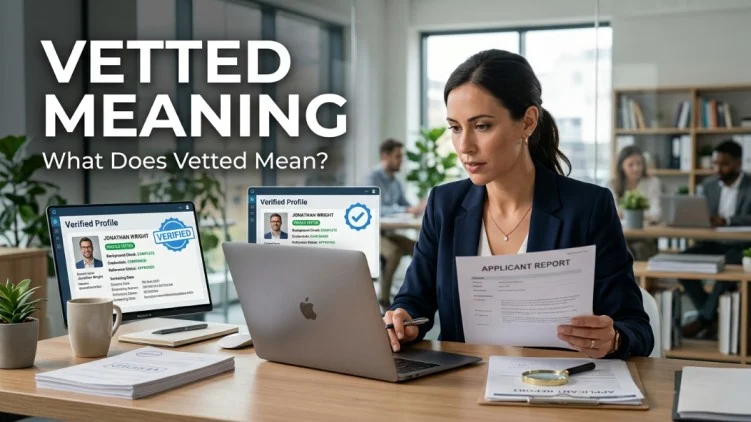
“Vetted” means something or someone has been carefully checked, reviewed, or evaluated before being accepted, trusted, or approved.
When something is vetted, it has been carefully checked before being accepted, trusted, or approved. You may see this word in job postings, news reports, business documents, applications, or online discussions. But what does vetted mean in everyday English, and how is it different from simply being reviewed? The word usually suggests a deeper level of checking.
It can involve examining a person, company, claim, document, or candidate to make sure they meet certain standards. The vetted meaning in English is therefore closely connected to careful evaluation and trust. Understanding the meaning of vetted also helps you recognize phrases such as “vetted and approved,” “heavily vetted,” and “well vetted.” This guide explains how vetted means something has been examined carefully, with clear examples and practical context.
Definition & Meaning
The word vetted means carefully checked, examined, reviewed, or evaluated.
It comes from the verb vet. When you vet a person, company, document, product, claim, or idea, you examine it closely to decide whether it is suitable, trustworthy, or acceptable.
For example:
“The company vetted all applicants before scheduling interviews.”
This means the company carefully reviewed the applicants before deciding who should move forward.
Another example is:
“The information was vetted by experts.”
This means experts checked the information for accuracy or reliability.
The word can apply to many different things.
Vetted People
A person may be vetted before getting a sensitive job.
“All security staff are thoroughly vetted.”
This suggests that the employer checks important details about the candidates before hiring them.
Vetted Information
Information can also be vetted.
“The journalist only published vetted information.”
Here, vetted means the information was checked before publication.
Vetted Products
A company might describe a supplier as vetted.
“We work only with vetted suppliers.”
This tells customers that the company has reviewed those suppliers before doing business with them.
Vetted Services
You may also see:
“Find vetted professionals in your area.”
This usually means the professionals have gone through some type of review or screening.
The important point is that vetted does not simply mean noticed or considered. It suggests that some form of checking took place.
However, the exact level of checking can vary. A company might perform a background check, verify qualifications, inspect documents, contact references, or use another screening process.
So, when you see vetted, always look at the surrounding context to understand exactly what was checked.
Background & History
The word vet has an interesting history. It is commonly understood as a shortened form of veterinarian, but the verb to vet developed with a different practical sense.
The modern verb became associated with carefully examining or evaluating something. The idea is similar to how a veterinarian carefully examines an animal before making a judgment about its condition.
Over time, the meaning expanded beyond physical examination.
Today, to vet someone can mean checking their background, experience, qualifications, or suitability. To vet information can mean reviewing it carefully before accepting or publishing it.
The past tense and past participle form is vetted.
For example:
“The candidate was vetted before receiving the offer.”
The word became especially common in professional, political, legal, security, journalism, and business settings.
Organizations often need to make decisions based on trust. A company may need to know whether a potential employee has the right qualifications. A journalist may need to know whether a source is reliable. A business may need to know whether a supplier is legitimate.
In all these situations, vetting provides a way to describe the checking process.
The word is now common in everyday English as well.
You might see phrases such as:
- “Vetted sellers”
- “Vetted experts”
- “Vetted candidates”
- “Vetted sources”
- “Vetted information”
Although the word can sound formal, its meaning is quite simple: someone checked something carefully before deciding whether it could be trusted, accepted, or used.
Usage in Various Contexts
The word vetted appears in many different situations. Its meaning stays close to “carefully checked,” but the specific type of checking depends on the context.
In Job Applications
Employers may vet candidates before hiring them.
Manager: “Have we vetted the final candidates?”
HR employee: “Yes. Their references and qualifications have been checked.”
Here, vetting means screening applicants.
In Business
Companies often vet suppliers and partners.
“We only purchase materials from vetted suppliers.”
This suggests that the suppliers have gone through some review process.
In Journalism
Journalists may vet information before publishing it.
Editor: “Has this claim been vetted?”
Reporter: “Yes. We confirmed it with two reliable sources.”
Here, vetted means checked for credibility or accuracy.
In Social Media
People may say:
“This account shares vetted information.”
The writer is claiming that the information has been checked before being shared.
However, remember that anyone can use the word vetted online. The word itself does not prove that the checking was thorough.
In Online Shopping
A website might describe sellers as vetted sellers.
This generally means the platform has reviewed them in some way.
In Professional Settings
You might hear:
“We need vetted candidates for this role.”
This means the employer wants candidates who have already gone through a screening process.
In Casual Conversation
The word can also appear casually.
“I have a few vetted recommendations for restaurants.”
The speaker means they have checked or personally evaluated the recommendations.
Common Misconceptions & Clarifications
One common misunderstanding is that vetted always means guaranteed to be perfect. That is not true.
If someone says a person is vetted, it usually means the person has gone through some form of checking. It does not necessarily mean the person is completely trustworthy in every situation.
For example:
“The contractor was vetted by the platform.”
This may mean the platform checked the contractor’s identity, qualifications, or other details. It does not automatically guarantee that every customer will have a perfect experience.
Vetted Does Not Mean Perfect
- A vetted product can still have problems.
- A vetted candidate can still make mistakes.
- A vetted source can still provide incorrect information.
The word describes the checking process, not an absolute guarantee.
Vetted Does Not Always Mean Background Checked
Background checks are one form of vetting, but they are not the only type.
Someone can be vetted through:
- Reference checks
- Qualification checks
- Identity verification
- Interviews
- Document reviews
- Experience checks
- Reputation checks
- Quality inspections
The exact process depends on the situation.
Is Vetted a Positive Word?
Usually, yes.
It often suggests that someone took care to check something before approving or recommending it.
For example:
“We use vetted professionals.”
This generally gives a positive impression.
Can Vetted Be Misleading?
Yes.
A person or company may use the word without explaining what was actually checked.
If the claim matters, ask:
“What does your vetting process include?”
That question can reveal whether the word represents a serious screening process or a simple review.
Similar Terms & Alternatives
Several English words have meanings close to vetted, but they are not always exact replacements.
Verified
Verified means something has been confirmed as true, accurate, genuine, or authentic.
Example:
“The account has been verified.”
This focuses on confirmation.
Screened
Screened means someone or something has been examined to decide whether it meets certain requirements.
Example:
“All applicants were screened before the interviews.”
This is very close to vetted.
Reviewed
Reviewed means something was examined or considered.
Example:
“The application was reviewed by the hiring team.”
This does not always suggest the same level of careful checking as vetted.
Checked
Checked is a general word.
Example:
“I checked the information.”
It can mean anything from a quick look to a detailed investigation.
Approved
Approved means someone officially accepted or authorized something.
Something may be vetted before it is approved, but vetting and approval are not the same thing.
| Term | Main meaning | Key difference |
|---|---|---|
| Vetted | Carefully evaluated | Focuses on screening and suitability |
| Verified | Confirmed as genuine or accurate | Focuses on confirmation |
| Screened | Examined against requirements | Often used for people or applications |
| Reviewed | Examined or considered | Can be less detailed |
| Checked | Looked at or examined | Very broad meaning |
| Approved | Officially accepted | Focuses on the final decision |
How to Respond to This Term
If someone uses vetted in a conversation, your response depends on what they mean.
Casual Response
“Got it. So they have already been checked?”
This is useful when you want confirmation.
Professional Response
“Could you explain what the vetting process included?”
This sounds polite and professional.
Curious Response
“What exactly was checked?”
This is useful when the word is unclear.
Funny Response
If a friend says:
“I have a list of vetted restaurants.”
You could reply:
“Excellent. My stomach appreciates the research.”
When You Want More Proof
If someone recommends a vetted service, you can ask:
“Was their license or certification verified too?”
This is especially useful when money, safety, or professional qualifications are involved.
When You Are Unsure
Do not assume that vetted means completely safe or perfect.
A good response is:
“What kind of vetting did they go through?”
That keeps the conversation clear and avoids misunderstanding.
Regional or Cultural Differences
The word vetted is widely understood in English-speaking environments, including the United States, United Kingdom, Canada, Australia, and other regions where English is commonly used.
The basic meaning remains the same: carefully checked or evaluated.
However, the situations in which people use the word can differ.
In American English, you may frequently see vetted in business, politics, employment, journalism, and online services.
In British English, the word is also common in professional and political contexts.
For example:
“The candidates were thoroughly vetted.”
This sentence sounds natural in both American and British English.
The word can also appear in international business communication because many companies use English as their working language.
Non-native English speakers may encounter the word in job advertisements, business websites, professional reports, or online platforms.
One important point is that the word itself does not tell you how something was vetted.
Different countries and organizations can have different standards.
For example, a “vetted professional” on one platform might have had their identity checked, while another platform might also verify qualifications and references.
So, cultural or regional differences are usually less about the meaning of the word and more about the specific vetting process behind it.
Comparison with Similar Terms
The words vetted, verified, screened, reviewed, and approved can sound interchangeable, but they have different focuses.
Vetted vs. Verified
Vetted suggests a broader evaluation.
Verified usually means confirming that something is true or genuine.
Example:
“The candidate was vetted.”
The candidate may have undergone several checks.
“The candidate’s degree was verified.”
This means the degree’s authenticity was confirmed.
Vetted vs. Screened
These are very close.
Screened often describes an initial process used to remove unsuitable candidates.
Vetted can suggest a more detailed or deliberate evaluation.
Vetted vs. Reviewed
A review can be simple.
For example:
“The manager reviewed my application.”
That does not necessarily mean the manager conducted a deep investigation.
Vetted vs. Approved
Approval is the decision.
Vetting is the checking that may happen before that decision.
| Phrase | What it tells you |
|---|---|
| Vetted candidate | Candidate was carefully evaluated |
| Verified candidate | Specific information about the candidate was confirmed |
| Screened candidate | Candidate passed an initial selection process |
| Reviewed candidate | Candidate’s information was examined |
| Approved candidate | Candidate received acceptance or authorization |
Usage in Online Communities & Dating Apps
The word vetted is increasingly useful online because people often need to decide whether an account, seller, expert, or recommendation can be trusted.
On social media, someone might say:
“These are vetted sources.”
They are claiming that the sources were checked before being recommended.
On dating apps, you might see phrases such as:
“All profiles are vetted.”
This generally suggests that the platform performs some kind of screening.
However, users should not assume that vetted means a person is completely safe.
If you are meeting someone online, it is still wise to use normal safety practices.
Dating Example
Sam: “The app says all users are vetted.”
Alex: “That’s helpful, but I would still take things slowly.”
That is a sensible approach because vetting standards vary.
Gaming Communities
Gaming communities may use the word when discussing players, servers, moderators, or sellers.
“Only vetted members can join the private server.”
This suggests that members have gone through some form of screening.
Online Shopping
A platform may promote:
“Vetted sellers with verified products.”
Here, the two terms can work together.
Vetted refers to the seller’s evaluation, while verified may refer to confirmation of specific information or products.
Hidden or Offensive Meanings
Vetted does not normally have a hidden or offensive meaning.
It is a standard English word and is generally neutral or positive.
However, context can sometimes make it sound negative.
For example:
“They vetted him for hours.”
Depending on the situation, this could suggest an intense or uncomfortable investigation.
Similarly:
“Why do I need to be vetted?”
Someone might say this if they feel the screening process is intrusive.
The word itself is not offensive. The concern comes from what is being checked and why.
Privacy Can Matter
Vetting may involve personal information.
Depending on the situation, a vetting process could involve checking:
- Identity
- Qualifications
- Employment history
- References
- Professional licenses
- Public records
- Reputation
Because of this, people may have legitimate privacy concerns.
If someone says:
“We need to vet you before you can join.”
You can reasonably ask:
“What information will you need, and how will it be used?”
That is a normal question, especially when sensitive personal information is involved.
Suitability for Professional Communication
Vetted is highly suitable for professional communication.
It is commonly used in:
- Business emails
- Job descriptions
- Company policies
- News reports
- Research
- Security procedures
- Recruitment
- Government communication
- Legal discussions
For example:
“We work with a network of vetted professionals.”
This sounds professional and natural.
Another example:
“All candidates will be vetted before final selection.”
This is also appropriate for a formal workplace.
Professional Alternatives
If you want simpler language, you can use:
Carefully reviewed
Thoroughly checked
Screened
Verified
Evaluated
The best choice depends on what you actually mean.
For example, if you confirmed a document’s authenticity, verified may be more accurate than vetted.
If you examined a job candidate’s qualifications and references, vetted may be the better choice.
Example Professional Email
“We have completed the initial screening process, and all shortlisted candidates have been thoroughly vetted.”
This clearly communicates that the candidates went through a careful evaluation.
FAQs
What does vetted mean in simple words?
Vetted means carefully checked or evaluated before someone decides to trust, accept, recommend, or approve something or someone.
What does vetted mean in a job?
In a job context, vetted usually means a candidate has been carefully screened. This may include checking qualifications, references, identity, experience, or background.
Is vetted the same as verified?
Not exactly. Verified usually means specific information has been confirmed as true or genuine. Vetted usually suggests a broader evaluation.
Does vetted mean trustworthy?
It can suggest that someone has been carefully checked, but it does not guarantee that the person or organization is completely trustworthy or perfect.
What is another word for vetted?
Depending on the context, alternatives include screened, checked, reviewed, evaluated, or verified.
Is vetted a formal word?
Yes. Vetted is common in professional, business, recruitment, journalism, security, and government settings. It can also be used in everyday conversation.
What does a vetted seller mean?
A vetted seller is a seller who has gone through some type of review or screening process. The exact checks depend on the platform or company.
Conclusion
The word vetted simply means carefully checked, reviewed, or evaluated. It is commonly used when people want to show that a person, product, source, company, or piece of information has gone through some form of screening.
You may see it in job listings, business communication, journalism, social media, online shopping, gaming communities, and dating platforms. While vetted often creates a sense of trust, it does not automatically mean something is perfect or completely safe.
The most important thing is to understand what was actually checked. If someone calls a person or service vetted, asking about the vetting process can give you a much clearer picture.
Once you understand that difference, vetted becomes a simple and useful word to recognize in both everyday and professional English.
Read More Related Articles:
What Does OFC Mean| Complete Meaning, Origin, Usage …
What Does Bop Mean| Complete Meaning, Origin, Usage …