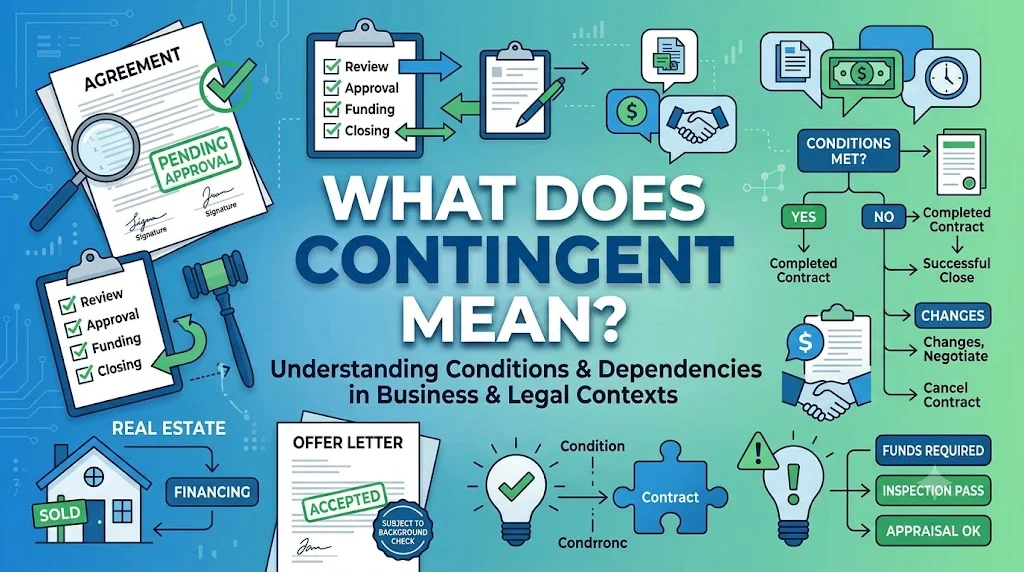
The contingent meaning of a word or situation often depends on what happens next. In simple terms, something is contingent when it relies on another condition, event, or circumstance. You may see this word in contracts, business discussions, news reports, or everyday conversations. Understanding the context makes it much easier to recognize what someone means.
So, what does contingent mean? It generally describes something that is possible or true only if another condition is met. The meaning of contingent can also refer to a group of people representing an organization or country, depending on the context. This guide explains the contingent definition, shows how to define contingent clearly, and provides practical examples. Whether you are asking what is the meaning of contingent, what is contingent, or simply wondering what contingent means, you will find the answer in plain, easy-to-understand language.
What Does Contingent Mean?
Contingent is an adjective that most commonly means “dependent on something else” or “subject to change based on certain conditions.” It describes a situation, agreement, or outcome that relies on specific circumstances or events occurring first. The term is frequently used in legal, business, and real estate contexts.
The word is commonly used in:
Real estate contracts and listings
Business agreements and proposals
Legal documents and contracts
Employment offers and negotiations
Financial planning and insurance
Academic research and planning
Government and policy discussions
Because the term is formal and precise, understanding its exact meaning is essential for proper usage in professional settings.
Definition
| Term | Meaning |
|---|---|
| Contingent | An adjective meaning “dependent on something else” or “subject to change based on specific conditions.” It describes situations where outcomes rely on certain events or circumstances occurring first. |
Pronunciation: con-TIN-jent
Origin
The exact origin of contingent can be traced back to Latin and French roots. The word entered the English language in the 14th century, deriving from the Latin word “contingentem,” which means “touching” or “happening.”
Several factors contributed to its development:
The Latin word “contingere” meaning “to touch” or “to happen”
The French adaptation “contingent” in medieval times
Legal and philosophical usage in the 17th century
Business and commercial adoption in the 19th century
Real estate and contract usage in the 20th century
Modern professional and academic applications
The word’s evolution from a philosophical term meaning “possible” or “subject to chance” to its modern usage as “dependent on conditions” reflects its long history in formal language. Its precision and clarity made it valuable for legal and business contexts.
Importance
Contingent became an essential word in professional language because it provides precise clarity about conditions and dependencies.
Several factors contributed to its importance:
Legal requirement for precise language
Business need for clear contract terms
Real estate transaction complexity
Financial planning accuracy
Academic and research precision
Government and policy formulation
International business communication
The word’s importance is especially evident in real estate, where contingent offers protect buyers while allowing sellers to continue marketing properties. This balance of interests demonstrates why such precise terminology is valuable.
Where You May See Contingent
| Context | Common Usage |
|---|---|
| Real Estate | Contingent offer, contingent contract |
| Business | Contingent plan, contingent agreement |
| Legal | Contingent fee, contingent liability |
| Employment | Contingent offer, contingent worker |
| Finance | Contingent asset, contingent liability |
| Insurance | Contingent beneficiary |
| Academic | Contingent upon, contingent factor |
How It Is Used
Contingent is generally used to describe situations where one thing depends on another. The intended meaning depends heavily on context.
Real Estate Context 🏠
Used to describe property offers with conditions.
Example:
The offer is contingent on the home inspection.
Business Context 💼
Used to describe agreements with conditions.
Example:
“Our partnership is contingent on final approval.”
Legal Context ⚖️
Used to describe fees or obligations with conditions.
Example:
“The attorney will work on a contingent fee basis.”
Employment Context 👔
Used to describe job offers with conditions.
Example:
“The job offer is contingent on background verification.”
Examples
Real Estate Examples
These examples show how contingent is used in property transactions.
“The sale is contingent on the buyer securing financing.”
“We made a contingent offer that depends on the inspection.”
“The contract is contingent upon the appraisal meeting the agreed value.”
“The property is listed as contingent, meaning there is an accepted offer with conditions.”
Important: Understanding contingent in real estate helps buyers and sellers navigate transactions more effectively.
Business Examples
These examples demonstrate professional usage.
“Our quarterly projections are contingent on market conditions.”
“The merger is contingent on regulatory approval.”
“The agreement is contingent upon both parties signing by Friday.”
“Our expansion plans are contingent on securing additional investment.”
Employment Examples
These examples show usage in professional settings.
“Your start date is contingent on the completion of background checks.”
“The offer is contingent upon verification of your credentials.”
“Your promotion is contingent on meeting performance targets.”
“The position is contingent on funding approval from the board.”
Legal Examples
These examples demonstrate legal terminology.
“The attorney will take the case on a contingent fee basis.”
“The settlement is contingent on the plaintiff’s acceptance.”
“The liability is contingent on proof of negligence.”
“The contract includes a contingent clause for unforeseen circumstances.”
Academic Examples
These examples show usage in research and education.
“The experiment’s success is contingent on precise measurements.”
“The research findings are contingent on sample size.”
“The conclusion is contingent on further data collection.”
“The grant is contingent on meeting specific deliverables.”
Comparison with Similar Terms
Many words describe dependency or conditions. Here’s how contingent compares.
| Term | Meaning | Context | Typical Use |
|---|---|---|---|
| Contingent | Dependent on conditions | Formal, professional | Contracts, real estate |
| Conditional | Subject to conditions | General, broad | Everyday language |
| Dependent | Relying on something | General | Casual, professional |
| Provisional | Temporary, conditional | Formal | Offers, agreements |
| Subject to | Dependent on | Formal, legal | Legal documents |
| Pending | Awaiting decision | Formal | Applications, approvals |
| Conditional | With requirements | General | Various contexts |
Among these terms, contingent is particularly common in real estate and legal contexts where precise language is essential.
Alternate Contexts
Unlike some terms that have one primary meaning, contingent has specific applications across different fields.
Real Estate
When a home is listed as contingent, it means the seller has accepted an offer but the sale depends on certain conditions being met, such as inspections, financing, or appraisals.
Business
In business, contingent describes agreements, plans, or liabilities that depend on specific events or conditions.
Legal
In law, contingent refers to fees, liabilities, or agreements that only come into effect if certain conditions are met.
Employment
In hiring, contingent describes job offers that depend on background checks, reference verification, or other conditions.
Finance
In finance, contingent assets or liabilities depend on future events that may or may not occur.
When you encounter contingent in any context, the surrounding information usually makes the specific application clear.
Common Mistakes
Many people misunderstand or misuse contingent. Here are the most common mistakes.
Confusing Contingent with Pending
Some users mistakenly believe contingent and pending mean the same thing.
They do not.
Pending means awaiting a decision. Contingent means dependent on conditions.
Using It Casually Without Specifics
Because contingent is a precise term, using it without explaining the conditions can be confusing.
Misunderstanding Real Estate Listings
In real estate, contingent properties have accepted offers with conditions. Some buyers assume they cannot make backup offers, which is incorrect.
Confusing Contingent with Conditional
While similar, contingent is more formal and often used in specific professional contexts.
Overusing the Term
Like any formal term, overuse in casual conversation may sound unnecessarily technical.
Quick Tips
Keep these practical guidelines in mind before using contingent.
- Know the exact meaning before using this formal term.
- Remember that contingent means dependent on conditions.
- Use it appropriately in professional, legal, or real estate contexts.
- Always specify the conditions when using this term.
- Consider your audience and whether they understand formal language.
- When in doubt, use simpler alternatives in casual settings.
- Be aware that different fields use the term differently.
- Use it precisely to maintain clarity and professionalism.
FAQ
What does contingent mean in real estate?
In real estate, contingent means that the seller has accepted an offer, but the sale depends on certain conditions being met, such as a home inspection, appraisal, or financing approval.
What does contingent mean in business?
In business, contingent refers to agreements, plans, or liabilities that depend on specific events or conditions occurring. It often appears in contracts and strategic planning.
What does contingent mean in a job offer?
A contingent job offer means the position is offered but depends on conditions being met, such as background checks, reference verification, or drug testing.
What does contingent mean in legal terms?
In legal terms, contingent describes agreements, fees, or liabilities that only come into effect if certain conditions are met. For example, a contingent fee means the lawyer only gets paid if the case is won.
Is contingent the same as pending?
No. Pending means awaiting a decision or completion. Contingent means dependent on conditions being met. In real estate, a pending sale typically means conditions have been satisfied and the sale is progressing.
What does contingent liability mean?
A contingent liability is a potential financial obligation that may occur in the future depending on the outcome of a specific event, such as a lawsuit or warranty claim.
How do you use contingent in a sentence?
“The purchase agreement is contingent on the property passing inspection.” “The job offer is contingent upon successful background verification.” “The project timeline is contingent on funding approval.”
Conclusion
So, what does contingent mean? In most professional, legal, and real estate contexts, it describes situations where one thing depends on something else. The term indicates that an outcome, agreement, or offer is subject to specific conditions being met first. While it has become essential vocabulary across various professional fields, its meaning remains precise and formal.
Understanding terms like contingent can help you navigate real estate transactions, business agreements, legal documents, and employment offers more effectively. The word provides clarity about conditions and dependencies in formal settings. Whether you are buying a home, reviewing a contract, or accepting a job offer, knowing the meaning behind this important term helps you make informed decisions.
Discover More Post:
What Does the Green Dot Mean on Snapchat – Punzelo.com
What Does Collate Mean When Printing – Punzelo.com