Quick Answer:
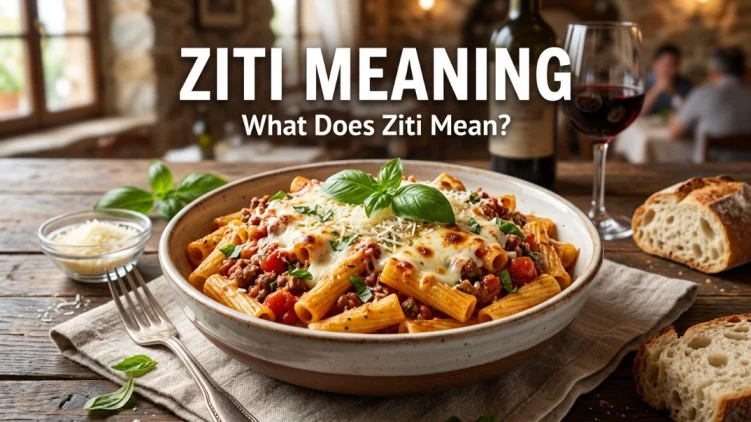
Ziti is an Italian pasta shape, usually made from durum wheat and formed into long, hollow tubes. It is especially popular in baked pasta dishes such as baked ziti.
Imagine ordering pasta at a restaurant and seeing the word ziti on the menu. You may recognize it as an Italian word, but what exactly does it mean? Is ziti a special sauce, a type of noodle, or a complete dish? The answer is simple: ziti is a type of pasta.
If you are searching for the ziti meaning because you saw it in a recipe, restaurant menu, cooking video, text, or social media post, understanding the word can make the context much clearer. Ziti is especially well known in the United States because of the popular dish called baked ziti.
In this guide, you will learn what ziti means, where the word comes from, how the pasta looks, how people cook it, and how it differs from similar pasta shapes. Whether you love Italian food or simply want to understand a menu better, this word is easy to learn.
Definition & Meaning
Ziti is a type of Italian pasta shaped like long, narrow, hollow tubes. The name comes from Italian and is traditionally associated with a type of pasta used in Southern Italian cooking.
The word ziti is the plural form of zito. In traditional Italian usage, zito is connected to the idea of a young man or bridegroom. The pasta has also been associated with weddings and celebrations in parts of Southern Italy.
Ziti usually looks similar to a straight, smooth tube. It is longer than many common pasta shapes, although it is often broken into smaller pieces before cooking.
A typical piece of ziti has:
- A hollow center
- A smooth surface
- A tube-like shape
- A firm texture when cooked properly
- A shape that holds sauces well
What Is Ziti Used For?
Ziti is especially popular in baked pasta recipes. One of the best-known dishes is baked ziti, which may contain pasta, tomato sauce, cheese, and other ingredients.
For example:
Sarah: “What are you making for dinner?”
Mike: “Baked ziti with tomato sauce and mozzarella.”
Sarah: “That sounds delicious!”
Ziti can also be used with meat sauces, creamy sauces, vegetables, cheese, and other ingredients.
The word itself refers to the pasta shape, not necessarily the entire recipe.
So, when someone says:
“I bought ziti.”
They mean they bought the pasta.
When someone says:
“We had baked ziti.”
They are talking about a complete dish made with ziti.
Background & History
Ziti has roots in Southern Italy, where tubular pasta varieties have been part of traditional cooking for generations. It is particularly associated with regions such as Campania and Sicily.
The word has an interesting cultural connection. The singular form zito has historically been linked with a young man or bridegroom. The pasta became connected with wedding meals and celebrations in some Italian traditions.
Traditional ziti was often prepared for special occasions rather than being treated simply as an everyday pasta shape. Long tubular pasta could be broken into smaller pieces and cooked with rich sauces.
Italian food traditions vary greatly from region to region. Pasta shapes were often developed to work well with local sauces, ingredients, and cooking methods. Ziti’s hollow center makes it useful for carrying sauce inside the tube while also allowing sauce to coat the outside.
Over time, ziti became especially familiar in the United States through Italian American cooking.
The dish baked ziti became a popular comfort food. It combines pasta with sauce and cheese and is often baked until the top becomes golden and bubbly.
Today, you can find ziti in Italian restaurants, American Italian restaurants, supermarkets, cookbooks, food blogs, and home kitchens.
Although its roots are Italian, the word ziti is now widely recognized by English-speaking food lovers.
Usage in Various Contexts
The word ziti usually appears in food-related situations, but the exact meaning depends on the context.
1. Restaurant Menus
A restaurant may list:
Baked Ziti with Mozzarella
This means a baked pasta dish made with ziti.
2. Recipes
You may see instructions such as:
“Cook the ziti until al dente.”
Here, ziti refers specifically to the pasta.
3. Grocery Shopping
Someone might say:
“Can you pick up a box of ziti?”
They are asking for the dry pasta.
4. Social Media
Food creators often use ziti in captions.
“Sunday dinner is officially baked ziti night! 🍝”
The word refers to the pasta dish.
5. Texting
A friend might text:
“I made ziti for everyone. Come over!”
The meaning is simply a meal featuring ziti.
6. Cooking Discussions
Chef: “Should I use penne or ziti?”
Friend: “Use ziti. It works really well in baked dishes.”
7. Food Videos
A cooking video may say:
“Start by boiling the ziti until it is slightly firm.”
Again, the word refers to the pasta itself.
Unlike internet slang, ziti does not normally have a special texting or gaming meaning. If you see it in a chat, the safest assumption is that the conversation is about food unless the surrounding context suggests otherwise.
Common Misconceptions & Clarifications
Several misunderstandings can happen when people first encounter the word ziti.
Is Ziti a Sauce?
No.
Ziti is pasta, not sauce.
You can combine it with marinara, tomato sauce, Alfredo-style sauces, meat sauce, or other ingredients.
Is Baked Ziti the Same as Ziti?
Not exactly.
Ziti refers to the pasta shape.
Baked ziti refers to a dish prepared using that pasta, usually with sauce and cheese and then baked.
Think of it this way:
Ziti = pasta
Baked ziti = prepared dish
Is Ziti the Same as Penne?
No, although they look similar.
Both are tubular pastas, but their shape and cut are different. Penne traditionally has angled ends, while ziti is usually straight-cut.
Is Ziti Spicy?
Not by itself.
Ziti is simply pasta. Whether a ziti dish is spicy depends on the sauce and other ingredients.
Is Ziti Always Baked?
No.
Although baked ziti is extremely popular, ziti can also be prepared with other sauces and ingredients.
Is Ziti a Complete Meal?
The word itself does not describe a complete meal.
It describes the pasta. A complete dish may include ziti, sauce, cheese, meat, vegetables, or other ingredients.
Similar Terms & Alternatives
There are many pasta shapes that can be used in recipes similar to ziti.
Penne
Penne is a short, tubular pasta with diagonally cut ends. It is one of the closest shapes to ziti.
Rigatoni
Rigatoni is a larger, wider tube with ridges on the outside. Its larger size makes it excellent for thick sauces.
Mostaccioli
Mostaccioli is another tube-shaped pasta. It is often similar to smooth penne and is commonly used in baked pasta dishes.
Manicotti
Manicotti consists of large tubes designed to be filled with ingredients such as ricotta cheese.
Cannelloni
Cannelloni is another large tubular pasta used for filling and baking.
| Pasta | Shape | Common Use |
|---|---|---|
| Ziti | Long, hollow tube | Baked dishes and sauces |
| Penne | Short tube with angled ends | Sauces and pasta salads |
| Rigatoni | Large ridged tube | Thick sauces and baked dishes |
| Mostaccioli | Smooth tube | Baked pasta |
| Manicotti | Large tube | Stuffed pasta |
| Cannelloni | Large tube | Filled and baked dishes |
The best substitute for ziti depends on the recipe. Penne and mostaccioli are often convenient alternatives because of their similar tubular shapes.
How to Respond to This Term
If someone uses the word ziti in conversation, your response depends on the situation.
If they are talking about dinner, you can respond naturally:
“I love baked ziti!”
If you are unsure what they mean, ask:
“Do you mean the pasta?”
If someone sends you a food picture and says:
“Look at this ziti!”
You could reply:
“That looks amazing!”
For a funny response:
“That much cheese should probably come with a warning!” 😂
For a simple response:
“Yum! I haven’t had ziti in ages.”
If You Are Ordering Food
You can ask:
“Is the ziti baked with cheese?”
or:
“What sauce comes with the ziti?”
There is no special response required when someone says ziti. It is simply a food term, so your reply should match the conversation.
Regional or Cultural Differences
Ziti has strong connections to Italian and Italian American food culture, but its popularity differs by region.
In Southern Italy, traditional pasta culture includes many shapes and regional recipes. Ziti is particularly connected with Southern Italian traditions and special meals.
In the United States, however, many people immediately associate ziti with baked ziti.
This difference is important.
An Italian speaker discussing pasta may use ziti to refer to the actual pasta shape. An American restaurant customer may hear ziti and immediately think about a baked dish covered with tomato sauce and cheese.
Italian American cuisine has also helped make the term familiar to people who may not speak Italian.
Family recipes, restaurants, holidays, Sunday dinners, and large gatherings have all helped popularize dishes such as baked ziti.
The pronunciation can also vary slightly depending on the speaker’s language and accent. Italian pronunciation is different from how some English speakers pronounce the word.
If you are learning Italian, listening to native speakers can help you develop the correct pronunciation.
Comparison with Similar Terms
Ziti is often confused with other tube-shaped pasta, especially penne and rigatoni.
| Feature | Ziti | Penne | Rigatoni |
|---|---|---|---|
| Basic shape | Long hollow tube | Short tube | Large tube |
| Ends | Usually straight | Angled | Usually straight |
| Surface | Often smooth | Smooth or ridged | Usually ridged |
| Size | Long | Short | Large |
| Common dish | Baked ziti | Pasta with sauce | Thick sauces |
| Best feature | Great for baking | Versatile | Holds thick sauces |
Ziti vs Penne
The easiest difference to remember is the ends.
Ziti usually has straight ends.
Penne has diagonally cut ends.
Ziti vs Rigatoni
Rigatoni is generally wider and has ridges. Ziti is typically narrower and smoother.
Ziti vs Mostaccioli
These can look very similar. In American cooking, mostaccioli is often used in baked pasta dishes and can be a practical substitute for ziti.
Usage in Online Communities & Dating Apps
Unlike many words people search online, ziti is not normally internet slang.
If you see it on social media, TikTok, Instagram, Reddit, Discord, or a dating app, it is usually being used in a food-related conversation.
For example, someone on Instagram might post:
“Made baked ziti for the whole family tonight. 🍝”
On a dating app, a person might write:
“My love language is homemade baked ziti.”
Here, the word is being used literally, but the sentence can also show personality.
Someone might jokingly say:
“Swipe right if you know how to make good ziti.”
That is simply a playful food preference.
In gaming communities, the word may appear when players are talking about dinner:
Player 1: “I’m getting off. Dinner’s ready.”
Player 2: “What’s for dinner?”
Player 1: “Ziti!”
There is no hidden gaming meaning in the ordinary use of the word.
If you see ziti online and the conversation is clearly about food, you can safely interpret it as the pasta or a dish made from it.
Hidden or Offensive Meanings
The standard word ziti does not have a widely recognized offensive meaning in ordinary English or Italian food conversations.
It is primarily a culinary term.
However, online conversations can sometimes create unusual meanings through usernames, inside jokes, memes, or private community slang. That does not mean the word itself has an established offensive definition.
If someone writes:
“I could eat ziti every day.”
They are almost certainly talking about food.
If someone uses the word in an unrelated conversation, check the surrounding context before assuming it has a slang meaning.
This is especially important with internet language because people sometimes invent private meanings for ordinary words.
The safest approach is simple:
Look at the sentence, topic, and conversation before interpreting the word.
Suitability for Professional Communication
The word ziti is completely appropriate in professional communication when the topic is food.
For example, a restaurant manager could write:
“Our baked ziti is one of today’s most popular dishes.”
A food blogger could write:
“This ziti recipe takes about 40 minutes to prepare.”
A chef could say:
“We are serving ziti with a tomato and basil sauce tonight.”
The word is also suitable for menus, recipes, restaurant websites, food reviews, cooking classes, and culinary articles.
There is no need to replace ziti with a more formal word.
However, remember that ziti describes the pasta, not necessarily the complete dish. In a professional menu, be specific about what customers are ordering.
For example:
“Baked Ziti with Mozzarella and Tomato Sauce”
is clearer than simply writing:
“Ziti”
when the dish contains several additional ingredients.
FAQs
What does ziti mean?
Ziti is an Italian pasta shape that looks like a long, hollow tube and is especially popular in baked pasta dishes.
Is ziti the same as penne?
No. Ziti usually has straight-cut ends, while penne has diagonally cut ends. They are similar but different pasta shapes.
What is baked ziti?
Baked ziti is a pasta dish made with ziti, sauce, cheese, and often meat or vegetables, which is then baked.
Is ziti Italian?
Yes. Ziti is an Italian pasta shape with strong roots in Southern Italian cooking traditions.
What does the word ziti mean in Italian?
Ziti is the plural form related to zito, a word historically associated with a young man or bridegroom. The pasta also has traditional connections with weddings and celebrations.
Can I use penne instead of ziti?
Yes. Penne can often work as a substitute for ziti, especially in baked pasta recipes, although the shape and texture are slightly different.
Does ziti have a slang meaning?
In normal usage, ziti refers to pasta and does not have a widely recognized slang meaning. Online communities may create private jokes or meanings, so context still matters.
Conclusion
The ziti meaning is simple once you know the food behind the word. Ziti is an Italian pasta shape made as a long, hollow tube, and it is especially famous in dishes such as baked ziti.
The word has roots in Southern Italian food culture and has become especially popular in Italian American cooking. Although it is often associated with baked pasta, ziti can be prepared in many different ways with sauces, cheese, meat, vegetables, and other ingredients.
It is also useful to remember that ziti is not the same as penne or rigatoni. These pastas may look similar, but their shapes and sizes differ.
If you see ziti on a menu, recipe, social media post, or conversation, you can usually understand it as a pasta shape or a dish made with that pasta. 🍝
Discover More Post:
- What Does FYM Mean in Text and Social Media – Punzelo.com
- What Does “Habibti” Mean in English in 2026 – Punzelo.com
- What Does TTYL Mean| Complete Meaning, Origin, Usage …