Quick Answer:
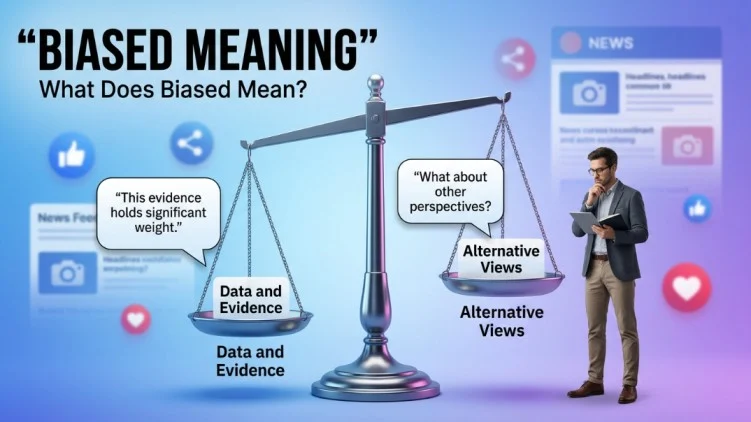
Biased means having an unfair preference for one person, group, idea, or side instead of judging something fairly.
It can describe opinions, decisions, news, reviews, or behavior influenced by personal feelings or preferences.
The biased meaning of a word or opinion is closely connected to the idea of unfair preference. When someone is biased, they tend to favor one person, group, side, or viewpoint instead of judging a situation fairly. In simple terms, biased mean is showing an unfair preference that can influence how someone thinks, speaks, or makes a decision. So, what is biased mean in everyday language?
It means being influenced by personal feelings, experiences, or opinions rather than looking at all sides objectively. A biased definition can apply to news, conversations, reviews, research, workplaces, and everyday choices. Understanding what biased means helps you recognize unfair judgment and communicate more clearly. This guide explains the definition of biased, common examples, and the difference between bias and fair judgment.
Definition & Meaning
The word biased means unfairly favoring or opposing someone or something.
When a person is biased, their opinion or decision is not completely neutral. Their personal feelings, experiences, preferences, relationships, beliefs, or interests may influence how they judge a situation.
For example, imagine two friends are arguing about which restaurant is better.
Tom: “The pizza place near my house is definitely the best.”
Sarah: “You only say that because your brother works there. You’re biased!”
Sarah is saying that Tom may not be giving a completely fair opinion because he has a personal connection to the restaurant.
Simple Meaning
Biased = not completely fair or neutral because of a preference or influence.
Bias does not always mean that someone is intentionally lying. A person can be biased without realizing it.
For example, a teacher might unconsciously expect a certain student to perform better because that student has always received high grades. The teacher may still try to be fair, but their expectations could influence their judgment.
Examples of “Biased”
“The article seems biased toward one political view.”
This means the article appears to favor one side.
“I’m biased because she’s my best friend.”
This means the speaker knows their personal relationship may affect their opinion.
“The referee was accused of being biased.”
This means people believed the referee was unfairly favoring one team.
“That review is biased.”
This suggests the review may not provide a neutral or balanced opinion.
The opposite of biased is usually unbiased, neutral, objective, or impartial.
Background & History
The word biased comes from bias, a word that has been used in English for centuries.
The older idea behind bias was connected to something that was not straight or even. Over time, the word developed a figurative meaning: a tendency to favor one direction, side, or viewpoint.
This idea is easy to understand when you imagine a ball that naturally moves toward one side instead of traveling straight. In a similar way, a person’s judgment can be pushed toward one preference.
The word became increasingly common when people began discussing fairness, judgment, politics, education, journalism, and social behavior.
Today, biased is used in many areas of life.
You may hear it when people discuss:
- News reporting
- Political opinions
- Sports
- Product reviews
- Education
- Hiring decisions
- Social media
- Movies and entertainment
- Personal relationships
- Artificial intelligence
- Advertising
The meaning has stayed fairly consistent, but modern technology has made the word even more common.
For example, people now talk about algorithmic bias when computer systems produce results that may unfairly favor or disadvantage certain groups.
Social media has also made discussions about bias more visible. Users may accuse a creator, journalist, reviewer, or platform of being biased when they believe the content favors one viewpoint.
The important point is that bias is not always deliberate. A person can have a preference without realizing that it affects their judgment.
Usage in Various Contexts
The word biased can be used in casual, professional, academic, and online conversations.
1. Everyday Conversations
Mike: “Which team do you think will win?”
Jake: “Obviously my team!”
Mike: “You’re biased!”
Here, the word is playful. Jake supports the team, so Mike jokes that his opinion cannot be completely neutral.
2. Social Media
Someone might comment:
“This creator is so biased toward that brand.”
The person believes the creator favors the brand and may not give an objective opinion.
3. News
You may hear:
“That news channel is biased.”
This usually means someone believes the channel presents information in a way that favors one political or ideological viewpoint.
However, calling something biased is a claim about fairness. It does not automatically prove that the source is actually biased.
4. Product Reviews
“Don’t trust that review. The reviewer received the product for free, so they might be biased.”
The speaker believes the relationship with the company could influence the review.
5. Gaming
Gaming communities often use the word jokingly.
Player 1: “This character is the best in the game.”
Player 2: “You’re biased because that’s your main!”
Here, the word may simply mean the player has a personal preference.
6. Professional Settings
“We need an unbiased hiring process.”
This means employers want decisions based on relevant qualifications rather than personal preferences or unrelated factors.
Common Misconceptions & Clarifications
One common misunderstanding is that biased always means dishonest.
That is not necessarily true.
A person can be biased while honestly expressing what they believe. Their opinion may simply be influenced by personal experience or preference.
For example:
“I’m biased, but I think my mom makes the best cookies.”
The speaker is not lying. They openly recognize that their relationship with their mother affects their opinion.
Bias Does Not Always Mean Intentional Unfairness
A person may not realize that they have a bias.
For example, someone may naturally prefer a certain brand because they grew up using it. They may honestly believe it is better, even though their experience has shaped their opinion.
Biased Does Not Mean Wrong
A biased opinion can still be correct.
Suppose a person strongly supports a particular basketball team and says that team will win. Their opinion may be biased, but the team could still actually win.
Bias describes how a judgment is influenced, not whether the final judgment is true or false.
Can “Biased” Be Positive?
Usually, the word has a negative or critical meaning. However, people often use it playfully.
“I’m totally biased, but my dog is the cutest dog ever.”
This is not a serious accusation. The speaker is joking about their personal affection.
Similar Terms & Alternatives
Several words are related to biased, but each has a slightly different meaning.
Unfair
Unfair means something does not treat people equally or reasonably.
Example:
“The decision was unfair.”
Subjective
Subjective means based on personal feelings, opinions, or experiences.
Example:
“Taste in music is subjective.”
Something can be subjective without being unfair.
Opinionated
An opinionated person has strong opinions and is often willing to express them.
Example:
“He is very opinionated about politics.”
An opinionated person is not necessarily biased.
Partial
Partial can mean favoring one side.
Example:
“The judge appeared partial to the defendant.”
One-sided
One-sided describes something that focuses heavily on one perspective while giving little attention to others.
Example:
“The discussion felt one-sided.”
| Term | Basic meaning | Always negative? |
|---|---|---|
| Biased | Unfairly favoring one side | Usually |
| Unfair | Not treating people equally | Usually |
| Subjective | Based on personal opinion | No |
| Opinionated | Having strong opinions | No |
| Partial | Favoring one side | Often |
| One-sided | Showing mainly one viewpoint | Often |
How to Respond to This Term
If someone tells you “You’re biased,” your response depends on the situation.
Casual Response
If they are joking:
“Maybe a little! 😂”
This keeps the conversation friendly.
Funny Response
“I prefer the term professionally loyal.”
This works when someone is teasing you about your favorite team, brand, movie, or person.
Thoughtful Response
If the discussion is serious:
“That’s possible. What makes you think my opinion is biased?”
This invites the other person to explain their reasoning.
Professional Response
“I understand your concern. Let’s look at the evidence from both sides.”
This shows that you are willing to consider different perspectives.
If You Disagree
You can say:
“I understand why you see it that way, but I don’t think my personal preference affected my conclusion.”
This is more respectful than immediately saying the other person is wrong.
If You Want to Stay Neutral
“I’d rather look at the facts before making a decision.”
This is especially useful in workplace or academic conversations.
Regional or Cultural Differences
The basic meaning of biased remains similar across English-speaking countries.
People in the United States, United Kingdom, Canada, Australia, and other English-speaking regions commonly use the word to describe a lack of neutrality.
However, the word can appear more often in certain topics depending on the culture and situation.
In the United States, for example, biased is frequently used when discussing news, politics, sports, media, and social issues.
In British English, the word is also common in discussions about journalism, education, sports, and personal opinions.
The pronunciation and spelling do not normally change.
The word is also widely understood by English learners because it appears in news articles, school materials, workplace discussions, and online conversations.
Some languages use different words or expressions for the idea of bias, but the concept itself is widespread.
For example, people in many cultures understand the idea that someone’s personal connection to a person or subject can affect their judgment.
Cultural Tip
Be careful when calling someone biased.
In a casual conversation, it can be playful.
In a serious conversation, however, it can sound like an accusation that someone is being unfair.
Tone matters.
Comparison with Similar Terms
Although biased, subjective, unfair, and prejudiced can sometimes appear together, they are not identical.
| Word | Meaning | Example |
|---|---|---|
| Biased | Favoring one side | “The review seems biased.” |
| Subjective | Based on personal opinion | “Music taste is subjective.” |
| Unfair | Not reasonable or equal | “That decision was unfair.” |
| Prejudiced | Holding an unfair opinion, often toward a group | “The comment was prejudiced.” |
| Objective | Based on facts rather than personal preference | “We need an objective assessment.” |
| Impartial | Not favoring either side | “The judge must remain impartial.” |
Biased vs. Subjective
A subjective opinion comes from personal experience or taste.
A biased opinion may involve an unfair preference.
For example:
“I prefer chocolate ice cream.”
That is subjective.
“Chocolate ice cream is the only good flavor, and every other flavor is terrible because my family owns a chocolate shop.”
That could be considered biased because a personal connection influences the judgment.
Usage in Online Communities & Dating Apps
The word biased is common online because people constantly share opinions.
On platforms such as X, Instagram, Reddit, TikTok, Discord, and dating apps, users may call someone biased when they believe that person’s opinion is influenced by personal preferences.
For example:
“You’re only defending that celebrity because you’re a fan. You’re biased.”
A sports fan might hear:
“You’re biased toward your team.”
On dating apps, the word may appear in playful conversations.
Person A: “I’m biased, but I think my city has the best food.”
Person B: “Haha, every person from there says that.”
This is usually harmless.
Someone might also say:
“I know I’m biased, but I think you’re really funny.”
Here, the word can even sound affectionate. The speaker admits that personal feelings may influence their opinion.
Tips for Online Use
Before calling someone biased, consider whether you are:
- Disagreeing with their opinion
- Actually identifying unfair treatment
- Making a joke
- Criticizing their evidence
- Reacting emotionally
Not every opinion you dislike is biased.
Hidden or Offensive Meanings
Biased does not have a secret offensive meaning by itself.
It is a standard English adjective.
However, the word can become sensitive when it is used to accuse someone of unfair treatment toward a particular group.
For example:
“The hiring process was biased.”
This could be a serious claim about discrimination or unfair treatment.
Similarly:
“That comment sounds biased against immigrants.”
This is stronger than simply saying someone prefers one movie or sports team.
The word prejudiced may be more appropriate when the issue involves negative beliefs toward a particular group.
Tone Matters
Compare these:
“You’re biased toward your favorite team.”
This can be playful.
“The company used a biased hiring process.”
This is a serious accusation.
The same word can therefore have a very different emotional impact depending on the subject.
If you are discussing a serious issue, it is better to explain why you believe something is biased rather than simply making the accusation.
Suitability for Professional Communication
Biased is completely appropriate in professional communication when used carefully.
You may see it in:
- Research
- Journalism
- Human resources
- Education
- Business
- Law
- Technology
- Data analysis
- Public policy
For example:
“The survey may contain biased results because the sample was too small.”
Or:
“We should make sure the selection process is fair and unbiased.”
In professional writing, it is often better to explain the specific source of the bias.
Instead of:
“The report is biased.”
You could write:
“The report appears to favor one interpretation and does not fully address the opposing evidence.”
That sounds more precise and professional.
Professional Alternatives
Depending on the situation, you can use:
- Not objective
- One-sided
- Partial
- Influenced by personal interests
- Lacking neutrality
- Not impartial
- Potentially subjective
These alternatives can help you make your point without sounding unnecessarily confrontational.
FAQs
What does biased mean in simple words?
Biased means favoring one person, group, idea, or side instead of judging something in a fully fair or neutral way.
Is biased a negative word?
Usually, yes. It often suggests unfairness or a lack of neutrality. However, people can also use it jokingly, such as saying, “I’m biased because she’s my sister.”
What is an example of being biased?
If a sports fan says their favorite team is always the best because they support that team, their opinion may be biased by their personal preference.
What is the opposite of biased?
Common opposites include unbiased, objective, neutral, and impartial.
Is biased the same as subjective?
No. Subjective means based on personal opinions or experiences. Biased usually suggests that a preference unfairly influences judgment.
Can someone be biased without knowing it?
Yes. People can have unconscious or unrecognized biases that influence their decisions or opinions without them deliberately trying to be unfair.
Is calling someone biased rude?
It depends on the context. Among friends, it can be playful. In a serious discussion, it may sound accusatory, so explaining your reasoning is usually better.
Conclusion
The word biased describes a judgment or opinion that is influenced by a preference, personal connection, or tendency toward one side. It is common in everyday conversations, social media, sports, news, education, business, and professional discussions.
Being biased does not always mean someone is lying or intentionally being unfair. A person may honestly hold an opinion while personal feelings influence their judgment. That is why context matters.
When someone says “You’re biased,” they may be joking about your favorite team or making a serious criticism about fairness. Learning to recognize that difference helps you respond appropriately.
In simple terms, biased means not fully neutral because something is influencing your judgment. Knowing this meaning can make everyday conversations much easier to understand.
Discover More Post:
What Does Collate Mean| Complete Meaning, Origin, Usage …
What Does WTW Mean| Complete Meaning, Origin, Usage …
Complete Meaning, Origin, Usage, Examples & Guide