Quick answer:
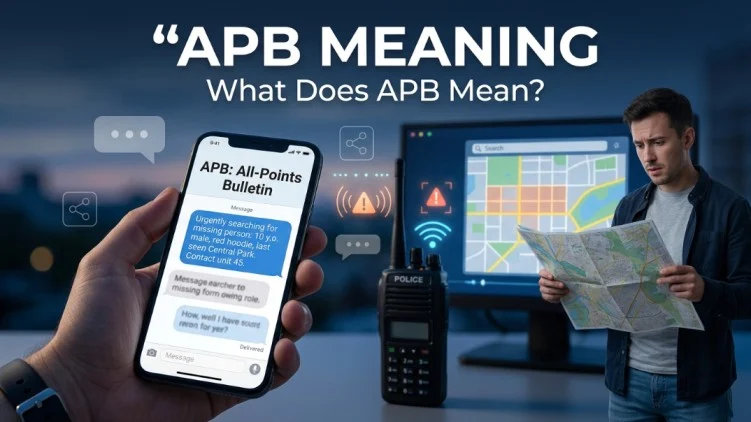
APB most commonly stands for “All-Points Bulletin,” an alert used to spread information about a person, vehicle, or situation. Online, people may use it casually to mean “everyone keep an eye out” or “help me find this.”
Three little letters can sound much more serious than they look. If you have seen APB in a text, movie, social media post, gaming chat, or news story, you may have wondered what those letters actually mean.
The most common APB meaning is “All-Points Bulletin.” It comes from law enforcement and refers to an alert sent out to multiple officers or agencies. But the term has also moved into everyday language. Online, someone might jokingly write “APB on my missing headphones” when they simply want friends to help find them.
For students, social media users, gamers, texters, and anyone learning modern slang, knowing this abbreviation makes conversations easier to understand. It also helps you recognize when APB is being used seriously and when it is just playful exaggeration.
Definition & Meaning
APB stands for “All-Points Bulletin.” Cambridge Dictionary defines APB as the abbreviation for all-points bulletin, while Collins describes it as an alert sent to law-enforcement agencies, such as information about a wanted person.
In simple terms, an APB is a wide-reaching alert.
Imagine that police are searching for a person or vehicle. Instead of giving the information to only one officer, authorities can distribute an alert to multiple officers or law-enforcement units. The goal is to make sure people who need the information receive it quickly.
Simple Example
Officer: “An APB has been issued for the vehicle.”
Meaning: Officers in the relevant area have been alerted to watch for that vehicle.
The abbreviation can also appear in ordinary conversation.
For example:
Sam: “Has anyone seen my blue backpack?”
Alex: “Nope.”
Sam: “APB on my backpack! I need it before class.”
Here, Sam is not actually issuing a police alert. The phrase is being used humorously to make a normal search sound dramatic.
APB Can Mean Different Things by Context
| Context | APB meaning |
|---|---|
| Law enforcement | All-Points Bulletin |
| News reports | Police alert or search notice |
| Texting | A request to help locate someone or something |
| Social media | A public call for information |
| Gaming | A playful alert or search request |
| Casual conversation | “Everyone keep an eye out” |
The important point is that APB is not originally internet slang. It began as a law-enforcement abbreviation and later became a phrase that people sometimes borrow for casual or humorous situations.
Background & History
The story of APB begins with law enforcement rather than social media.
All-Points Bulletin refers to a message distributed broadly to police officers or agencies. It can contain information about a wanted person, missing person, vehicle, or another situation requiring attention. Dictionaries continue to define the abbreviation in this law-enforcement sense.
The phrase became familiar to the general public through news reports, crime stories, movies, television shows, and police dramas. You may have heard a character say that an “APB has been issued” during a fictional chase.
That exposure helped turn a specialized police abbreviation into something ordinary people could recognize.
Over time, people began using the expression outside police work. Instead of searching for a suspect, someone might jokingly issue an “APB” for a missing phone, lost pet, friend who disappeared from a group chat, or even a favorite snack.
For example:
“APB: Has anyone seen my charger?”
This casual use keeps the original idea of a wide search or alert, but removes the serious police meaning.
Social media has made this figurative use easier to spot. Posts can reach many people quickly, so the idea behind an all-points bulletin fits naturally with online communities.
Still, APB is less common than many everyday texting abbreviations, so not every person will immediately understand it. If someone uses it without context, asking what they mean is perfectly reasonable.
Usage in Various Contexts
The meaning and tone of APB can change depending on where you see it.
APB in Texting
In texting, APB often means that someone is asking others to help locate a person or thing.
“APB on my keys. I swear they were on the table.”
The speaker is simply asking others to keep an eye out.
Another example:
“APB on Sarah. Has anyone heard from her?”
This can sound dramatic, but it does not necessarily involve anything serious.
APB on Social Media
A social media user might post:
“APB: Who knows where I can find this jacket?”
The person is asking followers for information.
APB in Gaming
Gaming communities sometimes borrow dramatic police language for humor.
Player 1: “APB on the missing healer!”
Player 2: “Check the other server.”
Here, APB simply adds urgency and humor to the search.
APB in Casual Conversation
You might hear:
“Put out an APB for my brother. He disappeared after dinner.”
This usually means:
“Everyone help me find my brother.”
APB in News or Crime Stories
This is where the original meaning matters most.
Reporter: “Police issued an APB for the suspect’s vehicle.”
Here, APB has its traditional law-enforcement meaning.
The topic and tone make the difference.
Common Misconceptions & Clarifications
Because APB can appear in both serious and casual settings, several misunderstandings are possible.
Misconception 1: APB Always Means a Police Emergency
Not necessarily.
The original meaning is connected to law enforcement, but people can use the phrase informally.
“APB on my missing sock.”
Obviously, this is probably a joke.
Misconception 2: APB Is Pure Internet Slang
Not exactly.
APB existed as a law-enforcement abbreviation long before modern social media. Its casual online use is an adaptation of the original term.
Misconception 3: Every APB Means Someone Is Wanted
No.
A real APB may concern a wanted person, missing person, vehicle, or other situation. The exact purpose depends on the alert.
Misconception 4: APB Is Extremely Common in Texting
It is recognizable, but it is not as universal as abbreviations such as LOL, BTW, FYI, or IMO.
If your audience does not know the term, writing the full phrase or explaining it can avoid confusion.
Misconception 5: APB Is Offensive
APB itself is not generally offensive.
The tone depends on how someone uses it. A serious police-related statement can feel urgent, while a joke about a missing remote can be playful.
Similar Terms & Alternatives
Several words and phrases can express ideas similar to APB.
“BOLO”
BOLO stands for “Be On the Lookout.”
It is also associated with law enforcement and alerts people to watch for a particular person, vehicle, or situation.
“Looking for”
This is much simpler and more casual.
“I’m looking for my phone.”
“Has Anyone Seen…?”
This is one of the clearest casual alternatives.
“Has anyone seen my keys?”
“Keep an Eye Out”
This asks people to watch for something.
“Keep an eye out for my package.”
“Call for Information”
This is more formal and can describe a public request for information.
| Term | Main meaning | Typical tone |
|---|---|---|
| APB | All-Points Bulletin | Serious or playful |
| BOLO | Be On the Lookout | Urgent/direct |
| Looking for | Searching for something | Casual |
| Keep an eye out | Watch for something | Friendly |
| Has anyone seen…? | Asking people to locate something | Casual |
| Alert | Warning or notification | Neutral/formal |
How to Respond to This Term
Your response depends on the situation.
If Someone Uses APB Seriously
If someone says:
“APB for a missing vehicle.”
You should treat it as an alert rather than a joke.
A suitable response could be:
“Understood. I’ll keep an eye out.”
If a Friend Uses APB as a Joke
Friend:
“APB on my headphones 😭.”
You could reply:
“Check under the couch 😂.”
Or:
“I’ll join the investigation.”
If You Want to Be Funny
“APB received. Detective mode activated. 🕵️”
If You Are Unsure
You can simply ask:
“Do you mean an All-Points Bulletin?”
This is especially useful if the abbreviation appears without enough context.
If You Want a Simple Response
You can say:
“Got it. I’ll keep an eye out.”
That works well in many casual situations.
Regional or Cultural Differences
APB is strongly associated with English-language law-enforcement terminology, particularly in the United States. Collins specifically identifies “all-points bulletin” as a U.S. term.
However, people outside the United States may still recognize the abbreviation because of American movies, television, news, and online culture.
The exact police terminology can vary between countries. A law-enforcement agency in another country may use a different term for a similar type of alert.
The casual online use is even more flexible.
For example, an English-speaking user might write:
“APB on my lost AirPods.”
Someone familiar with American internet culture may immediately understand the joke. Someone unfamiliar with the expression may need context.
This is why audience matters.
If you are speaking with international users, it is often clearer to write:
“APB — everyone keep an eye out for my missing bag.”
The extra wording removes confusion.
Comparison with Similar Terms
APB is sometimes confused with other alert-related expressions.
APB vs. BOLO
Both can involve asking people to look for someone or something, but they are not identical abbreviations.
APB: All-Points Bulletin.
BOLO: Be On the Lookout.
APB vs. Alert
“Alert” is a broad word. It can refer to almost any warning or notification.
APB is more specific because it comes from a particular law-enforcement phrase.
APB vs. Search
“Search” simply describes looking for something.
APB suggests that information has been broadcast or shared widely.
APB vs. Missing Person Notice
A missing-person notice specifically concerns someone who is missing. An APB can cover other subjects too, including vehicles or suspects.
| Expression | What it emphasizes |
|---|---|
| APB | Broadly distributed alert |
| BOLO | Watching for something |
| Alert | Warning or notification |
| Search | Act of looking |
| Missing-person notice | Locating a missing person |
Understanding these differences can help you interpret APB more accurately.
Usage in Online Communities & Dating Apps
Online communities have made it easier for people to borrow phrases from movies, police language, and popular culture.
On X, Instagram, TikTok, Reddit, Discord, WhatsApp, and gaming chats, someone might use APB as a playful call for help.
For example:
“APB: Who knows what restaurant this is?”
Or:
“APB on whoever took my fries.”
The second example is clearly humorous.
APB on Dating Apps
You may occasionally see similar language on dating profiles or messages.
Someone might write:
“APB for someone who knows the best coffee spots.”
This is not a police alert. It is simply a creative way to ask for recommendations.
Another example:
“APB: Where are all the people who actually like hiking?”
Again, the expression is playful.
Tips for Responding Online
- Look at the surrounding message.
- Check whether the person is joking.
- Do not assume every APB is a real police alert.
- If someone mentions a genuine missing person or danger, take the message seriously.
- If the meaning is unclear, ask.
Online tone can be difficult to read, so context is your best clue.
Hidden or Offensive Meanings
There is no widely recognized hidden or offensive meaning attached to APB itself.
The standard meaning remains All-Points Bulletin.
However, people can use ordinary words sarcastically.
For example:
“APB on my motivation. It disappeared three weeks ago.”
This is a joke about feeling unmotivated.
Another example:
“APB on whoever stole the last cookie.”
The phrase creates fake urgency for comic effect.
The potential problem is not the abbreviation itself but the subject and tone.
Using police language to joke about a harmless missing object is usually easy to understand. Using it to mock a real crime, victim, or emergency could be insensitive.
A good rule is simple:
Match the seriousness of your language to the seriousness of the situation.
Suitability for Professional Communication
APB can be appropriate in professional law-enforcement contexts, where the abbreviation has a recognized meaning.
For example:
“An APB was issued for the suspect’s vehicle.”
That is clear and professional within the right field.
But outside law enforcement, using APB in a workplace email may confuse your audience.
Instead of:
“APB on the missing report.”
a professional writer could say:
“Please let me know if anyone has located the missing report.”
Or:
“We are looking for the missing report. Please contact the team if you have it.”
Better Professional Alternatives
Use:
- Alert
- Notice
- Request for information
- Please be on the lookout
- We are looking for…
- Please let us know if you have seen…
For formal communication, clarity is usually better than slang.
FAQs
What does APB mean?
APB most commonly means “All-Points Bulletin.” It is a law-enforcement alert distributed to relevant officers or agencies.
What does APB mean in texting?
In texting, APB can be used informally to mean “everyone keep an eye out” or “help me find someone or something.”
Is APB a slang word?
APB is technically an abbreviation, not a word created as internet slang. However, people sometimes use it as informal slang online.
What does APB mean in police terms?
In police terminology, APB means All-Points Bulletin, a broad alert concerning a person, vehicle, or situation that requires attention.
Is APB offensive?
No. APB is generally neutral. Its tone depends on the context and the way someone uses it.
What is the difference between APB and BOLO?
APB means All-Points Bulletin, while BOLO means Be On the Lookout. Both can involve locating someone or something, but they are different expressions.
Conclusion
The main APB meaning is “All-Points Bulletin,” a law-enforcement alert used to spread information about a person, vehicle, or situation. The term has a serious origin, but its meaning has expanded in casual communication.
Today, someone might jokingly say “APB on my keys” or “APB on whoever ate my leftovers.” In these cases, the person is simply asking others to help find something or someone.
The best way to understand APB is to look at the context. A police report, news story, group chat, gaming message, and social media caption may use the same abbreviation in very different ways.
When in doubt, ask what the person means. Once you know the context, APB is easy to understand.
Discover More Post:
What Does Collate Mean| Complete Meaning, Origin, Usage …
What Does WTW Mean| Complete Meaning, Origin, Usage …
Complete Meaning, Origin, Usage, Examples & Guide