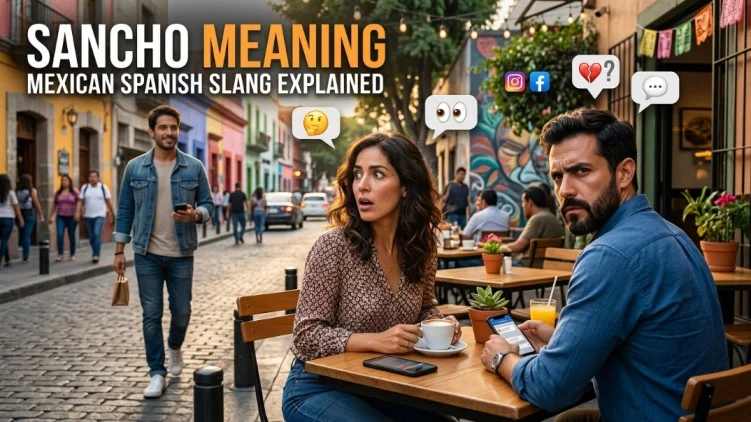
Quick Answer:
“Sancho” is Mexican Spanish slang for the other man in a relationship, usually a secret lover or affair partner. The exact meaning depends on context, because Sancho can also be a traditional male name.
A word can look completely harmless until you hear it in the right conversation. Sancho is a perfect example. You might know it as a Spanish name, recognize it from Don Quixote, or see it in a meme and wonder why everyone is laughing. In Mexican Spanish slang, however, it can have a very different meaning.
If you are learning Spanish, chatting with Mexican friends, reading social media comments, using dating apps, or watching Spanish-language videos, understanding this word can save you from a confusing moment. The slang meaning of sancho usually refers to a man who is having an affair with someone’s wife or girlfriend. The female equivalent is often sancha. The term is especially associated with Mexican Spanish.
This guide explains the sancho meaning in simple language, including its history, slang use, online examples, cultural differences, and when you should avoid using it.
Definition & Meaning
The word Sancho has more than one meaning, so context is very important.
In its ordinary use, Sancho is a Spanish male name. It has a long history in the Spanish-speaking world and is also strongly associated with Sancho Panza, the famous companion of Don Quixote in Miguel de Cervantes’s novel.
But sancho has a well-established slang meaning in Mexican Spanish. The Academia Mexicana de la Lengua defines it as the lover of a married woman. The Diccionario de americanismos from ASALE likewise identifies this meaning as Mexican Spanish.
In simple English, a Sancho can mean:
- The other man
- A woman’s secret lover
- An affair partner
- A side guy in a relationship
- The man someone is cheating with
For example:
Carlos: “Why does everyone keep calling him Sancho?”
Miguel: “Because they think he’s dating someone’s girlfriend behind her boyfriend’s back.”
The word can also be used jokingly among friends.
Luis: “Where did your girlfriend’s friend go?”
Marco: “Careful. They’re going to start calling you Sancho!”
Here, the speaker is making a relationship joke rather than making a serious accusation.
It is important to remember that calling someone Sancho can suggest infidelity, so it is not always a harmless nickname. The tone, relationship between the speakers, and surrounding conversation all matter.
Background & History
The slang history of sancho is older than modern texting and social media. The Academia Mexicana de la Lengua says that the word with the meaning of a married woman’s lover is specific to Mexican Spanish and has been documented in dictionaries since the 19th century.
The exact origin of this slang meaning is not completely settled.
One explanation connects the word with Mexican rural vocabulary involving animals. The Academia Mexicana de la Lengua notes that the Spanish word sancho has been connected with sanch, a word associated with calling pigs. Other historical sources have proposed different explanations, so the exact path from an older word to the modern slang meaning remains debated.
Another interesting detail is that Sancho already existed as a personal name. The famous literary character Sancho Panza helped make the name familiar to generations of Spanish readers.
Over time, the slang meaning developed separately from the ordinary name. This is a good example of how everyday language can give an existing word a completely different social meaning.
Today, the slang use is especially associated with Mexican Spanish. It can appear in jokes, casual conversations, music, memes, and discussions about relationships.
The term has also traveled beyond Mexico through Mexican-American communities and online culture. As social media spreads regional slang, people who do not speak Mexican Spanish may encounter the word and wonder what it means.
Usage in Various Contexts
The way Sancho is used depends on the situation.
Casual Conversation
Friends may use it to joke about someone’s romantic situation.
- Friend 1: “Who was that guy texting your girlfriend?”
- Friend 2: “I don’t know.”
- Friend 1: “Better find out. Maybe he’s the Sancho.”
The joke suggests that the other man could be having a secret relationship with the girlfriend.
Texting
Someone might send:
“Bro, don’t become the Sancho 😂”
This means something like:
“Bro, don’t become the other guy in someone’s relationship.”
The laughing emoji can make the message feel playful, but the underlying meaning still involves cheating.
Social Media
You may see comments such as:
“Looks like Sancho arrived 😂”
This could be a joke suggesting that another man has entered someone’s romantic situation.
Relationship Conversations
The word can also be used more seriously.
“She has a Sancho while her husband is away.”
Here, the meaning is clearly secret lover or affair partner.
Gaming Communities
The word can appear in gaming chats when Mexican or Mexican-American players joke with one another.
- Player 1: “Why are you leaving the match?”
- Player 2: “My girlfriend called.”
- Player 1: “Uh-oh, Sancho duty? 😂”
This is informal and humorous. It does not necessarily mean the person is actually cheating.
Nicknames and Jokes
Some people may use Sancho as a playful nickname without intending the literal slang meaning. That is why you should not automatically assume every person named Sancho is being called an affair partner.
Common Misconceptions & Clarifications
There are several easy ways to misunderstand Sancho.
Sancho Does Not Always Mean “Cheater”
If someone’s name is Sancho, that does not mean the person is an affair partner.
“Sancho is coming to dinner.”
This may simply refer to a man whose name is Sancho.
You need the surrounding context to know whether the word is a name or slang.
It Is Not a General Spanish Word for Boyfriend
A common mistake is assuming Sancho simply means boyfriend or lover.
That is not accurate.
In the Mexican slang sense, the word has a much more specific meaning. It points to the other man involved in an existing relationship, especially an affair involving a married woman.
It Is Not Used the Same Way Everywhere
The slang meaning is particularly associated with Mexico. Spanish varies greatly by country, so a word that is common in Mexican Spanish may not carry the same meaning elsewhere.
Does It Always Mean Cheating?
In slang, the word strongly suggests an affair or secret romantic relationship. But people can use it jokingly without claiming that an actual affair exists.
Is It Offensive?
It can be.
Calling someone Sancho can accuse or imply that the person is involved with someone else’s partner. That can be embarrassing or insulting if the claim is not true.
Similar Terms & Alternatives
English has several expressions that are close to the slang meaning of Sancho.
The Other Man
This is one of the clearest English alternatives.
“He is the other man in their relationship.”
Affair Partner
This is more neutral and often sounds more serious.
“She introduced her affair partner to her friends.”
Side Guy
This is informal slang for a man involved with someone who already has a primary romantic partner.
Secret Lover
This focuses on secrecy.
Side Piece
This is informal and can refer to a person involved outside someone’s main relationship. It can sound disrespectful.
Mistress
This traditionally refers to a woman involved in a relationship with a married man, so it is not a direct equivalent of Sancho.
| Term | Basic meaning | Tone |
|---|---|---|
| Sancho | Other man in an affair | Mexican slang |
| Other man | Male affair partner | Neutral |
| Affair partner | Person involved in an affair | More formal |
| Side guy | Secondary male romantic partner | Casual |
| Secret lover | Hidden romantic partner | General |
| Side piece | Person outside a main relationship | Informal |
How to Respond to This Term
If someone calls you Sancho, your response should depend on the situation.
Casual Response
If a friend is clearly joking:
“Haha, that’s not me.”
or:
“Wrong guy, bro.”
Funny Response
You could play along:
“I reject these allegations. 😂”
Or:
“Where is your evidence?”
Serious Response
If someone is making a real accusation:
“That’s not true, so please don’t spread that around.”
This is better than turning a serious situation into a joke.
If You Do Not Understand
Simply ask:
“What do you mean by Sancho?”
That is completely reasonable if you are unfamiliar with Mexican slang.
If Someone Uses It Toward Your Partner
Do not immediately assume the claim is true.
A slang term is not proof of an affair. Look at the actual context before reacting.
Regional or Cultural Differences
The slang meaning of Sancho is strongly associated with Mexican Spanish. The Academia Mexicana de la Lengua specifically describes the “lover of a married woman” meaning as belonging to Mexican Spanish.
ASALE’s Diccionario de americanismos also labels this meaning as Mexico.
That means you should be careful about treating Sancho as universal Spanish slang.
Spanish-speaking countries have their own vocabulary for relationships, cheating, flirting, and romantic situations. Even when speakers understand the word, they may not use it with the same frequency or meaning.
The female form sancha is also used in discussions of the same slang concept.
Cultural context matters too. A joke that sounds funny among close Mexican friends may sound rude or confusing to someone unfamiliar with the expression.
If you are traveling or speaking Spanish with people from different countries, it is safer to learn the local meaning before using regional slang yourself.
Comparison with Similar Terms
Several words can describe people involved in relationships, but their meanings are not identical.
| Expression | Meaning | Main difference |
|---|---|---|
| Sancho | Other man in an affair | Mexican Spanish slang |
| Sancha | Female counterpart in the slang sense | Refers to a woman |
| Lover | Person in a romantic or sexual relationship | Does not always imply cheating |
| Affair partner | Person involved in an affair | More neutral and direct |
| Other man | Male person involved with someone’s partner | Common English expression |
| Side guy | Secondary male partner | Modern informal slang |
| Boyfriend | Male romantic partner | Does not imply an affair |
The biggest difference is relationship status.
A boyfriend can be someone’s legitimate partner.
A lover can be a romantic or sexual partner without necessarily being described as a secret affair.
A Sancho, in the Mexican slang sense, specifically carries the idea of being the other man in an existing relationship.
Usage in Online Communities & Dating Apps
The word Sancho can appear online because relationship humor spreads easily through memes and short-form content.
On platforms such as X, TikTok, Instagram, Reddit, Discord, and dating apps, people may use the term as a joke about cheating or romantic competition.
For example:
“When her boyfriend is at work and Sancho pulls up 😂”
The joke suggests that the woman’s secret lover has arrived while her partner is away.
On a dating app, someone might write:
“I’m nobody’s Sancho.”
This could mean:
“I do not want to be someone’s secret side guy.”
Another person might jokingly say:
“Don’t worry, I’m not looking for a Sancho.”
The meaning depends on the profile and conversation.
Tips for Online Use
If you see Sancho in a comment:
- Check whether it is being used as a person’s name.
- Look at the surrounding relationship context.
- Consider whether the speaker is joking.
- Remember that the slang meaning is especially associated with Mexican Spanish.
- Do not accuse someone of cheating based on the word alone.
Because online conversations lack facial expressions and voice tone, jokes about Sancho can easily be misunderstood.
Hidden or Offensive Meanings
The main slang meaning is already somewhat sensitive because it relates to infidelity.
Calling a man Sancho can imply:
“You are the guy secretly involved with someone’s wife or girlfriend.”
That can be funny between close friends, but offensive when directed at a stranger.
The word itself is not automatically a profanity. However, its implication can make it insulting depending on the situation.
There are also other meanings of the word sancho in Spanish. SpanishDictionary, for example, lists pig or hog as one meaning and notes a Mexican regional use connected with an animal raised by a female that is not its mother.
That is another reason context matters.
You should also avoid confusing Sancho with unrelated expressions that happen to contain the same word.
Important Tip
If someone says:
“That’s my Sancho.”
Do not automatically translate it as “That’s my boyfriend.”
In Mexican slang, the phrase may suggest “That’s the other guy in the relationship” or “That’s my secret lover.”
Suitability for Professional Communication
Using Sancho as slang is generally not suitable for professional communication.
You should avoid it in:
- Business emails
- Workplace reports
- Academic writing
- Customer service
- Formal presentations
- Job applications
- Professional meetings
The word can imply infidelity and may sound disrespectful or accusatory.
If you need to discuss the subject professionally, use clearer and more neutral terms.
Instead of:
“He is her Sancho.”
You could say:
“He is reportedly her affair partner.”
Instead of:
“She has a Sancho.”
You could say:
“She is reportedly involved in another relationship.”
If the situation has not been confirmed, use careful language such as:
“There are allegations of an affair.”
This avoids presenting an unverified claim as fact.
FAQs
What does Sancho mean in slang?
In Mexican Spanish slang, Sancho refers to the other man in a relationship, usually a man having an affair with someone’s wife or girlfriend.
Is Sancho a bad word?
Not exactly. Sancho is also a normal male name, but its slang meaning can be offensive because it may imply that someone is involved in an affair.
Is Sancho a Mexican slang word?
Yes. The slang meaning referring to a married woman’s lover is specifically documented as Mexican Spanish.
What is the female version of Sancho?
Sancha can be used as the female counterpart in the slang sense.
Does Sancho mean boyfriend?
No. In Mexican slang, Sancho has a more specific meaning and usually refers to the other man in an existing relationship.
Why do people call someone Sancho?
They may be suggesting, seriously or jokingly, that he is secretly involved with someone’s partner.
Is Sancho used online?
Yes. The slang appears in casual conversations, jokes, memes, social media posts, and online discussions about relationships. However, its meaning should always be judged from context.
Conclusion
The sancho meaning is more interesting than it first appears. Sancho can simply be a Spanish male name, but in Mexican Spanish slang, it has a very different meaning. It commonly refers to the other man in a relationship, especially a secret lover or affair partner.
The word can appear in jokes, texting, social media, gaming chats, and casual conversations. However, it is not something you should casually call a stranger because it can suggest cheating and may cause offense.
Remember the key point: context is everything. If Sancho is someone’s name, it may have no slang meaning at all. If it appears in a relationship joke, however, it may be referring to an affair partner. Understanding that difference will help you read Spanish slang more confidently and avoid an awkward misunderstanding.
Discover More Post:
What Does “Habibti” Mean in English in 2026 – Punzelo.com
What Does FYM Mean in Text and Social Media – Punzelo.com
Missus Meaning | What Does “Missus” Mean in 2026