Quick Answer:
“Chisme” is a Spanish word that usually means gossip or juicy personal information about someone. It can also refer to the act of sharing or discussing rumors in a casual, playful way.
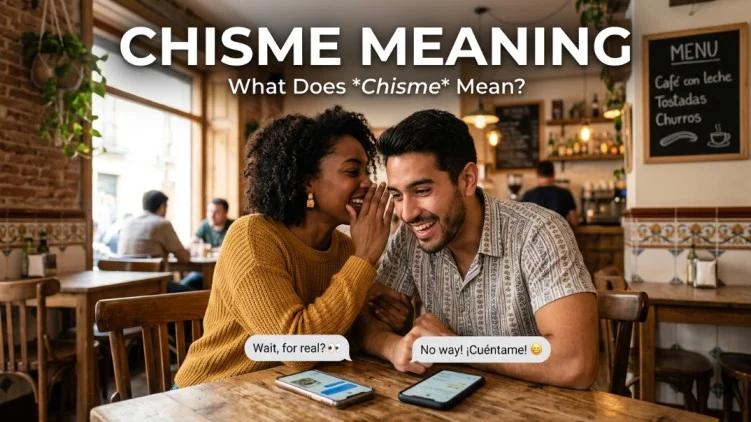
Have you ever heard someone say “¡Tengo un chisme!” and wondered what they were about to reveal? If you have, you were probably about to hear some gossip. The Spanish word chisme is common in casual conversations, social media posts, group chats, and everyday Spanish.
If you are learning Spanish, talking with Spanish-speaking friends, using dating apps, or watching Spanish-language videos, understanding the chisme meaning can help you catch the real tone behind a conversation. It is often more playful than the English word “gossip,” especially when friends use it to share an interesting story.
For younger speakers and online communities, chisme has also become a fun way to talk about drama, secrets, rumors, or entertaining personal stories. Someone may even ask, “¿Cuál es el chisme?”, meaning “What’s the gossip?” or “What’s the tea?”
The word can be harmless, funny, or negative depending on the situation. Context matters.
Definition & Meaning
The Spanish word chisme most commonly means “gossip,” “rumor,” or “piece of juicy information.”
It is a noun, and its meaning can change slightly depending on how it is used.
For example:
“Tengo un chisme.”
This can mean:
“I have some gossip.”
A person saying this may be about to share an interesting story about another person.
Another common phrase is:
“Cuéntame el chisme.”
This means:
“Tell me the gossip.”
It does not always mean that the information is harmful or false. Friends may use chisme simply to describe an entertaining story or piece of social news.
Common Uses of “Chisme”
| Spanish phrase | English meaning |
|---|---|
| Tengo un chisme | I have some gossip |
| Cuéntame el chisme | Tell me the gossip |
| ¿Cuál es el chisme? | What’s the gossip? |
| No seas chismoso | Don’t be nosy/gossipy |
| Eso es puro chisme | That’s just gossip |
| Me encanta el chisme | I love gossip |
The word can also describe an object, gadget, or miscellaneous thing in some Spanish-speaking regions. In those cases, context is very important.
For example:
“Pásame ese chisme.”
Depending on the region, this could mean:
“Pass me that thing.”
So, while gossip is the most common meaning, chisme has additional regional uses.
Chisme as a Verb-Related Idea
The related verb chismear means to gossip.
For example:
“Ellas están chismeando.”
This means:
“They are gossiping.”
The related adjective chismoso or chismosa describes someone who likes gossip or gets involved in other people’s business.
Background & History
The history of chisme is interesting because the word has been part of Spanish vocabulary for a long time.
Its exact origin is not completely certain, but Spanish dictionaries have long recorded chisme with meanings connected to gossip, rumor, and idle talk. In some historical uses, the word was also connected with small objects or insignificant things.
Over time, the gossip-related meaning became especially familiar in everyday Spanish.
The word is now widely used throughout the Spanish-speaking world. You can hear it in casual conversations between friends, family members, coworkers, and classmates.
However, its tone can vary.
In a serious situation, chisme may describe harmful gossip that damages someone’s reputation. In a relaxed conversation, it can simply mean an entertaining story.
Modern social media has made the word even more popular. Spanish-speaking users may use chisme when discussing celebrity drama, relationship rumors, influencer controversies, or funny stories.
For example, someone may post:
“Necesito el chisme completo.”
That means:
“I need the full story.”
Online communities have also connected chisme with the English expression “spill the tea.” Both can describe sharing interesting or dramatic information.
Still, they are not exact translations in every situation.
Usage in Various Contexts
Chisme appears in many everyday situations.
1. Casual Conversations
Friends may use it when discussing something interesting that happened.
Sofia: “Tengo un chisme.”
Mia: “¿Qué pasó?”
Sofia: “Carlos y Ana están saliendo.”
Here, chisme means juicy gossip or news.
2. Texting
In a group chat, someone might send:
“Amiga, tengo chisme 👀.”
A natural English interpretation is:
“Girl, I have some tea 👀.”
The emoji adds curiosity and excitement.
3. Social Media
A person may comment:
“Necesitamos el chisme completo 😂.”
This means:
“We need the full story 😂.”
The phrase can be playful rather than serious.
4. Family Conversations
Family members may also use the word casually.
“¿Cuál es el chisme de la familia?”
This means:
“What’s the family gossip?”
5. Dating
Someone might tell a friend:
“Tengo un chisme sobre mi cita.”
Translation:
“I have some gossip about my date.”
6. Gaming Communities
Spanish-speaking gamers can use chisme when discussing drama between players.
“¿Qué pasó entre esos dos? Dame el chisme.”
That means:
“What happened between those two? Give me the gossip.”
7. Workplace Conversations
This is where caution is useful.
A coworker might jokingly say:
“¿Cuál es el chisme de hoy?”
But using chisme about a colleague’s private life can create problems if the conversation becomes disrespectful or harmful.
Common Misconceptions & Clarifications
One common misunderstanding is that chisme always means a serious rumor. That is not true.
Among friends, chisme can be lighthearted. Someone may use it to describe a funny story, relationship update, celebrity news, or small piece of drama.
Another misconception is that every chisme is false.
A chisme can be true, partly true, exaggerated, or completely unverified. The word describes the nature of the conversation more than the truth of the information.
Is Chisme Always Negative?
No.
For example:
“Tengo un chisme bueno.”
This can mean:
“I have some good gossip.”
The speaker may simply be excited to share interesting news.
However, gossip can become negative when it involves private information, insults, lies, or damaging rumors.
Does Chisme Mean “Secret”?
Not exactly.
A secret is information that someone wants kept private. Chisme is information being discussed or shared, often about another person.
A secret can become gossip if people start spreading it.
Does Chisme Mean “Drama”?
Sometimes it can refer to drama, but the words are not identical.
Drama focuses more on conflict or emotional situations.
Chisme focuses more on the gossip or information being shared about those situations.
Is Chisme an Insult?
The noun itself is not necessarily an insult. But calling someone chismoso can be critical.
For example:
“Eres muy chismoso.”
Depending on tone, this could mean:
“You’re so gossipy.”
Among friends, it may be teasing. In a serious situation, it may be an insult.
Similar Terms & Alternatives
Spanish has several words related to gossip and curiosity.
Chismear
Chismear means to gossip.
Example:
“Nos gusta chismear.”
Translation:
“We like to gossip.”
Chismoso / Chismosa
This describes a person who likes gossip or gets involved in other people’s affairs.
“Mi hermana es muy chismosa.”
Translation:
“My sister is very gossipy.”
Rumor
Rumor means rumor in English.
It usually refers to information that has not been confirmed.
Cotilleo
In Spain, cotilleo is commonly used for gossip or idle talk.
Murmuración
This can refer to talking negatively about someone, often behind their back. It has a more negative tone.
| Term | Meaning | Typical tone |
|---|---|---|
| Chisme | Gossip / juicy story | Casual |
| Chismear | To gossip | Casual |
| Chismoso/a | Gossipy person | Playful or negative |
| Rumor | Unverified information | Neutral |
| Cotilleo | Gossip | Common in Spain |
| Murmuración | Speaking negatively about someone | More negative |
How to Respond to This Term
Your response depends on what someone means by chisme.
Casual Response
If your friend says:
“Tengo un chisme.”
You can answer:
“¡Cuéntame!”
That means:
“Tell me!”
Another natural response is:
“¿Qué pasó?”
Funny Response
If you want to joke around:
“A ver, suelta el chisme. 👀😂”
This means:
“Okay, spill the gossip.”
Curious Response
“¿Es bueno o malo?”
Translation:
“Is it good or bad?”
Privacy-Conscious Response
If the gossip concerns someone’s private life, you can say:
“Prefiero no hablar de eso si no sabemos si es cierto.”
Translation:
“I’d rather not talk about it if we don’t know whether it’s true.”
This is a good response when gossip could hurt someone.
If Someone Calls You Chismoso
You can respond playfully:
“Yo solo hago preguntas importantes. 😂”
Translation:
“I just ask important questions. 😂”
Regional or Cultural Differences
Chisme is widely understood across Spanish-speaking communities, but its exact use and tone can vary by region.
- In many parts of Latin America, chisme is a very common word for gossip or interesting personal information.
- In Mexico, for example, people often use chisme casually when discussing social drama or entertaining news.
- In other Latin American countries, the word is also common, although local slang may differ.
- In Spain, cotilleo is another familiar word for gossip.
This means a Spanish learner may hear different words depending on where they are.
The word can also have a second meaning in some regions. Chisme may sometimes refer to a thing, gadget, object, or miscellaneous item, especially when the speaker does not know or does not want to say its exact name.
For example:
“Pásame ese chisme.”
Depending on context, this could mean:
“Pass me that thing.”
This regional use is one reason you should not translate every occurrence of chisme as “gossip.”
Cultural Tip
If someone says:
“Tengo un chisme.”
They are probably talking about gossip or interesting news.
If someone says:
“Dame ese chisme.”
They may be talking about an object.
The surrounding words usually make the meaning clear.
Comparison with Similar Terms
The closest English expressions depend on the context.
| Spanish | English equivalent | Difference |
|---|---|---|
| Chisme | Gossip | General casual gossip |
| Chisme | Tea | Modern, playful internet slang |
| Chisme | Rumor | Information that may be unverified |
| Chisme | Drama | Conflict or social tension |
| Chismear | Gossip | Action of discussing gossip |
| Chismoso/a | Gossipy | Describes a person |
| Cotilleo | Gossip | Especially common in Spain |
Chisme vs. “Tea”
Online, “spill the tea” is often a good translation for the playful use of chisme.
“Cuéntame el chisme.”
→ “Spill the tea.”
But this is not a literal translation.
The natural translation depends on the conversation.
Chisme vs. Rumor
A rumor is usually information that has not been confirmed.
Chisme can be a rumor, but it can also be true information shared in a gossipy way.
That is an important difference.
Usage in Online Communities & Dating Apps
The rise of social media has made chisme especially useful online.
On platforms such as TikTok, Instagram, X, Reddit, Discord, and dating apps, people often use it when discussing celebrity news, relationships, influencer drama, or community conflicts.
A person might post:
“¿Alguien sabe el chisme?”
Translation:
“Does anyone know what happened?”
Another person might write:
“Necesito contexto y chisme. 👀”
This means they want both the background and the juicy details.
Dating Apps
On Tinder or other dating apps, someone might use the word playfully:
“Match conmigo y te cuento el chisme. 😂”
That could mean:
“Match with me and I’ll tell you the gossip. 😂”
It can create a playful, curious tone.
However, sharing private information about former partners or other people can cross a line.
Gaming Communities
Gaming groups may use chisme when players are discussing team drama.
“¿Qué pasó en el servidor? Dame el chisme.”
Translation:
“What happened on the server? Give me the gossip.”
The term often makes the conversation sound lighter and more humorous.
Online Tip
Before repeating a chisme, consider whether it is:
- True
- Private
- Harmful
- Relevant
- Worth sharing
Being curious is normal. Spreading false information can cause real problems.
Hidden or Offensive Meanings
There is no widely recognized hidden offensive meaning of the word chisme itself.
Its standard meaning is related to gossip, rumors, or casual information.
However, related forms can sound insulting.
Chismoso
Calling someone chismoso can mean:
“You’re gossipy.”
Depending on tone, it can be friendly teasing or criticism.
For example:
“¡Qué chismoso eres! 😂”
Among close friends, this may simply mean:
“You’re such a gossip! 😂”
But saying it to someone during a serious argument can be offensive.
Context Matters
Consider these two situations:
Friend: “You always want the latest chisme.”
This may be playful.
Coworker: “Stop being chismoso and mind your business.”
This is clearly negative.
The word has not changed. The tone and relationship have.
You should also avoid assuming that gossip is harmless. If the information involves someone’s private life, health, relationships, finances, or reputation, spreading it can cause real harm.
Suitability for Professional Communication
The word chisme is generally too casual for formal professional communication when it means gossip.
You might hear coworkers joking about chisme during a relaxed conversation, but it is not the best choice for a formal email, report, presentation, or official workplace message.
Instead, choose a more precise word.
Professional Alternatives
Depending on your meaning, you could use:
- Rumor unverified information
- Información no confirmada unconfirmed information
- Comentarios comments
- Información informal informal information
- Especulación speculation
- Información privada private information
For example, instead of writing:
“Hay mucho chisme sobre la empresa.”
A professional version could be:
“There are several unconfirmed reports about the company.”
That sounds more neutral and professional.
When Is Chisme Fine at Work?
If you are talking casually with a close coworker, you may hear it.
For example:
“¿Cuál es el chisme del día?”
This can be harmless workplace humor.
Still, it is wise to avoid gossip about colleagues that could damage someone’s reputation.
FAQs
What does chisme mean in English?
Chisme usually means “gossip,” “rumor,” or “juicy information.” In some regional contexts, it can also mean a thing or object.
Is chisme the same as “tea”?
Not exactly, but the playful use of chisme can be translated as “tea” in modern English slang. “Spill the tea” and “cuéntame el chisme” can have a similar feel.
What does “tengo un chisme” mean?
“Tengo un chisme” means “I have some gossip” or “I have some juicy news.”
What does chismoso mean?
Chismoso means gossipy, nosy, or someone who likes gossip. Depending on tone, it can be playful or insulting.
Is chisme a bad word?
No. Chisme is a normal Spanish word. However, gossip itself can become harmful when it spreads false or private information.
What does “cuéntame el chisme” mean?
It means “Tell me the gossip,” “Tell me what happened,” or, in a playful online style, “Spill the tea.”
Can chisme mean “thing”?
Yes. In some Spanish-speaking regions and contexts, chisme can refer to an object, gadget, or thing whose name is unknown or not being specified.
Conclusion
The chisme meaning is usually gossip, rumor, or juicy information, but the word can be much more playful than the English word “gossip.” Friends may say “Tengo un chisme” when they have an interesting story, while online users may use it much like “tea” or “drama.”
The related word chismoso describes someone who likes gossip, and chismear means to gossip. In Spain, you may also hear cotilleo for gossip.
Remember that context matters. Chisme can be funny and harmless among friends, but spreading private or false information can hurt someone. In formal settings, use neutral terms such as rumor, unconfirmed information, or speculation instead.
Once you understand the context, recognizing chisme in Spanish conversations, texts, social media, dating apps, and gaming chats becomes much easier.
Discover More Post:
What Does TBH Mean| Complete Meaning, Origin, Usage …
What Does WTW Mean| Complete Meaning, Origin, Usage …
Complete Meaning, Origin, Usage, Examples & Legal Guide